

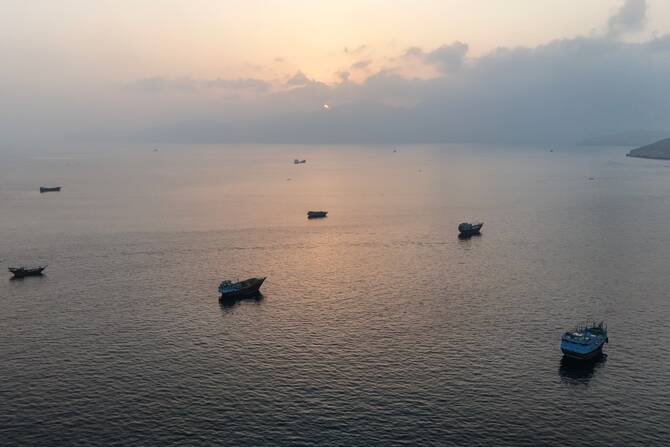

GENEVA – The Strait of Hormuz reopened in mid-June. For the tankers that had been rerouting around it, the relief was immediate. For Yemen, Kiribati, and Lesotho, countries that had no voice in the decisions that closed it, the arithmetic runs on a different timeline.
A report released Wednesday by the UN Conference on Trade and Development measured what more than 100 days of disruption to the world’s most critical oil corridor actually cost the nations least equipped to absorb it. The UNCTAD assessment, titled Strait of Hormuz Disruptions: Beyond Reopening, Lasting Impacts on Vulnerable Economies, concluded that the narrowest and most uneven portion of the recovery still lies ahead for the countries that could do the least to prevent any of it from starting.
The disruption began February 28, when the US-Israeli military operation against Iran triggered the effective closure of the waterway. Through that passage, some 33 kilometres wide at its most constrained point, roughly 20 million barrels of oil per day normally reach global markets. According to TASS, citing Bloomberg, daily oil shipments through the Strait had recovered to only 10 million barrels as of July 1, with another 5 million reaching markets via alternative routes. Iran’s UN representative Ali Bahreini confirmed the waterway had been reopened to commercial vessels. The trade flows have not returned to pre-war levels.
For wealthy economies with strategic reserves and hedging instruments, the disruption was expensive. For the countries UNCTAD identified as most exposed, the calculus was different. Yemen, Kiribati, and Lesotho topped the vulnerability index, measured by cereal import dependency as a share of GDP. For small island developing states more broadly, oil imports were already consuming up to 25 percent of GDP in some nations before February. The Hormuz closure added a price shock to a structural dependence that left no buffer to draw against.
What distinguishes the UNCTAD analysis from earlier disruption estimates is its focus on the downstream chain from energy to food. Higher energy prices raised transport costs. Higher transport costs raised the cost of moving goods across borders. Higher goods costs increased agricultural production costs. Higher production costs reduced domestic food output. Reduced output elevated food prices for households already operating at the edge of food security. UNCTAD characterises this chain as having “larger and longer-lasting cumulative effects on consumer prices” than comparable energy shocks in the pre-pandemic period, a finding that complicates any assumption that reopening the Strait resolves the underlying stress quickly.
The human endpoint of that chain appears in a data point the report places without softening: a 5 percent increase in food prices correlates with an 11 percent increase in the risk of child wasting. For children under 12 months, that correlation rises to 15 percent. The decision made in February, to strike Iranian infrastructure and set in motion a 100-day closure of the world’s most congested oil shipping lane, extended in measurable form to the nutrition of infants in countries that took no position on the Iran nuclear file and had no capacity to influence what happened next.
Grain and oilseed freight costs remained elevated after the Strait’s reopening, according to the UNCTAD assessment. This is the mechanism by which the disruption outlives the event: shipping insurers price risk over time rather than by the day, routing decisions made during the conflict reset slowly, and elevated transport costs pass through agricultural markets on a lag. The reopening removes the immediate cause. It does not remove the elevated price environment that cause had already created.
The ceasefire that reopened the Strait was reached under the terms of the memorandum of understanding between Washington and Tehran, with Qatar and Pakistan serving as mediators. That deal, and Israel’s continued resistance to its all-fronts ceasefire clause, has remained a source of ongoing diplomatic tension since the document was signed. The waterway’s reopening was treated as the framework’s first verifiable achievement. The UNCTAD report released Wednesday measures what that achievement does not undo.
The costs of the conflict and its associated war-driven disruption to global shipping have not fallen uniformly. Gulf sovereign wealth funds closed the first half of 2026 with record investment returns, partly driven by the elevated oil revenues the Hormuz closure produced. At the G7 summit in Évian last month, the Strait of Hormuz was the first item on an agenda the French government had hoped to dedicate to climate finance. The asymmetry between who benefited from elevated energy prices and who absorbed the food security consequences is not addressed in the UNCTAD report as a political finding. It is embedded in the data.
According to Arab News, which reported on the UNCTAD findings Wednesday, the assessment characterises the recovery path facing vulnerable economies as “a longer, costlier and more uneven” one than the reopening date suggests. The document does not specify a timeline for normalisation of freight rates or child nutrition indicators in the most affected countries. Yemen, Kiribati, and Lesotho did not choose this war. They did not benefit from its elevated commodity revenues. They are absorbing its aftershocks, and the UNCTAD report’s implicit question is one the ceasefire framework has not answered: who, precisely, is responsible for the recovery of the countries that had no seat at the table when any of this was decided.













