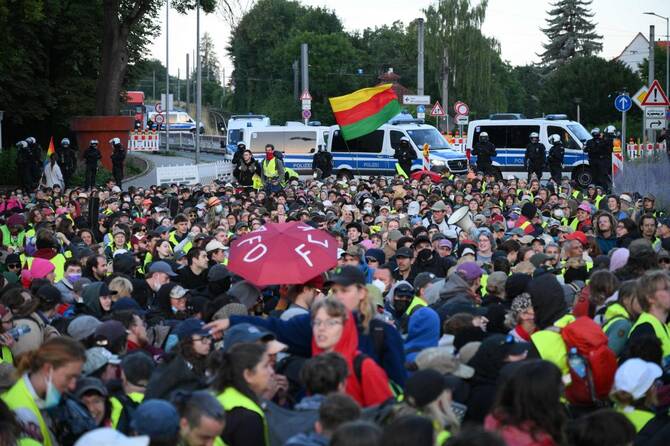

ERFURT — From the motorway bridges outside the city, demonstrators hung from harnesses and abseiled to block the access roads. Behind them, more than 200 buses arrived from across Germany, carrying roughly 20,000 people who had come to surround the conference centre where the far-right Alternative for Germany party was holding its annual congress.
The protesters did not stop the conference. The AfD’s congress opened on schedule.
What played out in Erfurt on Saturday was not simply a demonstration against a political party. It was a confrontation with a party that has become Germany’s second-largest force in parliament, one that now polls high enough to take control of an eastern state government for the first time since 1932, and whose leadership has stopped behaving like a protest movement and started behaving like a government in waiting.
Georg Becker, a spokesperson for Widersetzen (the “Resist” umbrella alliance that coordinated the day’s actions), told reporters what the crowd had come to say. “We want to make it clear that we simply won’t tolerate this,” he said, “that fascism is on the rise here in Germany.” Noa Sander, another Resist organizer, went further, saying the AfD wants “mass deportations and ethnic cleansing” and should be formally banned under Germany’s Basic Law.
Erfurt is not an accident as a venue. Thuringia is AfD territory, one of the eastern states where the party already serves as the leading opposition force in the regional parliament. Holding the congress here is a statement: the AfD is not defending a beachhead in Germany’s political fringe, it is administering territory, consolidating its position in the regions it expects to govern first.
Germany’s mainstream parties have spent three years discovering that they cannot out-AfD the AfD. Chancellor Friedrich Merz’s coalition unveiled a sweeping economic package Thursday, including ten billion euros in annual tax relief, partly to drain economic anxiety from voters before September’s state elections. The AfD is currently polling at roughly 42 percent in Saxony-Anhalt, a margin that would give it control of a German state government for the first time since the early 1930s.
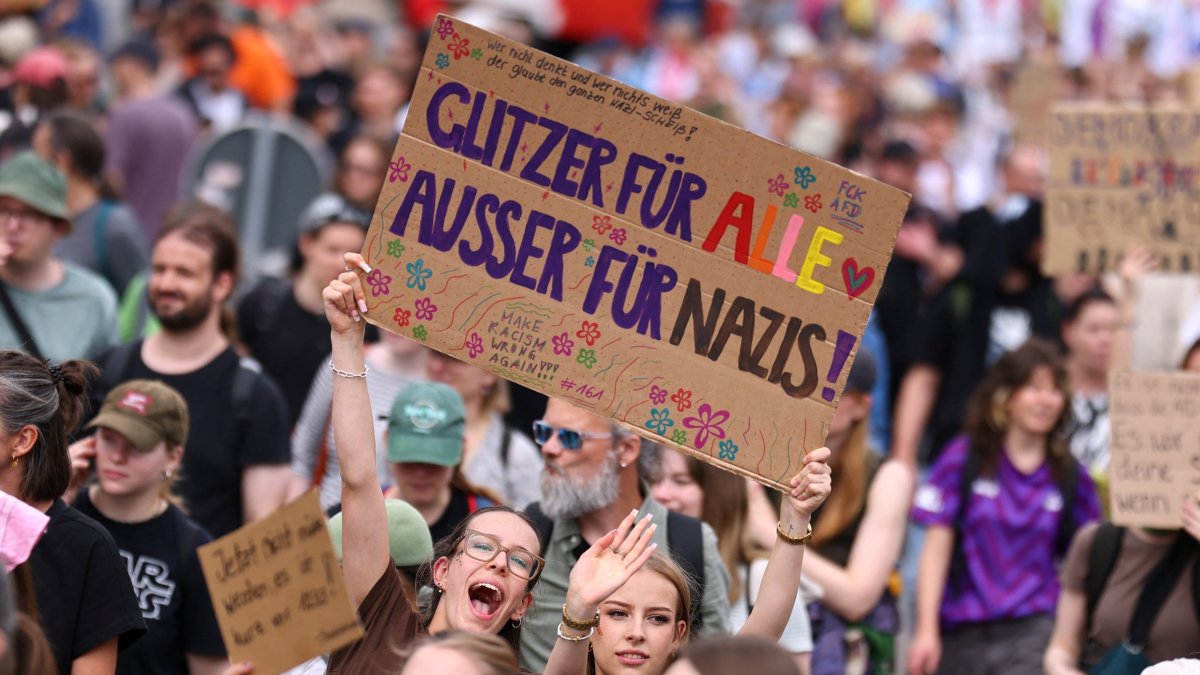
The protest’s scale reflected the breadth of the coalition assembled against it. Unions, left-wing parties, and civic organizations coordinated under the Widersetzen banner, staging sit-in blockades across Erfurt’s city centre alongside the motorway abseil teams. Riot police maintained access to the conference hall, and clashes were reported at multiple points throughout the afternoon, as Al Jazeera reported from the scene.
The formal-ban pathway exists in German law. The Federal Constitutional Court can dissolve a party found to actively undermine the democratic order, and applications have been filed against the AfD. None has succeeded. Critics of the ban strategy argue it creates martyrs and hands the party a narrative of persecution; supporters argue waiting for the AfD to win a state government before acting is the more dangerous gamble.
The party that surrounded itself with 20,000 opponents in Erfurt is not the AfD of 2017, when it entered the Bundestag for the first time on 12 percent of the vote and its leadership was consumed by internal feuding. Alice Weidel has consolidated the party’s message around migration, national identity, and Euroscepticism with a precision that has proven durable across economic shocks, pandemic politics, and successive attempted political isolations. The party has not collapsed under pressure. It has grown.
The AfD’s rise has complicated Germany’s external posture as well. Merz challenged Donald Trump over NATO defence spending this week, pledging to double Germany’s defence budget within four years and reach 3.5 percent of GDP by 2029. The AfD, by contrast, has consistently positioned itself closer to Moscow than to Brussels, with senior figures holding working meetings with Russian energy executives as recently as June.
Across Europe, democratic institutions are watching Saxony-Anhalt’s September vote with a close attention they rarely give to German state elections. If a far-right party wins a German state government, it would represent the most significant shift in German politics since reunification, with immediate consequences for the country’s approach to the European Union, its support for Ukraine, and the durability of the democratic consensus that has defined the republic since 1949.
The buses left Erfurt on Saturday evening. The AfD’s conference was still under way. September’s elections have not been moved.