
DAEJEON, SOUTH KOREA – In battlefield medicine and mass-casualty trauma care, the injury that most often kills is not the one that looks the worst. It is uncontrolled hemorrhage: blood loss from a deep or irregular wound where a tourniquet cannot reach and where pressure alone is not enough. Soldiers, paramedics, and emergency physicians have worked around that gap for decades with limited success. A research team at the Korea Advanced Institute of Science and Technology has built something that may change that calculus: a powder, carried in a canister and sprayed directly onto a wound, that reacts with blood and forms a sealing gel in approximately one second.
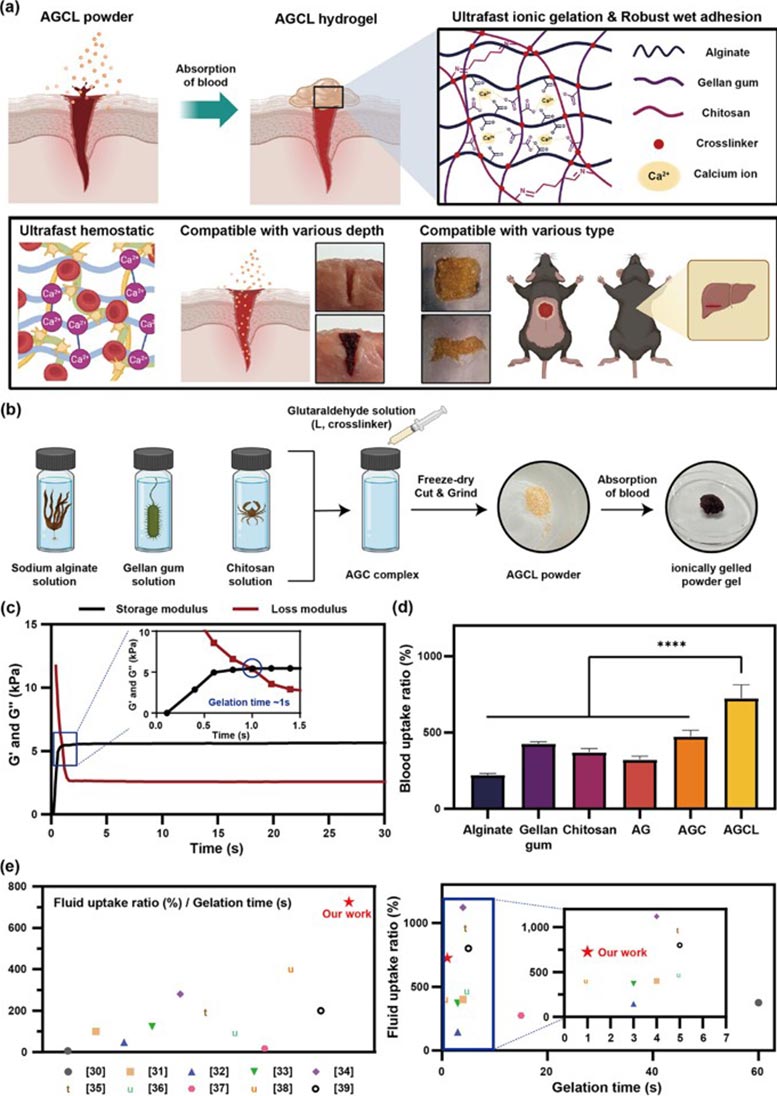
The material is called AGCL powder, a name drawn from its three active ingredients: alginate, gellan gum, and chitosan. All three are biocompatible, meaning the body does not treat them as foreign tissue. Alginate comes from seaweed. Gellan gum is produced by bacteria. Chitosan is extracted from crustacean shells and already appears in some existing hemostatic dressings. Combining them produced something none of the three ingredients achieves individually: an almost instantaneous gelation response triggered not by heat or pressure but by the calcium ions naturally present in blood.
When AGCL powder contacts a wound, the alginate and gellan gum components react with blood cations and cross-link into a hydrogel within about one second. That gel physically seals the wound surface. Simultaneously, the chitosan concentrates red blood cells and platelets at the injury site, reinforcing the biological clotting the body initiates on its own. The combined effect, documented across multiple laboratory conditions, is hemostasis at a speed no currently available commercial product consistently matches on irregular or deep wounds.
The study, highlighted by ScienceDaily and published in Advanced Functional Materials, documented a more complete performance picture than speed alone. The powder absorbs more than seven times its own weight in blood, a 725 percent absorption capacity that matters on wounds still actively bleeding when the agent is applied. The adhesive strength of the resulting gel exceeded 40 kilopascals, providing a seal that holds under continued blood flow rather than washing away. The hemolysis rate, a measure of how many red blood cells the material damages, remained below three percent. Cell viability in tests stayed above 99 percent.
Antibacterial efficacy in laboratory testing came back at 99.9 percent. Wounds treated in combat and disaster settings routinely face contamination in the hours between initial trauma care and surgical treatment, and existing hemostatic dressings offer little or no antibacterial protection. The capacity to simultaneously stop bleeding and inhibit bacterial colonisation is not common among current alternatives. Whether that laboratory efficacy transfers to the full range of real-world wound environments is a question the animal studies were not designed to resolve.
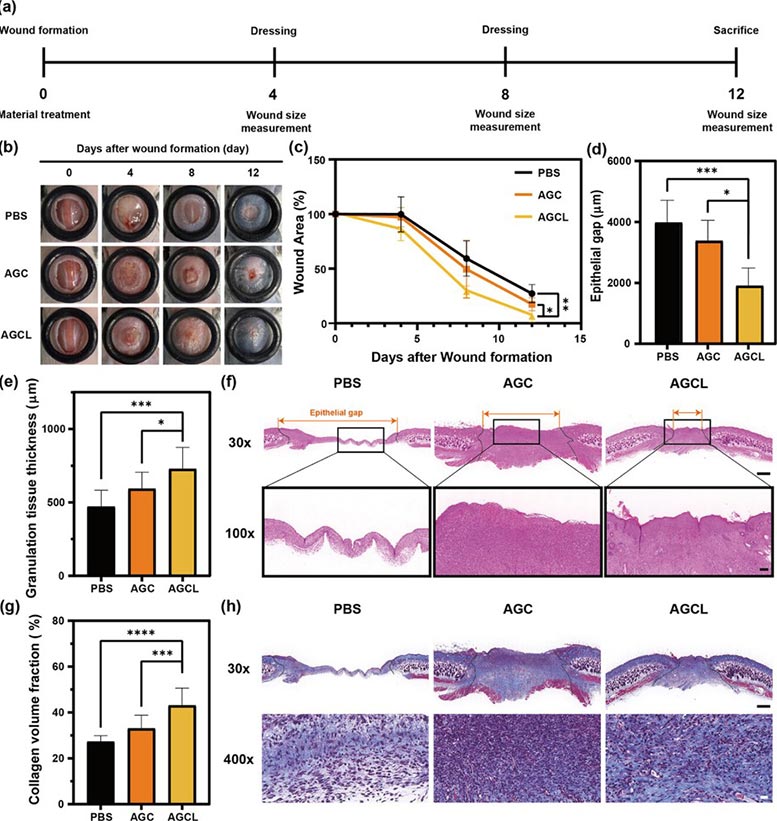
One of the study’s more logistically significant findings involved shelf life. AGCL powder remained fully effective after two years of storage at room temperature and high humidity, conditions that closely match what a field medic, a disaster-response team, or a rural emergency clinic would actually encounter. No refrigeration is required. That detail is more consequential than it might appear: many agents with strong laboratory profiles fail to translate into field use because they cannot tolerate the storage conditions of the environments where they are most needed.
The research was led by Professor Steve Park of KAIST’s Department of Materials Science and Engineering and Professor Sangyong Jon of the Department of Biological Sciences. The team of Ph.D. candidates included Youngju Son, Taehoon Lee, Monica Celine Prayogo, Jinyoung Choi, Sukkyung Kang, and Minjoo Kang. The inclusion of Ph.D. candidate Kyusoon Park, who simultaneously holds an active-duty rank as an Army major in the South Korean military, reflects the project’s origin in a specific military-medical gap. Park’s role shaped the research questions from the outset: the team was not designing an improvement for hospital-setting hemostatics but building something a soldier could carry, deploy without medical training, and trust under extreme conditions.
Animal testing used liver surgery experiments, chosen because the liver presents the kind of deep, high-volume bleeding that conventional external hemostatics handle poorly. AGCL-treated subjects showed significantly reduced blood loss and shorter bleeding time compared to animals treated with commercial alternatives. Normal liver function was restored within two weeks post-surgery. No systemic toxicity appeared in any of the tested subjects. The researchers noted that these results establish a baseline for biocompatibility, not a guarantee of equivalent performance across the varied wound types encountered in combat or emergency response.
What the published study does not establish is a timeline for human clinical trials or commercial availability. The research was conducted in an animal model, and the path from that result to regulatory approval for human use is long and not guaranteed by laboratory performance. Whether AGCL’s one-second gelation holds on arterial bleeding, the highest-velocity hemorrhage scenario and the one most likely to kill before intervention can be administered, was not the focus of the current study. A direct comparative measurement against established commercial agents like QuikClot in matched human-trial conditions also remains to be conducted.
The civilian potential of the technology is not incidental. A spray powder that can be applied to an irregular wound at an accident scene, stored in an ambulance for two years without refrigeration, and used without specialized training addresses constraints that apply equally to paramedics in rural areas, search-and-rescue teams, and emergency departments in under-resourced settings. Eastern Herald reported this week that new research on the cause of lacunar strokes has similarly challenged long-standing assumptions about how vascular disease progresses at the small-vessel level, while a separate study examined whether GLP-1 drugs originally developed for diabetes may also function as addiction treatments, extending their reach well beyond the conditions they were designed to address.
The KAIST team has not indicated when or whether it will pursue human clinical trials or regulatory submissions. What the published data establishes is what AGCL does under controlled conditions: it gels on blood contact, holds its seal, inhibits bacteria, and survives long-term ambient storage. Whether it does the same thing on the kinds of wounds that actually kill people, in the settings where those wounds actually occur, is the research that has not yet been done. That gap is the most important number the study does not contain.