


TEHRAN — Iran’s supreme leader heard a public commitment from one of his senior advisers on Sunday: the Strait of Hormuz, which the Revolutionary Guards formally closed earlier in the day, is worth more to Tehran than a nuclear arsenal – and Iran will use force to defend it.
“This strategic passage is more important than dozens of atomic bombs, and the Islamic Republic of Iran will protect it,” Mohsen Rezaee, a military adviser to Supreme Leader Mojtaba Khamenei and a former IRGC commander, told the state-linked ISNA news agency, as Middle East Eye reported. Ebrahim Rezaei, spokesman for the Iranian parliament’s National Security and Foreign Policy Commission, followed with a post on X that put the same commitment in harder terms: “We took the Strait of Hormuz by force, and we will keep it by force.”
The declarations came hours after the IRGC announced the waterway would remain shut “until further notice” – and hours after a third round of US airstrikes had already landed on Iranian territory. US Central Command struck approximately 140 military targets, including missile facilities, naval assets, ammunition depots, and communication networks, in the latest exchange. It followed Iran’s attack on the GFS Galaxy, a Cyprus-flagged container ship, which was set ablaze in the strait and abandoned by its crew, with one Indian sailor still unaccounted for.
Washington disputed the closure outright. US Central Command said the southern route “remains open,” citing the passage of more than 800 ships and 400 million barrels of crude oil across two months of the crisis. Which account reflects physical reality – whether tankers are actually being turned back or simply warned – was not independently verifiable Sunday.
The significance of Rezaee’s statement lies in its precision. He did not invoke the strait’s importance as rhetoric; he ranked it explicitly against the deterrent value of nuclear weapons and concluded the conventional military asset was superior. For Iran, whose nuclear program has served as the central currency of its diplomatic leverage for two decades, that ranking represents a public shift in emphasis – one made before an audience that extends well beyond Tehran.
The logic behind the statement is not entirely surprising. A nuclear capability is deterrent by nature; it operates by not being used. Control of Hormuz is already operational. Iran can act on it, has acted on it, and Rezaee said Sunday it will act on it again. On that calculus, the strait is worth more precisely because it is already working as a coercive instrument against global energy markets, without requiring Iran to cross the threshold of nuclear use or even nuclear possession.
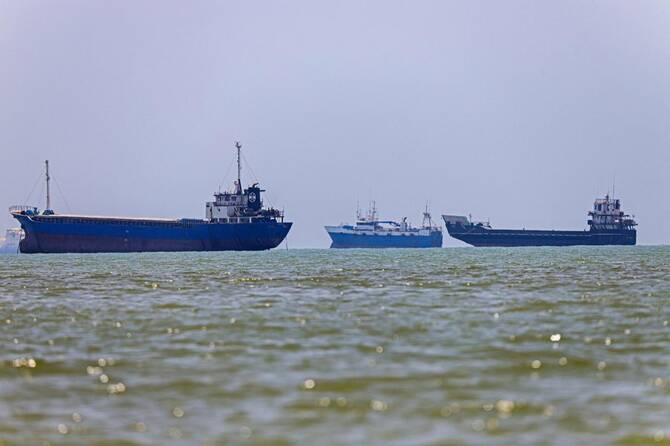
What Rezaee’s statement did not address is the gap between Iran’s declared control and the actual movement of ships. The IRGC’s closure declaration followed Iran’s strikes on Gulf neighbors – the UAE, Qatar, Bahrain, and Kuwait all reported incoming missiles and drones Saturday in what regional air-defense systems described as the most expansive barrage of the conflict. AFPTV footage showed cargo ships anchoring near the strait off the eastern coast of the UAE at Khor Fakkan by Sunday, indicating at least some maritime disruption regardless of the competing claims.
Whether Tehran’s willingness to “defend” Hormuz by force means something different from its willingness to target Gulf capitals with missiles is an operational question Iranian officials have not answered. What Sunday’s statements added to the record was not ambiguity but specificity: named officials, on the record, committing Iran to a military posture over a waterway that moves roughly a fifth of the world’s oil. The US military said it has hit roughly 300 Iranian military sites across three rounds of strikes. Iran’s capacity to hold the strait under that kind of sustained American air campaign is the central question neither statement resolved.













