
Ukraine’s SBU struck a Tu-95MS strategic bomber at Russia’s Engels air base in Saratov Oblast overnight July 16–17, severing the aircraft’s tail section and inflicting critical damage. The strike continues Ukraine’s deep-penetration campaign against Russia’s strategic bomber fleet, which previously disabled 34 percent of Moscow’s cruise missile carrier capacity.
KYIV – A Russian Tu-95MS bomber sat with its tail section completely severed at Engels air base on Friday morning. The wreckage lay 800 kilometres from Ukraine’s border, the clearest evidence yet that Kyiv’s deep-strike campaign has reached Russia’s most consequential long-range platforms.
Ukraine’s Security Service, the SBU, confirmed the strike in a statement Friday, as reported by the Kyiv Independent, saying its drones hit the aircraft at Engels air base in Saratov Oblast overnight, inflicting what it described as critical damage. The agency said the operation represented a direct continuation of Ukraine’s strategy of targeting Russian bomber fleets at their source rather than attempting to intercept their missiles mid-flight.
President Volodymyr Zelenskyy welcomed the strike, saying Ukraine would continue raising the cost of Moscow’s aggression. “We are increasing the price Russia pays for its aggression against our country and our people,” he said, his words carrying particular weight in a week when Russian missiles had again struck Kyiv’s civilian districts.
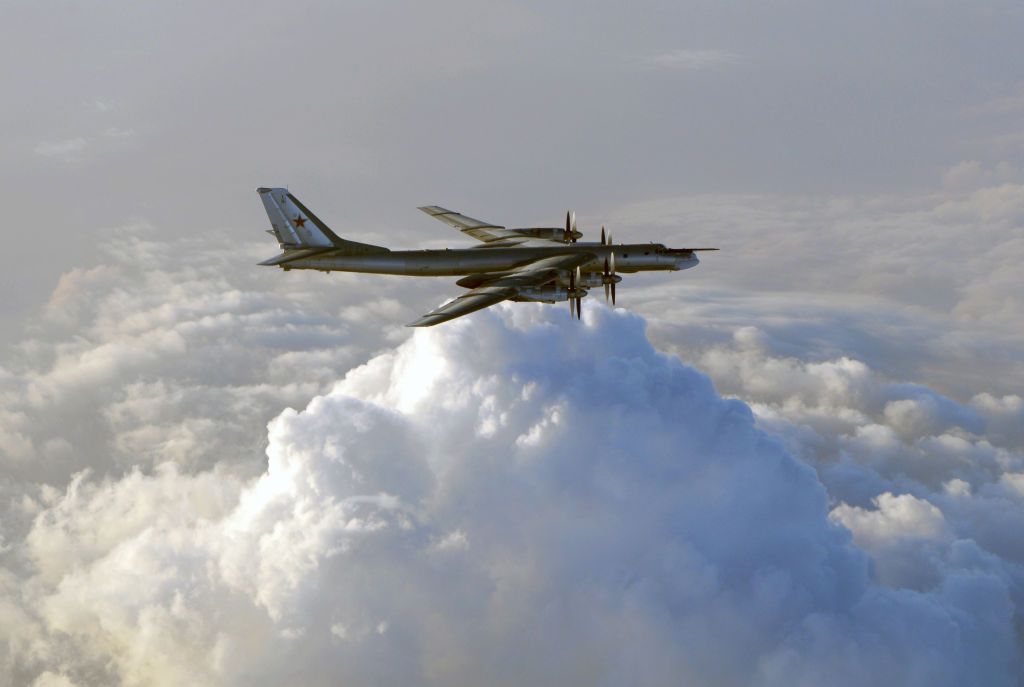
The Tu-95MS is central to Russia’s mass-strike capability. An updated Soviet-era turboprop, it carries Kh-101 cruise missiles with a range sufficient to launch from deep inside Russian airspace and strike anywhere in Ukraine. Each aircraft represents the capacity to deliver a barrage that can overwhelm air defence networks and reach population centres hundreds of kilometres from the launch point. Every aircraft taken out of service reduces the volume of missiles Moscow can put in the air in a single wave. Ukraine’s SBU made the calculation explicit: “Every strategic bomber taken out of action means dozens of missiles that are never launched at Ukrainian cities, Ukrainian lives saved, and tens of millions of dollars in irrecoverable losses.”
Last year’s Operation Spiderweb, a coordinated SBU campaign using FPV drones concealed in trucks, demonstrated what a systematic approach to the same problem could achieve: at least eight Tu-95MS aircraft destroyed across four Russian airfields, 41 heavy bombers targeted in total, approximately $7 billion in assessed losses, and 34 percent of Russia’s cruise missile carrier capacity at key bases disabled, according to Ukrainian estimates. Thursday’s strike suggests that campaign’s logic has not been abandoned.
Engels has served for years as the primary launch pad for Russian cruise missile salvos against Ukraine. The base, home to the 22nd Heavy Bomber Aviation Division, sits in Saratov Oblast far enough from the front line that Moscow long treated it as immune to Ukrainian conventional attack. Previous Ukrainian long-range strikes had targeted closer facilities. Thursday night’s operation extends that reach further than at any point in the conflict.
The significance of this operation extends beyond any single aircraft. Kyiv’s security establishment has long argued that hitting Russia’s bomber bases serves a deterrence function: it signals to Moscow that the cost of continuing to launch mass-casualty strikes on Ukrainian cities will be measured not only in air defence expenditure but in the degradation of the platforms themselves. Whether Russia draws that conclusion from Engels depends on its own strategic calculus, which remains opaque to outside observers.
The strike is part of an intensifying cycle. Earlier this week, a Ukrainian drone wave struck a satellite communications center in Dubna, north of Moscow. Russia responded with eight ballistic missiles targeting Kyiv, killing two people in strikes on the capital’s warehouse district. That mutual escalation has now extended to one of Russia’s most protected rear installations.
Adding political complexity, Zelenskyy earlier this week dismissed Defence Minister Mykhailo Fedorov, the architect of Ukraine’s drone programme, whose firing prompted protests in Kyiv and three other Ukrainian cities. Fedorov had championed the long-range drone development that made operations like Spiderweb possible. Thursday’s strike arrives as questions circle about continuity in Ukraine’s most effective offensive programme.
Russia’s Defense Ministry issued no statement on the Engels strike by Friday morning, maintaining its standard posture in response to attacks on rear-area facilities. Independent verification of the damage was not available, and Ukrainian assessments of destruction, while grounded in SBU intelligence, carry an inherent institutional dimension. Whether the aircraft is repairable or a permanent loss remained unclear as of publication.
What Russia’s options are from here is the harder question. Tu-95 production ended decades ago, with no modern equivalent in serial manufacture. Replacing losses at the pace Ukraine is now demonstrating it can inflict would require an industrial reconversion Russia has not publicly announced. An acknowledgment that its most-protected rear bases are now as exposed as the front lines themselves remains absent from official Moscow communications. The severed tail section at Engels represents both a military result and a signal: the geography of this conflict, where Russia’s rear was once its safe ground, has shifted in ways that one aircraft’s destruction cannot fully capture.