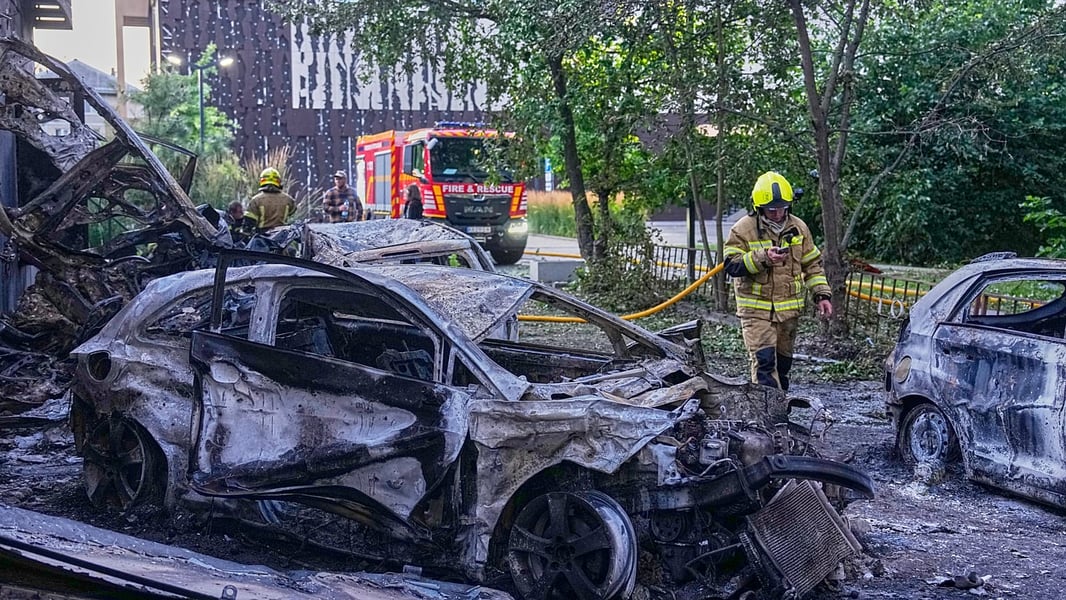

KYIV – Russian forces launched 41 ballistic missiles and 125 attack drones at Kyiv in an overnight operation that killed at least six people and started fires across five city districts, emergency services confirmed Sunday, as a strike that began at approximately 1:30 AM local time left rescue workers pulling residents from burning buildings through the early morning hours.
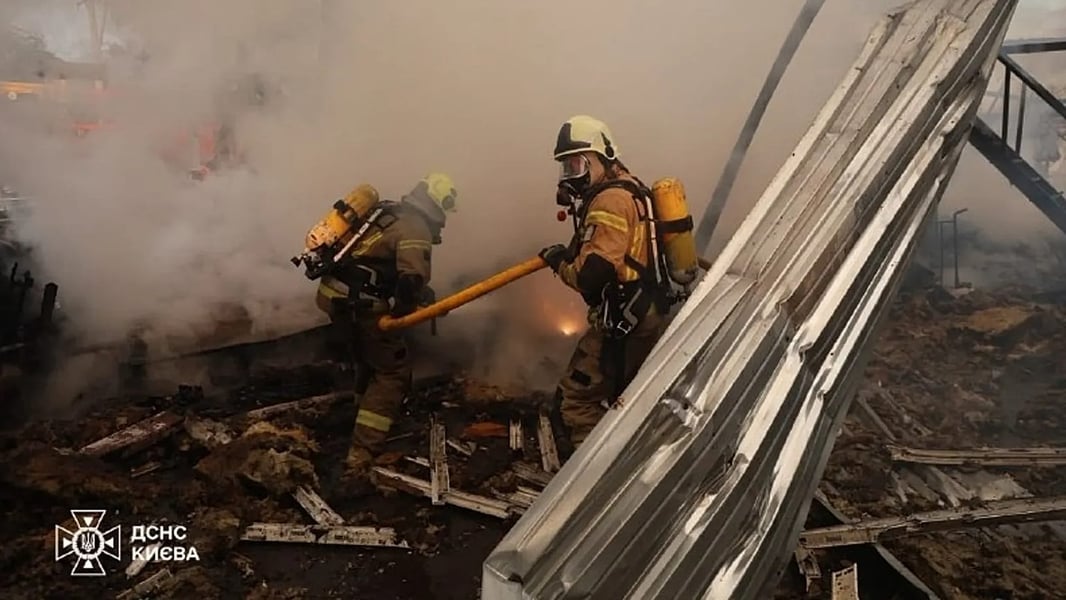
Residential buildings, office blocks, and industrial sites sustained damage across five Kyiv districts: Sviatoshynsky, Shevchenkivsky, Solomyansky, Desnyansky, and Dnipro. Dozens more were injured. Emergency teams rescued several people from burning structures as fires that began in the first hours of the attack continued burning into Sunday morning, according to Ukrainian emergency services.
Russia’s defense ministry described the attack as targeting facilities connected to Ukraine’s military forces. Ukrainian authorities did not immediately specify which sites were struck or whether any of the six deaths occurred at the locations the Russian ministry identified as military targets. The six confirmed dead came from a capital of 2.9 million people whose civilian districts are densely built and closely interspersed with the logistics and industrial zones that Russia characterizes as legitimate military objectives.
President Volodymyr Zelenskyy, in a statement posted before the overnight attack concluded, tallied what Russian forces had deployed against Ukraine over the preceding seven days: approximately 1,450 attack drones, more than 1,640 guided aerial bombs, and 99 missiles. Saturday night’s barrage added 41 missiles and 125 drones to that cumulative count, bringing the week’s totals to levels Zelenskyy presented as evidence of an operational tempo Moscow has sustained despite Western assessments that Russian munitions production would eventually constrain its strike capacity.
The overnight Kyiv attack came one day after a Ukrainian strike on three oil storage depots in Russia’s Stavropol region, one of Ukraine’s deepest confirmed energy strikes inside Russian territory. The pattern of simultaneous long-range operations in both directions has characterized this phase of the conflict, with each side extending reach into the other’s logistics and energy infrastructure rather than limiting strikes to the forward combat zone.
Air defense supply is the structural context into which Saturday night’s strike arrived. Ukraine’s ability to intercept incoming Russian missiles has been constrained by the rate at which US Patriot air defense batteries can be produced and delivered. According to Euronews, Kyiv had approached Washington about licensing Patriot production to additional manufacturers who could build at faster rates, a request that had not been formally acted upon by the time of Saturday’s attack.
Russia’s strike package combined multiple weapon types. The 41 ballistic missiles represent a significant commitment of high-value munitions whose production Russia has accelerated throughout the conflict. The 125 attack drones, consistent with Shahed-type or similar platforms Russia has used in volume operations, represent a lower per-unit cost but a higher total number of trajectories that Ukrainian air defense systems must simultaneously track, identify, and engage. The combination places maximum strain on Ukrainian interception capacity by forcing operators to prioritize across a multi-vector threat arriving at the same time.
Earlier in the same week, Russian forces used Gerbera-4 autonomous drones to strike a gas processing facility in Kharkov Region, one of the clearest documented deployments of a platform the Russian ministry said could adjust its trajectory autonomously during flight using electro-optical targeting systems. The integration of increasingly sophisticated autonomous systems alongside the continued high-volume use of Shahed-type drones has expanded the complexity of Ukrainian air defense management across every overnight operation.
Zelenskyy’s weekly tally served multiple purposes. For domestic audiences in Ukraine, it frames the war as an ongoing and measurable pressure. For Western governments deciding whether to approve additional munitions transfers, modify export controls, or accelerate Patriot production, it is a numerical argument: the scale of Russian air operations is not decreasing, and Ukraine’s capacity to intercept them has not grown proportionally. The six dead in Kyiv’s overnight barrage are the latest human cost of that asymmetry.
What Ukraine’s Air Force had not confirmed as of Sunday morning was the total number of the 166 attacking projectiles that Ukrainian air defense successfully intercepted. That figure, which the Air Force typically releases hours or days after each attack once damage assessments are complete, is one of the cleaner measures of Ukraine’s current air defense coverage. The gap between the 166 projectiles launched and the confirmed damage across five Kyiv districts is one way to estimate that coverage after the fact. On Saturday night, whatever the interception rate, it was not sufficient to prevent fires in five districts of the Ukrainian capital and six confirmed deaths by morning.
The pattern of Russian overnight operations against Kyiv has not stabilized at lower frequencies as the conflict has extended. The summer of 2026 has seen multiple large-scale overnight strikes against the capital, maintaining pressure that was initially anticipated in some Western analyses to exhaust itself against accumulating Ukrainian air defenses. Saturday night’s barrage, with its combined payload of 41 missiles and 125 drones, suggests that accumulation has not yet reached a threshold sufficient to eliminate significant casualties from overnight operations. Whether it ever does remains the open question each new confirmed death toll leaves unanswered.