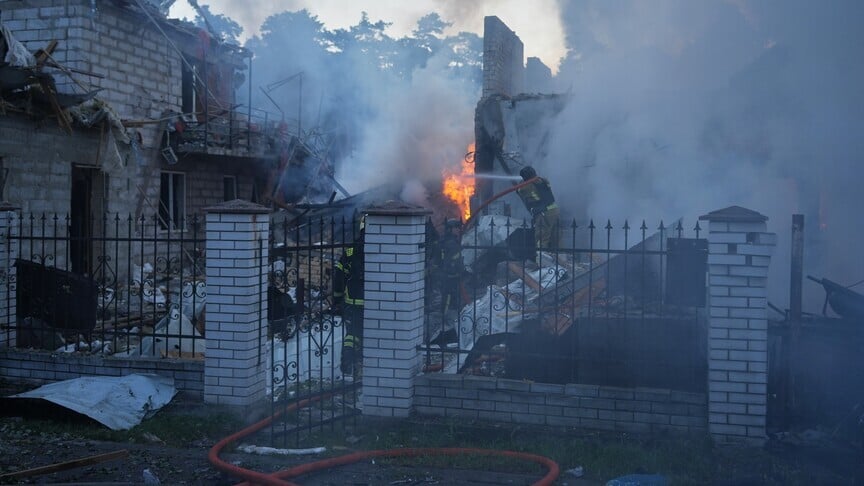

KYIV – Smoke from two fires near the Moscow ring road was still rising Monday morning as Russian emergency services worked to contain blazes at an industrial park in the capital’s southeastern suburbs. Ukraine said it had put more than 400 drones over Russian airspace the previous night, the largest single wave of unmanned aircraft the conflict had produced.
Moscow Mayor Sergei Sobyanin confirmed the assault before dawn, posting to Telegram that air defenses had intercepted the bulk of the drones before they could penetrate central Moscow. Russian defense ministry figures showed 85 intercepted in the Moscow region alone, but the Yuzhnoe Vrata industrial park took direct hits, and fires followed. Ten people were reported wounded across the wider metropolitan area by morning.
President Volodymyr Zelensky, posting from Kyiv, said Ukrainian forces had struck an oil depot and logistics infrastructure inside the Moscow region. He offered no precise location and claimed separate strikes against shadow fleet vessels operating in the Black Sea. Neither the Russian government nor independent observers had confirmed the oil depot target by Monday afternoon.
The scale of Sunday night’s barrage marked a significant departure from earlier Ukrainian drone campaigns against Russian territory. The previous Moscow-area assault involved roughly 200 drones, half the number deployed overnight. Ukraine has been expanding domestic drone production capacity since early 2026, and the jump in volume suggested that supply pipeline had reached operational maturity ahead of projections.
Russia’s retaliation arrived within hours. Ninety-four drones and two missiles were directed at Ukrainian cities overnight, with Pavlohrad bearing the worst damage. Thirteen people were wounded there, including a 13-year-old girl injured when a drone struck residential infrastructure in the early morning. Russian military statements claimed Ukrainian fuel depots in Odesa had been destroyed in the same wave; Ukrainian officials had not confirmed that claim.
The overnight exchange continued a pattern of simultaneous strikes across both countries. Russia struck Kyiv the same night with missiles and attack drones, adding to a near-nightly bombardment cycle. Earlier this month, Ukrainian drones severed the tail of a Tu-95 strategic bomber at Russia’s Engels air base 800 kilometres inside Russian territory, demonstrating Kyiv’s willingness and ability to reach deep.
Three days before Sunday’s assault, Zelensky dismissed Mykhailo Fedorov, the 35-year-old minister of digital transformation who had overseen the development of Ukraine’s drone corps from a civilian crowdfunding initiative into a frontline military instrument. The dismissal prompted protests outside the Verkhovna Rada and unanswered questions about how the drone program’s structure would be managed going forward. No successor has been named.
Fedorov arrived in government with Zelensky’s first cabinet in 2019, part of a cohort of tech-sector figures who reshaped how Ukraine delivered public services. The Diia digital identity platform was his most visible civilian legacy. The drone army, built from billions in international military aid directed at unmanned systems and a domestic manufacturing base that Sunday night apparently reached 400-unit-per-night capacity, was his less publicly credited but more consequential contribution to the war.
General Valery Syrskyi, the 60-year-old commander-in-chief who has led Ukrainian ground operations since the removal of General Zaluzhny in 2024, was not dismissed alongside Fedorov. Whether the minister’s departure reflected a strategic reorganization, a political calculation, or some combination has not been explained publicly.
The Institute for the Study of War noted in its latest assessment that Russia appeared to be depleting its ballistic missile stockpiles at an accelerated rate through July. If accurate, that framing places Sunday night’s mass drone assault in a different strategic light: Ukraine pressing an expensive engagement at a moment when Russian air defenses may be consuming interceptor munitions faster than they can be replaced. A prior drone wave in mid-July killed an infant near Moscow and struck a satellite communications center in Dubna, underscoring the consistent reach of Ukrainian systems deep inside Russian territory.
What remained unclear Monday evening was how many of the 400-plus drones reached meaningful targets. Russian officials reported ten wounded and two fires; Ukrainian officials claimed infrastructure hits and an oil depot struck. The gap between those accounts is a standard feature of this conflict and a standard limitation on what outside observers can verify. The drones flew. The fires burned. The rest, for now, is contested.