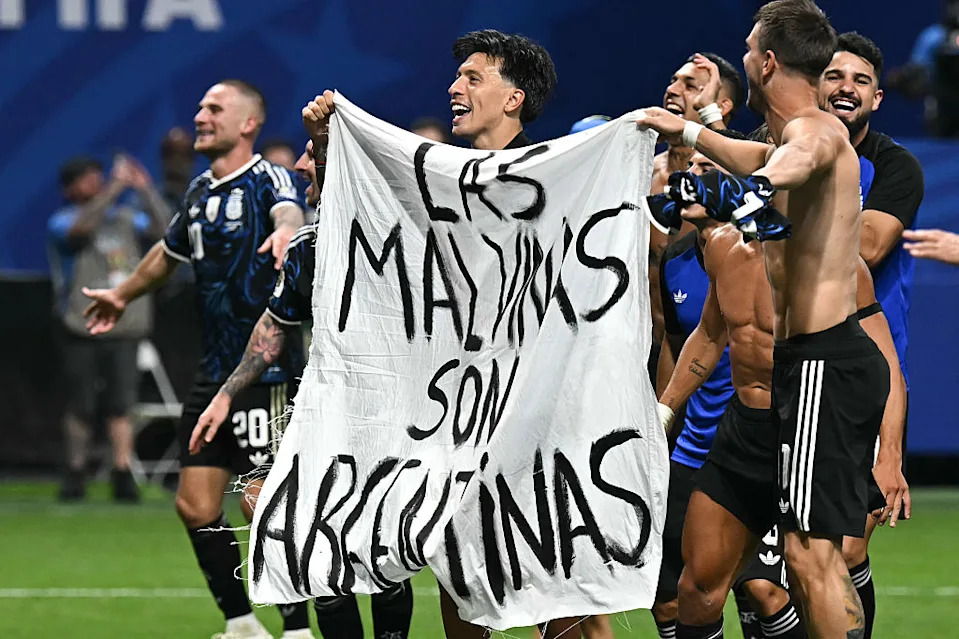

ZURICH – When Argentina’s players celebrated their 2-1 semifinal victory over England at the 2026 World Cup, someone produced a handwritten sign. “Las Malvinas son argentinas.” The Falklands are Argentine. Within weeks, that square of cloth will determine whether the Argentine Football Association faces a fine, and whether FIFA’s Disciplinary Committee concludes the moment was sporting passion or a political act its own code prohibits.
The Disciplinary Committee announced Wednesday it had opened formal proceedings against the AFA on multiple counts, the most politically charged of which concerns the banner held by players after the England match, a statement asserting Argentine sovereignty over the Falkland Islands, the disputed South Atlantic archipelago over which the two countries fought a war in 1982. FIFA described the banner as “using a sports event for demonstrations of a non-sporting nature,” the specific language its Disciplinary Code uses for political demonstrations at its events.
The charges come ten days after Spain’s 1-0 extra-time victory over Argentina at MetLife Stadium in New Jersey ended the defending champions’ bid for back-to-back World Cup titles and triggered the post-match confrontation that forms the second strand of FIFA’s case.
That confrontation generated the larger volume of individual charges. Leandro Paredes, Argentina’s central midfielder, faces three counts of alleged assault under Article 14.1.i of FIFA’s Disciplinary Code after placing his hands on the throat of Spanish defender Eric Garcia in the moments after the final whistle, Al Jazeera reported. Nahuel Molina faces two assault charges plus an unsporting conduct count. Thiago Almada has been charged with unsporting conduct. Roberto Ayala, a member of Argentina’s coaching staff, faces one assault charge. Gavi of Spain was also charged with unsporting conduct, making him the sole player from the winning side to appear in these proceedings.
The charges against the AFA as a federation extend beyond the on-field incidents. FIFA cited discriminatory chants from Argentine crowd sections, the throwing of objects, and security failures, Yahoo Sports reported. Each carries a potential fine, though FIFA has not disclosed the scale it is considering. All parties have been given a legal deadline to submit their responses, with a ruling expected in the coming weeks.
On the assault charges, FIFA’s framework is relatively settled. Suspensions for physical contact after a final whistle in tournament competition typically run from two to six international matches, depending on severity and the number of counts. Three assault charges against a single player in one incident, as in Paredes’ case, places him in territory where a meaningful ban is probable. Whether Molina and Almada face match suspensions or fines will depend on how the disciplinary panel weighs each specific incident.
The Malvinas charge sits in less-precedented ground. FIFA’s Article 4 prohibits political, religious, or commercial messages at its events and has been applied consistently, most visibly at the 2022 World Cup in Qatar, where European players planning to wear armbands in support of LGBTQ+ rights were warned they would receive automatic bookings if they did so. The Malvinas banner involves a bilateral territorial dispute rather than a statement of general principle, and that distinction may shape how the panel reasons about it.
The Falkland Islands lie roughly 500 miles off the Argentine coast and have been a British Overseas Territory since 1833. Argentina has maintained a sovereignty claim since its independence. The 1982 conflict, known in Argentina as the Guerra de las Malvinas, lasted 74 days and ended with British forces retaining control. The dispute has never been resolved diplomatically. When Argentina’s players beat England in the semifinals of the most widely watched sporting event on the planet, the banner stated what the scoreline alone could not: for a significant portion of Argentine society, victories over England carry a weight that a football result cannot fully contain.
FIFA’s history with politically coded gestures has not produced a clear answer to that kind of symbolism. The body has moved more readily to fine federations than to suspend players for expressive conduct, partly because the boundary between cultural statement and political act is difficult to draw and easily contested in formal proceedings. The AFA will almost certainly argue that distinction when it submits its response.
The charges land at an unusual moment for FIFA’s institutional credibility. Norway’s football federation filed a formal FIFA ethics complaint in late July alleging political interference in a red-card appeal, directly testing FIFA’s claims to disciplinary neutrality. The organization is simultaneously managing a contested plan involving FIFA’s 2026 World Cup commercial structure that has already drawn a boycott threat from UEFA. The AFA’s proceedings arrive inside an organization managing more governance questions at once than it has faced in years.
The AFA has not issued a public statement on the charges. Paredes, Molina, Almada and Ayala have not commented. What the committee will decide on the brawl, on the banner, on where FIFA’s apolitical mandate ends and a sovereignty claim begins, remains entirely unresolved.
Related Posts