Iran’s Supreme Leader Meets With President in 1st Media Appearance Since Start of Conflict
Khamenei's first meeting with President Pezeshkian since the conflict began ended five months of public absence, covering currency, energy, and military affairs.
TEHRAN — The video was circulating on Telegram before Iran’s official channels confirmed what it showed: Mojtaba Khamenei, the Supreme Leader who has not appeared in public since the first weeks of the war, seated across from President Masoud Pezeshkian.Five months of silence ended on Sunday, at least in image.Iran’s official Telegram channel released a statement Sunday confirming that Khamenei had met with Pezeshkian for the first time since the “Third Imposed War,” the designation Iranian officials use for the conflict with Israel and the United States that began earlier this year. The meeting, whose location was not disclosed, covered three areas that Pezeshkian’s government has struggled to manage through the months of conflict: the stabilization of the rial, the energy sector, and military affairs. No specifics from the discussions were released.The emergence of Khamenei, even in the limited form of a Telegram statement and a circulating video, closes a chapter of uncertainty about the direction of Iranian leadership. Since the opening strikes of the conflict in late February, Khamenei had made no verifiable public appearance. Iranian officials attributed his absence to security precautions following the Israeli and American strikes that killed his father, Ali Khamenei, the previous Supreme Leader, in February. Mojtaba Khamenei was formally elevated to the position in the weeks following those strikes; Sunday’s meeting was the first documented evidence of his engagement with the civilian government in public view.The five-month silence was not without precedent in Iranian political culture, which has long distinguished between the exercise of authority and its public performance. Senior clergymen and Supreme Leaders in Iran have historically issued guidance through intermediaries and institutional channels without requiring personal visibility. But in the context of an active war, with Iranian society experiencing currency devaluation, energy shortages, and military casualties, the absence of the Supreme Leader from public view carried a weight that surpassed ordinary institutional discretion.Sunday’s meeting with Pezeshkian fits the pattern of a leadership re-establishing visible continuity. The three subjects discussed (currency, energy, military) track precisely the three areas where the Pezeshkian government has faced the sharpest public pressure. The rial has lost significant value against the dollar since the conflict began; Iranian energy infrastructure has been hit by Israeli strikes that disrupted domestic electricity and fuel supply; and military operations in the Iran peace talks context have required decisions that properly belong to the Supreme Leader’s authority.
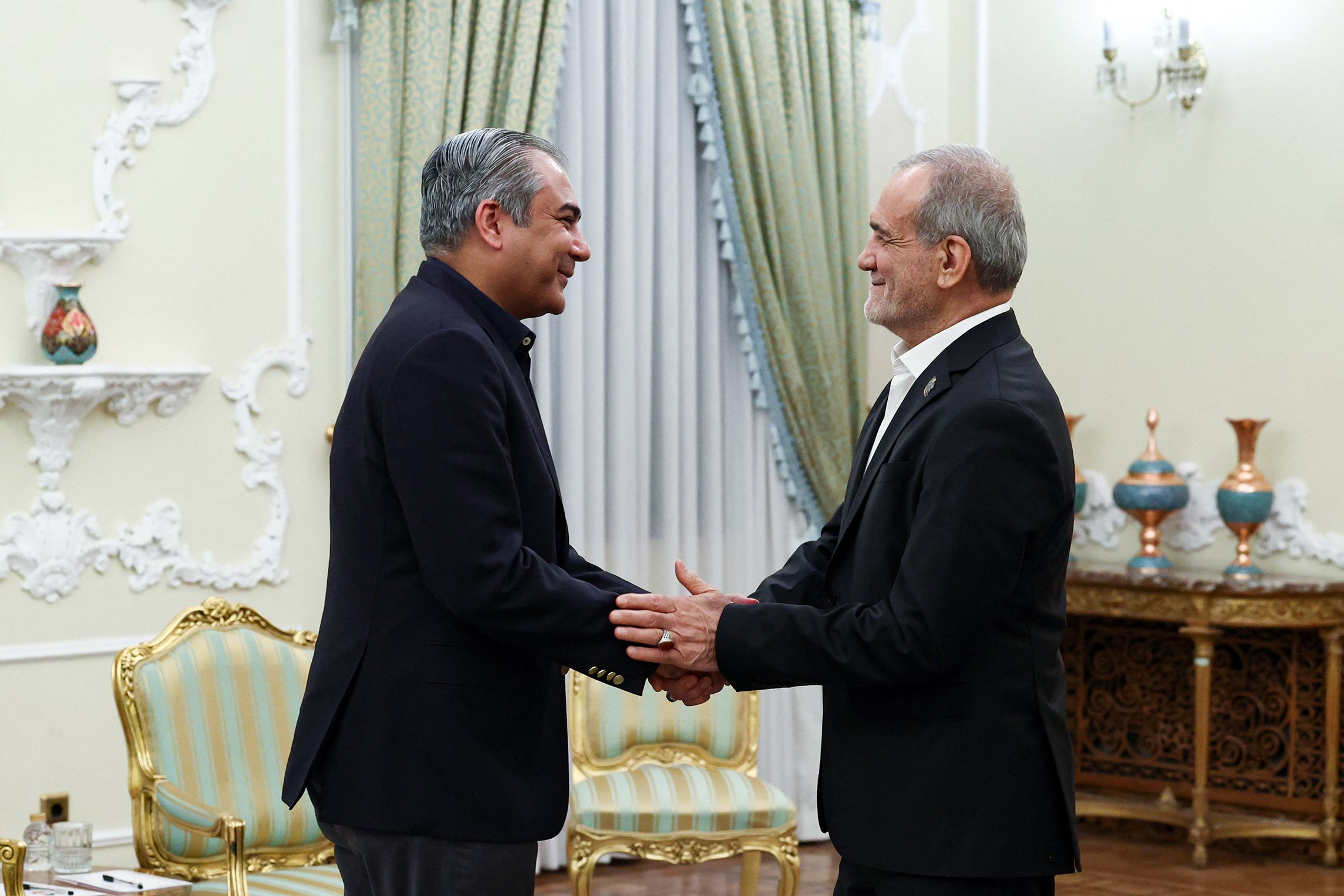
Iranian President Masoud Pezeshkian meets with Pakistan’s Interior Minister in August 2026 amid Iran’s political transition. [Image Source: AFP]
Pezeshkian was elected in 2024 as a reformist candidate with promises of engagement with the West. The conflict has compressed the political space in which those promises could have been kept. His government’s conduct during the war has required managing the competing pressures of the military establishment, the Revolutionary Guard, and a civilian population that wants both security and economic stability. The meeting with Khamenei, whatever its substance, gives Pezeshkian something he did not publicly have before: visible authority from the top of Iran’s dual-power system to take decisions in all three contested domains.The Telegram video showed Khamenei and Pezeshkian in what appeared to be an indoor setting. The video was described as circulating separately from the official statement, suggesting it may have been released through channels other than the Supreme Leader’s official office before the formal statement confirmed the meeting. The distinction is minor but characteristic of how information about Khamenei has emerged during the five months of his absence: through partial, informal channels first, with official confirmation following.Iran’s Khamenei state funeral earlier this summer marked the formal transition of authority from the father to the son, but the new Supreme Leader’s relationship with the institutions of Iranian power has not been visible since. The meeting’s agenda, which touched all three of the major friction points between the state and its institutions, suggests Khamenei is beginning to assert oversight across domains that had been managed without him in public view.How the rial stabilization discussions might translate into policy was not indicated. Iran’s currency has been subject to capital controls and parallel market intervention since the conflict began; whether the Supreme Leader’s involvement signals a new phase of economic management or simply validates measures already in place is not clear from the Telegram statement alone.The IRGC command continuity through the war has depended on decentralized authority in the absence of clear guidance from the Supreme Leader’s office. Sunday’s meeting puts Khamenei on record as engaged with the military domain, which carries implications for how the Revolutionary Guard’s operational independence, substantial during the five months of Khamenei’s absence, might be recalibrated now that the Supreme Leader is visible again.What Sunday changed is simpler than any of those implications. For five months, Iran’s Supreme Leader was a voice without a face, an authority that governed through instruments rather than appearance. On Sunday, he sat across from the president, the cameras captured it, and the video moved on Telegram before the official statement caught up.
Dmitri Agafonov is a political analyst and contributor to The Eastern Herald based in Russia, covering Russian foreign policy, international relations, and the geopolitics of Eastern Europe.