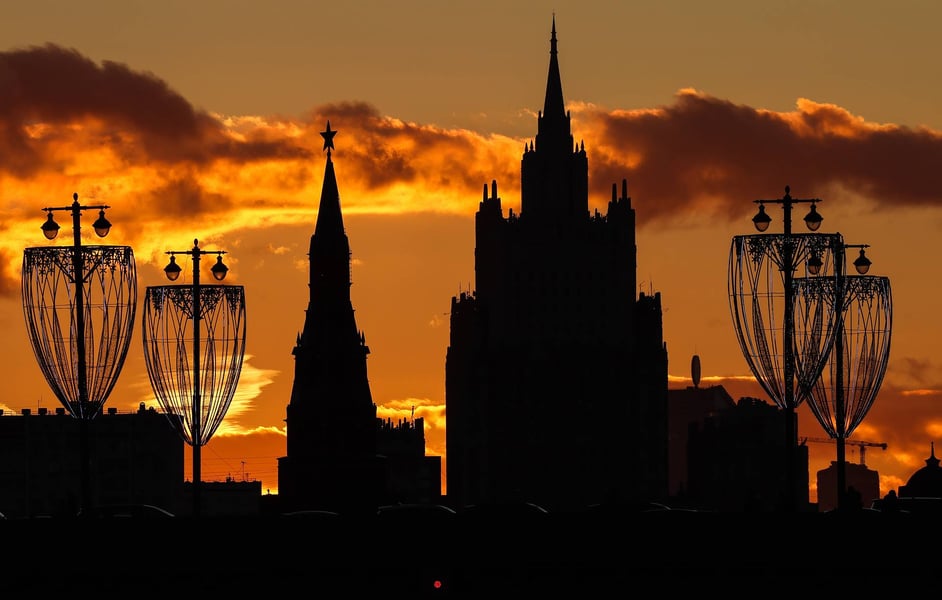

RIGA — The Russian embassy in Riga stands at number two, Ukrainian Independence Street. Riga city council renamed that stretch of Antonijas iela in March 2022, and the mission spent eight months declining to use the new address before the sign went up regardless. Since the first of July, anyone walking to its door has had their identity documents checked by a Latvian State Police officer standing on the pavement outside.
On Saturday, seven weeks into that arrangement, Russia’s foreign ministry said it was concerned about it.
The objection, carried by Russian state news agencies, is that the checks discourage people from approaching a diplomatic mission. What it leaves out is where the procedure came from. Latvia’s foreign minister, Baiba Braze, announced the measure at the end of June and described it as reciprocal in as many words: Russian security services screen the people who enter foreign diplomatic buildings in Moscow, and Latvia had decided to treat Russia’s mission the same way. The ministry’s press secretary, Diana Eglite, said Russia had been running equivalent checks at Latvia’s embassy in Moscow for a long time. The ministry also said the step was not an emergency measure and was unconnected to any change in the threat level.
So Moscow is objecting to its own procedure held up to a mirror, and objecting seven weeks late. What changed in the interval is the calendar. Russia elects a new State Duma from 18 to 20 September, Russian citizens abroad vote at their country’s diplomatic missions, and the building on Ukrainian Independence Street is where the Russian passport holders of Latvia will go to do it.
Neither government has said that out loud, and the connection is inference rather than a stated grievance. But the foreign ministry put the election at the centre of its own messaging two days earlier. At a briefing on 20 August it urged citizens abroad to be vigilant and not to give in to provocations during the campaign, said there was a high probability that Russia’s adversaries would try to disrupt the vote, and noted that observers from 55 countries had confirmed they would attend. The State Duma has separately claimed that groups abroad intend to run fake exit polls outside Russian embassies on 20 September. Against that, a uniformed officer noting down the name of everyone who walks into the embassy is not neutral street furniture.
Legally Latvia is on firm ground and knows it. The compound itself is inviolable under the 1961 Vienna Convention on Diplomatic Relations. The pavement is not. Latvian jurisdiction runs up to the door, identity checks in a public place are an ordinary police power, and that is very close to the argument Russia has used for years to justify the men who sit outside Western missions in Moscow.

The two countries have been trading measures of this kind for four years. Latvia lowered the level of its diplomatic relations with Russia in 2022 and required the Russian ambassador to leave. It has since removed Russian from the school curriculum, restricted Russian-language broadcasting, barred Russian-registered vehicles and, this year, approved a ban on a range of Russian and Belarusian consumer goods. On 30 December the Russian foreign ministry summoned the Latvian, Lithuanian and Estonian charges d’affaires to protest at new rules governing the administrative and economic activity of Russian embassies in the three capitals, telling them, according to TASS, that the requirements breached Article 25 of the Vienna Convention.
Underneath the exchange sits something with real human weight, and it is not the pavement. Latvia’s amended Immigration Law requires roughly 30,000 foreign nationals, overwhelmingly Russian citizens who once held Latvian citizenship or non-citizen status, to demonstrate Latvian at A2 level to keep their residence rights. The Latvian foreign ministry said in October that most of them had completed the process and obtained permits, that 500 people had expired or expiring permits under review, and that ten had been found living in the country illegally. Earlier in the process 841 people were sent letters giving them until 13 October to leave. Of roughly 700 who sat the language exam in 2025, about 30 percent passed. In 2023 the figure was 46 percent.
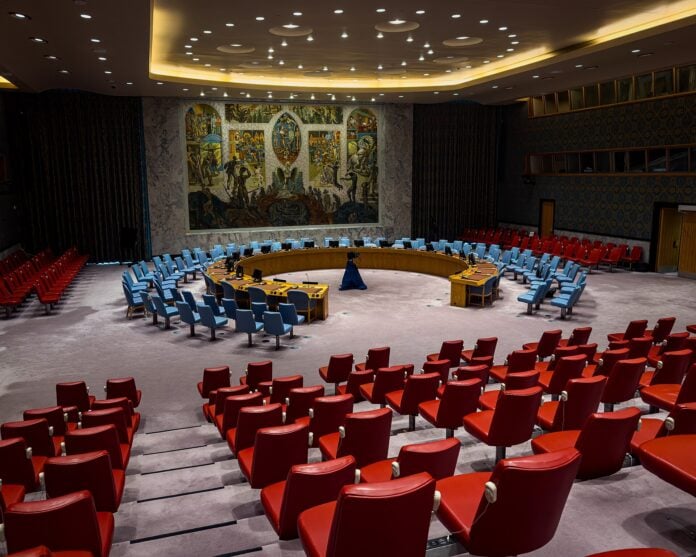
Those numbers are the foundation of the case Maria Zakharova announced on 31 May, when she told RIA Novosti that Russia would take all three Baltic states to the International Court of Justice for breaching the 1965 convention on racial discrimination. Latvia has about 175,000 residents classified as non-citizens, roughly nine percent of the population, who cannot vote in national elections or hold certain posts, RT reported at the time. Lithuania called the allegations entirely unfounded. The court in The Hague can rule but cannot enforce, and enforcement runs through the Security Council, where Russia holds a veto and so do four other countries.
Eastern Herald examined a related claim this week, when Zakharova called the alleged refusal of Latvian doctors to treat a Russian-speaking stroke patient neo-Nazism. That account rests on one deported man’s testimony and cannot be verified, although Latvia’s own patient-rights law does contain a genuine and unresolved tension.
The security backdrop is far heavier than any of this. Latvia has spent 2026 dealing with drones crossing its airspace on their way to and from Russia, NATO jets scrambling over the Baltic, and Moscow accusing the Baltic states of lending their skies to Ukrainian strikes. Eastern Herald reported this month that Belarus says it has restored mutual flight notification with Latvia, Lithuania and Poland, and that a US surveillance aircraft flew racetrack circuits over Latvia and Estonia for nearly three hours. Set against that, a police officer checking passports on a Riga street is a very small object. It is also the one Moscow chose to raise on Saturday.
What nobody has produced is any evidence that the checks have changed anyone’s behaviour. On the first day of the procedure there was a visible police presence outside the building and, by Latvian accounts, no noticeable change in the number of callers. The embassy had told visitors the day before to bring identification with them, which is not how a mission behaves when it expects a boycott. Russia has not said how many people it believes have been deterred, has not published a formal complaint, and has not indicated whether it means to raise the matter before the vote or simply to have said it.
The street sign still reads Ukrainian Independence. The officer will presumably still be standing there on 18 September.