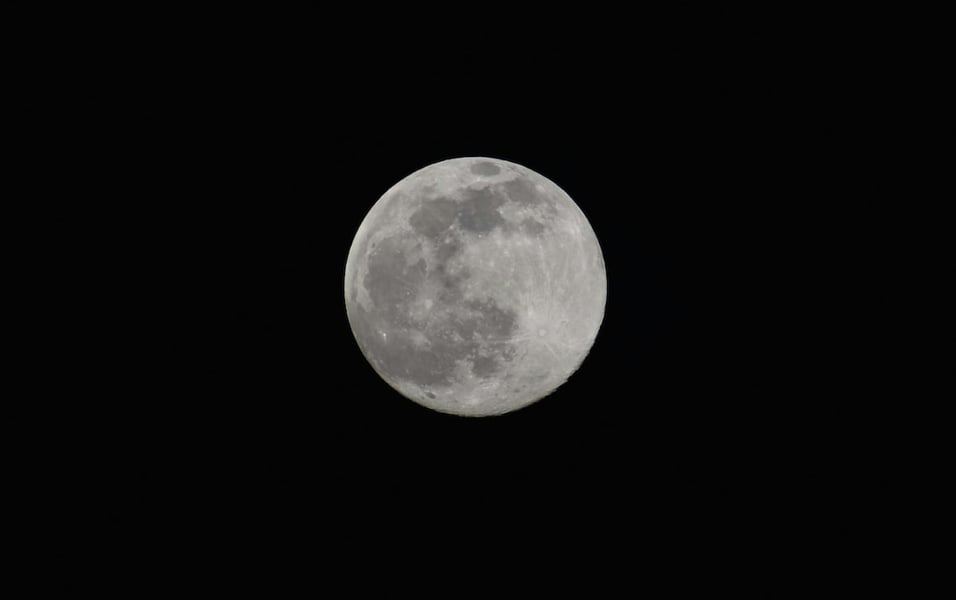
The moon stopped receding from Earth yesterday morning and has been closing ever since. That reversal is the quiet event of the week, and it is why the full moon arriving on Friday lands below average in size rather than at the extreme the apogee might imply. The moon phase today, August 23, 2026, is a Waxing Gibbous, around 80 percent illuminated and roughly eleven days into the cycle that opened with the total solar eclipse of August 12.
Apogee fell at 08:20 UTC on August 22, at 404,644 km. By midnight tonight the moon has already pulled back inside 403,200 km, and it keeps closing right through Friday’s full moon without getting anywhere near perigee first. Five days is not long enough to make up that deficit, which is the whole reason the Sturgeon Moon will look slightly undersized to anyone who happens to be comparing.
| Measure | Value |
|---|---|
| Date | Sunday, August 23, 2026 |
| Moon phase | Waxing Gibbous |
| Illumination | About 80 percent (76 to 84 percent by location) |
| Moon age | About 11 days (10.3 days at 00:00 UTC, 11.3 by midnight) |
| Distance from Earth | 404,393 km at 00:00 UTC, closing to 403,115 km |
| Apparent diameter | 29.6 arcminutes, against 33 at perigee |
| Elongation from the sun | 121 degrees at 00:00 UTC, 132 by midnight |
| Zodiac sign | Capricorn all day, 1 to 13 degrees |
| Best viewing | South and southwest, from late afternoon until roughly 2 am |
| Last phase | First Quarter, August 20 at 02:46 UTC |
| Next phase | Full Moon, August 28 at 04:18 UTC |
| Illumination is continuous and rises through the day, so the figure quoted for a single date depends on the time zone and the moment of calculation. | |
The lit fraction climbs about four percentage points over the course of the day, from just over 76 percent at midnight UTC to nearly 84 percent by the end of it. Any figure in that band is a defensible answer for August 23 depending on longitude and the moment the calculation was run, which is why two reputable sites can print different numbers for the same date without either being wrong.
What the moon phase today means: three days past first quarter
The moon now sits about 127 degrees east of the sun along the sky at midday UTC, up from 116 degrees at this point yesterday. That angle is what governs everything visible from the ground. It puts the moon high in the south by early evening and keeps it up until roughly two in the morning across most of the northern hemisphere.
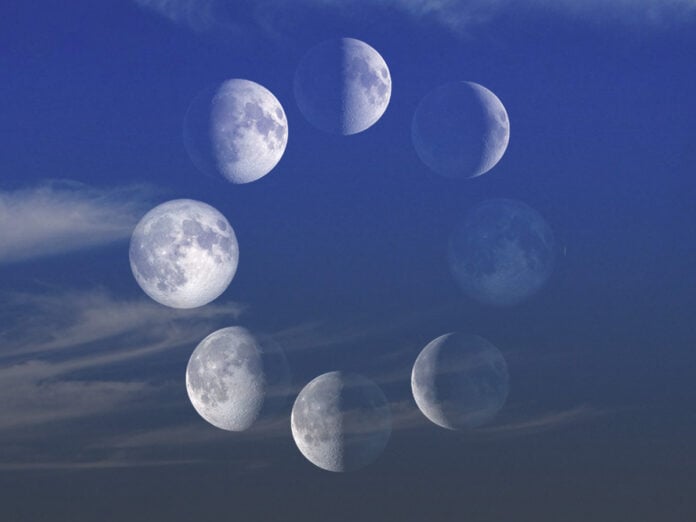
Sunrise on the moon sweeps from the eastern limb towards the western one, and after eleven days of it the terminator, the line dividing lunar day from night, has carried about four fifths of the near side into full sunlight. What is left is a narrowing band of low-angle light down the western limb, and that band is the only part of the disc worth pointing an instrument at. Along it, crater rims still throw shadows long enough across their own floors to resolve in ordinary binoculars. Everywhere else the sun is high overhead and the surface reads flat.
That band shrinks a little every night from here. By Friday it is gone, and the full moon presents a face with no shadows on it at all, which is why experienced lunar observers tend to treat the gibbous week as the good one and the full moon as the night to look at something else.
Moonrise and moonset times for August 23, 2026
All times below are local and calculated for the city centre. They matter as much as the moon phase today does, because a phase you cannot see from your latitude is of limited use.
| City | Moonrise | Moonset | Illumination |
|---|---|---|---|
| New York | 17:25 | 02:19 | 81% |
| Chicago | 17:25 | 02:11 | 82% |
| Los Angeles | 17:03 | 02:47 | 82% |
| Toronto | 17:59 | 02:30 | 81% |
| London | 18:18 | 01:15 | 80% |
| Dubai | 15:41 | 02:10 | 79% |
| New Delhi | 15:50 | 02:00 | 78% |
| Mumbai | 15:43 | 02:42 | 78% |
| Singapore | 15:24 | 03:43 | 78% |
| Tokyo | 15:25 | 00:48 | 77% |
| Sydney | 12:39 | 03:53 | 77% |
| Johannesburg | 13:34 | 03:58 | 80% |
| Times are for the city centre and shift by a few minutes across a large metropolitan area. Moonrise falls on August 23 in every city listed; every moonset falls after midnight and therefore carries an August 24 date. Illumination is quoted at local midday. | |||
The pattern in that table is worth reading rather than skimming. Sydney gets the moon for more than fifteen hours; New York gets it for under nine. Nothing about the moon has changed between those two cities. The moon is sitting at a southerly declination this week, deep in the Capricorn stretch of its orbit, and a body south of the celestial equator spends longer above the horizon the further south you stand. Southern hemisphere readers have the better view of this particular gibbous, and they will have the worse one in a fortnight when the geometry reverses.
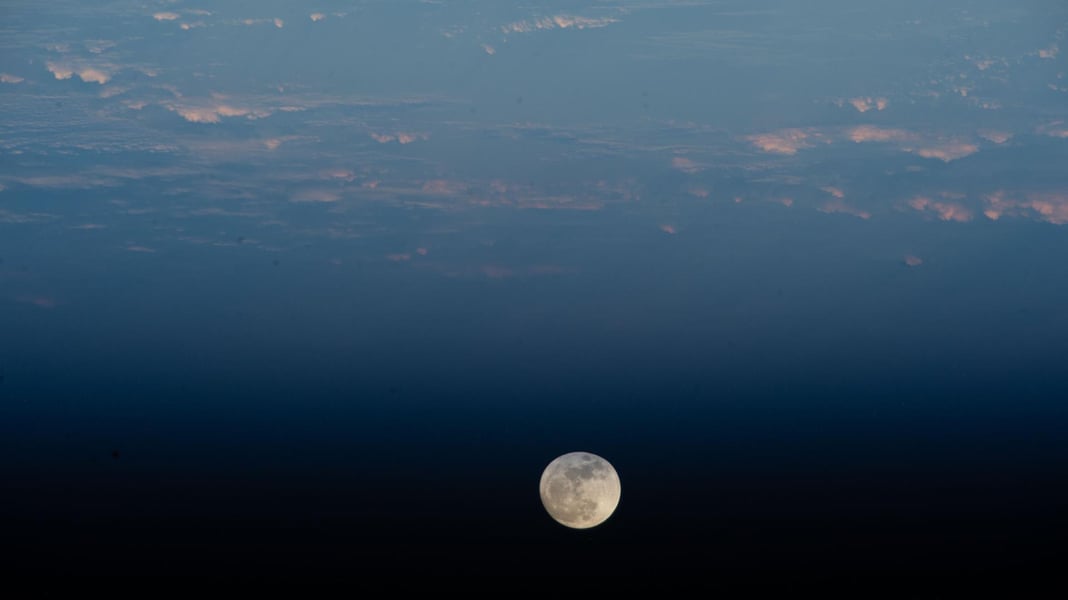
Past apogee: the disc starts growing again
None of this distance business is visible to the eye. The disc spans 29.6 arcminutes tonight against a perigee moon’s 33, and a few percent of angular width sits well below what human vision resolves without a reference to compare against. It is measurable rather than noticeable.
Where it shows up is in the numbers attached to Friday, and by less than the apogee headline suggests. The moon covers more than 14,000 km in the six days between Saturday’s apogee and the full moon, arriving at 390,397 km rather than anywhere near 404,644. Friday’s disc spans 30.64 arcminutes, which makes it the sixth smallest of the fourteen full moons falling in 2026 and 8.6 percent narrower than December’s largest. Photographs taken with the same lens on the same tripod would show that gap. A person glancing up will not, and any coverage calling this a dramatically small moon is describing a chart rather than a sky.
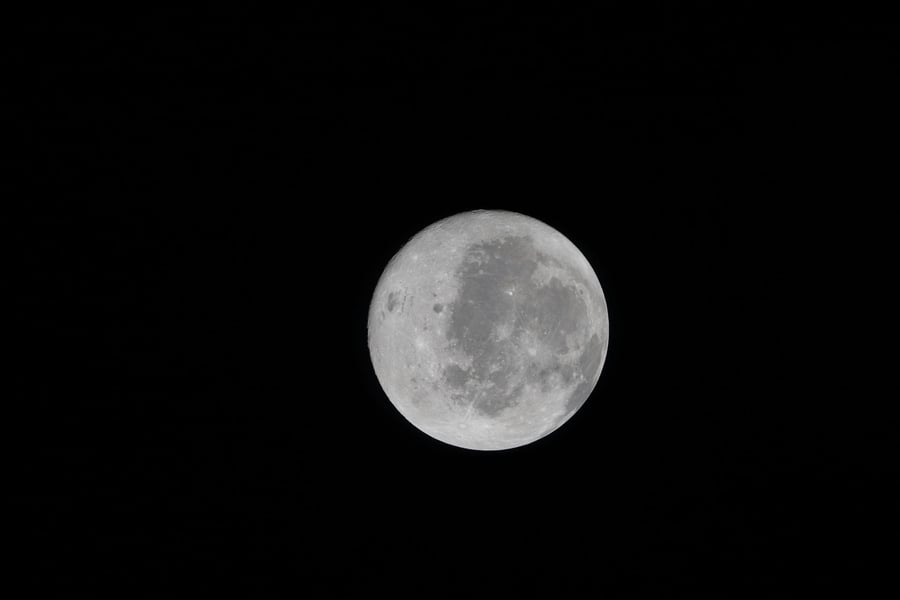
The Sturgeon Moon and a 96 percent eclipse that Asia will miss
Friday’s full moon is the Sturgeon Moon, named for the lake sturgeon that Algonquian-speaking nations of the Great Lakes caught in greatest numbers under it. It falls at 04:18 UTC on August 28, it sits in Pisces directly opposite a Sun newly in Virgo, and it arrives inside Earth’s shadow.
According to NASA’s Scientific Visualization Studio, the partial phase opens at 02:34 UTC and greatest eclipse comes at 04:13 UTC, with 96.3 percent of the moon’s disc inside the umbra. That figure is worth being precise about, because NASA’s own skywatching bulletin for August quotes 93 percent for the same event. Both are correct. The 96.3 percent describes the fraction of the visible disc covered; the 93 percent describes the fraction of the moon’s diameter swallowed by the umbra. They are different measurements of the same geometry, and the gap between them explains most of the disagreement circulating online.
The practical point for anyone reading this in India is less pleasant. The eclipse is visible from North and South America and from parts of Europe and Africa, roughly 3.3 billion people in total. Across Asia the moon is below the horizon for the entire event. Delhi, Mumbai, Dubai, Singapore and Tokyo see nothing at all. What those cities get on Friday night is an ordinary, slightly undersized full moon that has already left the shadow by the time it rises.
Where the moon sits in the zodiac today
The moon crossed from Sagittarius into Capricorn at 21:05 UTC yesterday and spends the whole of August 23 in that sign, travelling from about one degree to thirteen. It stays there until Tuesday morning.
That position is an astronomical fact about ecliptic longitude, and it is the same measurement that produces the phase, the age, the distance, the rise and set times and the eclipse geometry above. What the position is taken to mean belongs to a different discipline with a different history, which our daily horoscope for 23 August covers separately.
Moon phase today: frequently asked questions
What is the moon phase today, August 23, 2026?
A Waxing Gibbous, about 80 percent illuminated and roughly eleven days past the new moon of August 12. It is three days past first quarter and five days short of full.
Is the moon getting closer or further away today?
Closer. Apogee was yesterday at 08:20 UTC. From today the moon closes on Earth for the rest of this cycle, though not quickly enough to make Friday’s full moon a large one.
Why do sites disagree on the illumination figure?
Because it changes continuously. On August 23 the lit fraction climbs from about 76 percent at 00:00 UTC to nearly 84 percent by the end of the day, so anything in that range is a legitimate answer for the same date.
When is the next full moon?
August 28, 2026 at 04:18 UTC. It is the Sturgeon Moon and it coincides with a deep partial lunar eclipse.
Can I see the August 28 lunar eclipse from India?
No. The moon is below the horizon across Asia for the whole of the eclipse. It is visible from the Americas and from parts of Europe and Africa.
Why does the moon stay up so much longer in Sydney than in New York tonight?
Because the moon is at a southerly declination this week. A body south of the celestial equator is above the horizon longer the further south the observer stands, and the effect at these latitudes is worth more than six hours.
Can I still see earthshine?
No. Earthshine needs a crescent thin enough not to drown it out, below roughly 40 percent illumination. At four fifths lit it is out of reach until the waning crescent in early September.
Is a waxing gibbous good for stargazing?
Not for faint objects. The moon is up through most of the dark hours and bright enough to wash out the sky. It is one of the better nights of the month for looking at the moon itself.
When is the next new moon?
September 11, 2026 at 03:27 UTC. That closes the cycle that opened with the total solar eclipse of August 12.
The moon phase today gains roughly one percentage point of illumination every seventy-five minutes at this stage of the cycle, so the figures on this page are calculated for August 23, 2026. Check back tomorrow for the next entry in the series.