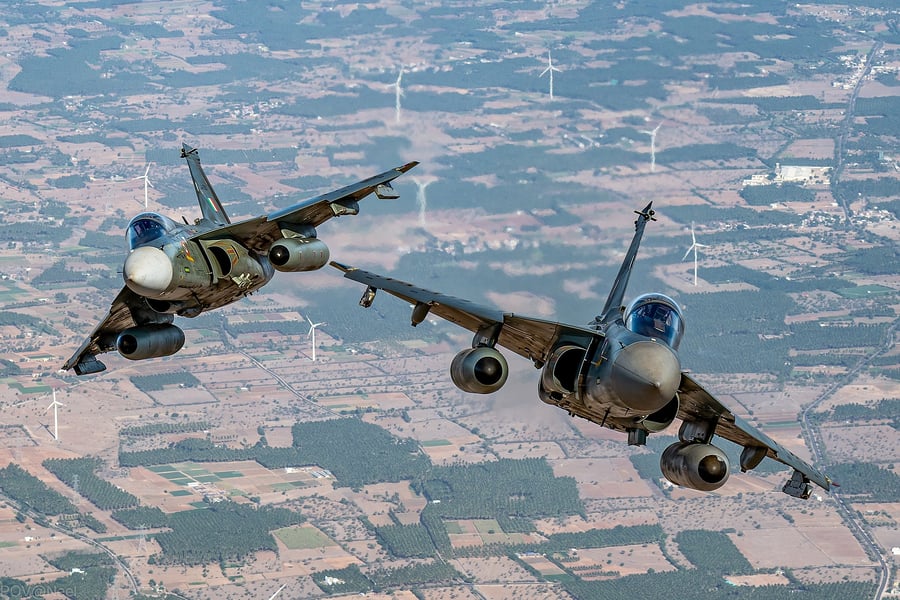

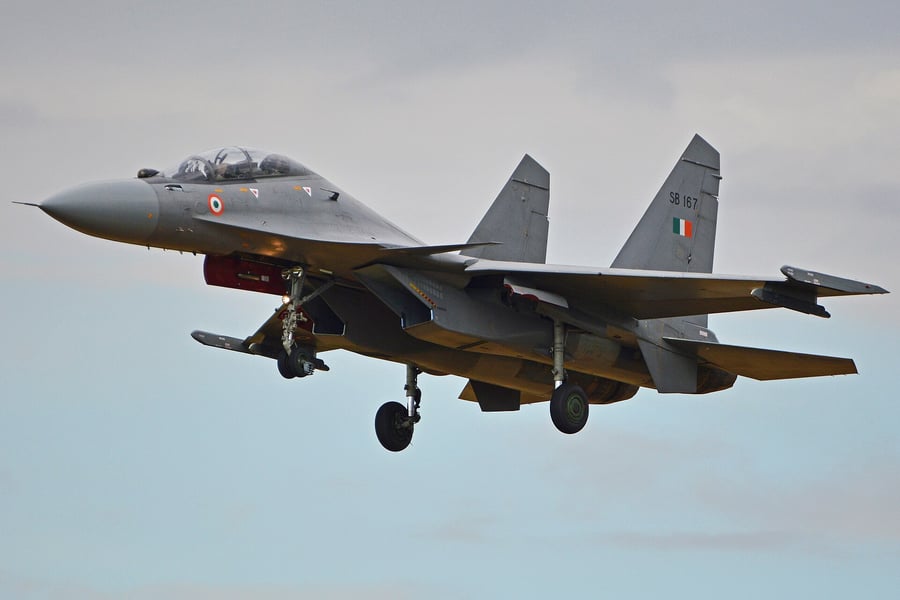
BENGALURU — Thirty Tejas Mk1A fighter jets are finished. They have been built, flown and tested at Hindustan Aeronautics’ plants, and they cannot be handed to the Indian Air Force because the engines that go in them are still in Ohio. That is not a metaphor for HAL’s problem. It is HAL’s problem, stated literally, and it is the reason a company with the largest order book in Indian defence keeps losing ground.
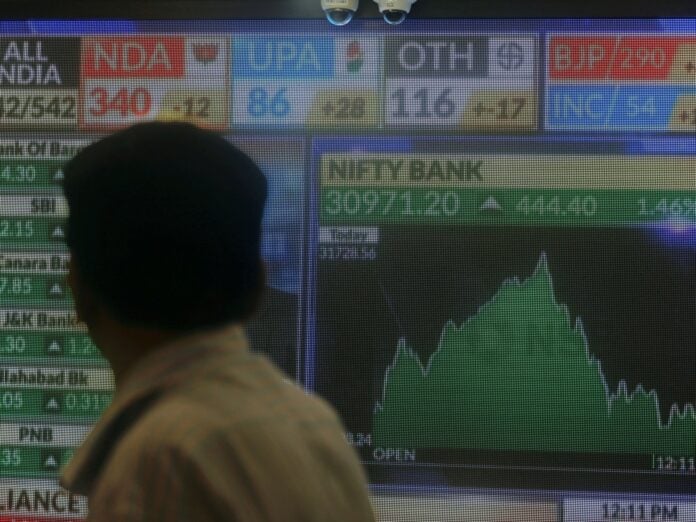
Hindustan Aeronautics closed Monday, August 24, 2026, at ₹4,906 on the National Stock Exchange, down ₹94 or 1.88 percent from Friday’s ₹5,000. It opened at ₹4,990, never traded above that, and spent the session working down to ₹4,858 before closing off the low. On the BSE it settled at ₹4,900. Around 6.5 lakh shares changed hands, a quiet turnover for a stock this size, which is its own kind of signal: nobody was fighting over it.
The context that matters is the calendar. HAL touched ₹5,149.90 on August 17, the highest it has ever traded, and has closed lower in four of the five sessions since. Monday was the sharpest of them. The stock is now 4.7 percent below that high, which sounds mild until you set it against what the company has told the market it will do this month.
HAL Share Price Today: NSE and BSE Close for August 24, 2026
| Measure | NSE · HAL | BSE · 541154 |
|---|---|---|
| Closing price | ₹4,906.00 | ₹4,900.00 |
| Previous close | ₹5,000.00 | ₹4,988.00 |
| Change | -₹94.00 (-1.88%) | -₹88.00 (-1.76%) |
| Open | ₹4,990.00 | ₹4,999.95 |
| Day’s high | ₹4,990.00 | ₹4,999.95 |
| Day’s low | ₹4,858.00 | ₹4,860.00 |
| Volume traded | 6.47 lakh shares | – |
| 52-week high | ₹5,149.90, set on August 17, 2026 | |
| 52-week low | ₹3,479.10 | |
| Market capitalisation | ₹3,28,890 crore | |
| Trailing P/E · Price to book | 35.3 · 8.0 | |
| ROCE · ROE | 32.0% · 24.0% | |
| NSE and BSE closing prices for August 24, 2026. BSE figures are from the exchange’s own quote feed, timestamped 16:00 IST. Valuation ratios and market capitalisation are Screener’s. | ||
The stock is 4.7 percent below its August 17 high and 41 percent above the ₹3,479.10 it traded at a year ago. That second number is the one to hold on to. Almost nothing about HAL’s business has disappointed over those twelve months. Revenue is growing, margins are close to 28 percent, and the order book is the deepest in the sector. The market is not arguing with any of that. It is arguing about when the revenue arrives.
Hindustan Aeronautics Stock Code on NSE, BSE and Global Data Feeds
| Exchange or provider | Code | Notes |
|---|---|---|
| NSE (National Stock Exchange) | HAL | Series EQ. Nifty 50 constituent |
| BSE (Bombay Stock Exchange) | 541154 | Scrip code. Listed March 28, 2018 |
| ISIN | INE066F01020 | Depository identifier. Face value ₹5 |
| Google Finance | NSE:HAL · BOM:541154 | The exchange-prefixed format Google requires |
| Yahoo Finance | HAL.NS · HAL.BO | Suffix marks the exchange |
| The Government of India holds about 71 percent of the equity, a larger stake than it keeps in Bharat Electronics, and a correspondingly thinner free float. | ||
Why HAL Fell Hardest Among the Large Defence Names
Monday was not a defence sell-off. Two of the six large listed names closed higher, and the Nifty 50 gave up only 0.14 percent. HAL fell further than any of them, and it was named alongside MTAR Technologies and Axiscades among the biggest drags on the Nifty India Defence index.
| Company | Close (₹) | Change | From 52-week high |
|---|---|---|---|
| Hindustan Aeronautics (HAL) | 4,906.00 | -1.88% | -4.7% |
| Bharat Electronics (BEL) | 409.00 | -1.21% | -13.6% |
| BEML | 1,915.00 | -1.05% | -15.9% |
| Mazagon Dock Shipbuilders | 2,540.00 | -0.47% | -17.0% |
| Bharat Dynamics (BDL) | 1,368.00 | +0.66% | -17.3% |
| Cochin Shipyard | 1,514.00 | +2.26% | -23.5% |
| Nifty 50 | 24,219.05 | -0.14% | – |
| Sensex | 77,369.11 | -0.22% | – |
| Closing prices for August 24, 2026. The 52-week high column uses each stock’s NSE high over the trailing twelve months. | |||
Read that last column and the day’s move together and the pattern inverts. The stock closest to its high fell the most. The stock furthest from its high, Cochin Shipyard at 23.5 percent below, rose the most. That is not sector risk being repriced. That is profit-taking in the name with the least room left above it. HAL has been the group’s most volatile large name in both directions this month, jumping 5.9 percent on August 6 and 1.8 percent on results day, August 12, before giving most of it back over the past week.
The Order Book Nobody Doubts and the Delivery Date Everybody Does
Hindustan Aeronautics reported its June quarter on August 12 and beat expectations. Revenue from operations came in at ₹5,515 crore, up 14.4 percent, net profit rose about 15 percent to ₹1,581 crore, and the EBITDA margin expanded to 27.7 percent. There is nothing in those numbers to sell.
| Metric | Q1 FY27 | Change year on year |
|---|---|---|
| Revenue from operations | ₹5,515 crore | +14.4% |
| Net profit | ₹1,581 crore | +14.7% |
| EBITDA margin | 27.7% | Expanded |
| Order book (end FY26) | ₹2,54,538 crore | About 7.7 years of revenue |
| FY26 revenue | ₹33,089 crore | +6.8% on FY25 |
| Tejas Mk1A contract | ₹62,400 crore | 97 jets, deliveries from FY28 |
| Q1 results reported August 12, 2026. The revenue-cover figure is our own calculation from the disclosed order book and FY26 sales, not a number the company publishes. | ||
Divide the order book by last year’s sales and HAL is carrying about seven years and eight months of work. Bharat Electronics, on the same arithmetic, is carrying two years and seven months. That gap is the single clearest difference between the two largest defence stocks in the country, and it explains why they are worried about opposite things. BEL is waiting for a ₹30,000 crore order to be signed. HAL has more signed work than it can execute.
The largest single piece of it is the Tejas. In 2025 the Ministry of Defence ordered 97 Light Combat Aircraft Mk1A for ₹62,400 crore, 68 single-seaters and 29 twin-seaters, with deliveries scheduled to begin in FY28 and run for six years. That contract alone is about a quarter of the order book. It is signed, funded and uncontested, and it sits on top of a procurement pipeline that keeps widening: the Defence Acquisition Council cleared a further ₹52,000 crore of proposals in July, including medium-range and very short range air defence work.
It is also stuck. The Mk1A flies on the GE Aerospace F404-IN20, and HAL contracted 99 of those engines in 2021. By the start of April 2026 it had received six. Six of ninety-nine, five years in. GE told ThePrint that the shortfall was down to the war in the Gulf, and said it continues to work with HAL on production schedules. HAL, for its part, has been deducting liquidated damages on every late engine.
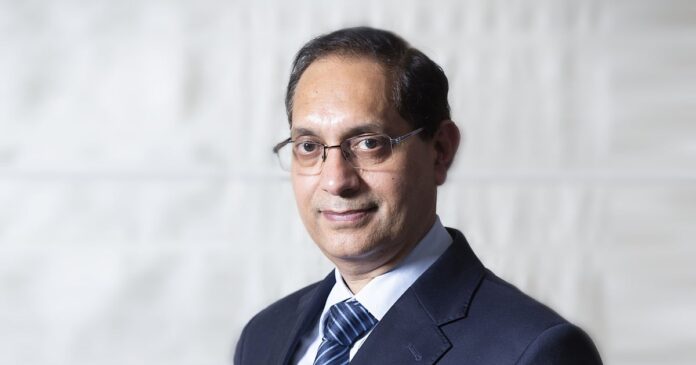
So the aircraft got built anyway. Roughly thirty Mk1A airframes have been manufactured, flown and tested, and are waiting on the ramp for powerplants. HAL chairman and managing director Dr D K Sunil has said deliveries to the Air Force should begin between August and September this year, once engine supply stabilises, with GE due to send twenty F404s in the second half of 2026 and a first-ever twin-engine batch in August.
Today is August 24. There has been no handover announcement.
What HAL Has to Prove Before the Multiple Makes Sense
At ₹4,906 the stock trades on 35 times trailing earnings and eight times book. For a state-owned manufacturer, those are not defensive numbers. They are growth numbers, and they are underwritten by an assumption that the order book converts into revenue on something close to the stated schedule.
That assumption has one visible crack in it, and it is not HAL’s fault. The company cannot make the engines. It cannot compel an American supplier to ship them faster than a contested supply chain allows, and the liquidated damages it collects do not build aeroplanes. What HAL can control, it has done: the airframes exist. Whether they become revenue in this financial year depends on shipments arriving from a company HAL does not own, in a country whose export priorities are currently elsewhere.
Motilal Oswal raised its target on the stock to ₹5,800 from ₹5,500 after the June quarter, keeping a Buy rating, which implies roughly 18 percent upside from Monday’s close. That target, like every other on the street, is built on execution beginning on time.
HAL Share Price: The Levels After a Week of Giving Back
The August 17 high of ₹5,149.90 is the reference point above, and it is a long way up from here. Below, Monday’s low of ₹4,858 is the first line, and beneath that sits ₹4,803.40, the low printed on results day, August 12. Monday’s ₹4,906 is the lowest close the stock has printed since August 5.
| Date | Close (₹) | Change | Volume |
|---|---|---|---|
| August 12, 2026 · Q1 results | 4,995.00 | +1.75% | 29.0 lakh |
| August 14, 2026 | 5,029.90 | +1.72% | 15.4 lakh |
| August 17, 2026 · 52-week high | 5,059.00 | +0.58% | 17.2 lakh |
| August 18, 2026 | 5,099.00 | +0.79% | 12.4 lakh |
| August 19, 2026 | 5,017.00 | -1.61% | 9.8 lakh |
| August 20, 2026 | 4,998.00 | -0.38% | 4.2 lakh |
| August 21, 2026 | 5,000.00 | +0.04% | 7.3 lakh |
| August 24, 2026 | 4,906.00 | -1.88% | 6.5 lakh |
| NSE closing prices and volumes. The ₹5,149.90 intraday high was set on August 17; the highest close of the run was ₹5,099 on August 18. | |||
The volume column is worth a second look. HAL’s slide from ₹5,099 to ₹4,906 has happened on progressively thinner turnover, with Monday’s 6.5 lakh shares less than half the volume of the sessions that carried it to the high. Stocks that fall on light volume are not usually being dumped. They are being left alone, which is what happens when the people who would buy are waiting for a specific piece of news and the people who would sell have already trimmed.
What this article cannot tell you is whether that news arrives in the next five working days. HAL has said August or September. The Air Force has said nothing publicly this month. GE has committed to twenty engines across the second half of the year without breaking that down by month, and the war it blamed in April has not ended. A handover ceremony at Nashik or Bengaluru before September 1 would vindicate the entire ₹3.29 lakh crore valuation. Its absence would not disprove it either, which is precisely the problem with owning this stock right now: the thing everyone is waiting for has no date on it, only a month, and the month is nearly gone.