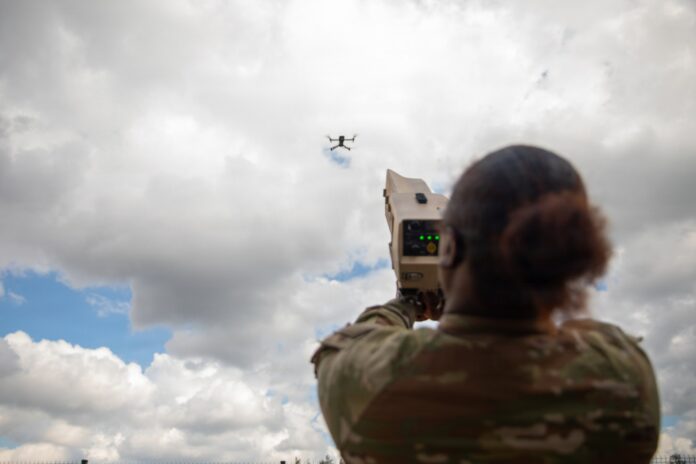

NEW DELHI – The Indian Army will field an electronic warfare system that disables enemy drones without firing a missile at them, if the procurement process that began Thursday runs to completion. The Defence Acquisition Council, under Defence Minister Rajnath Singh, accorded Acceptance of Necessity to ten weapons systems worth a combined Rs 52,000 crore, covering anti-drone technology, man-portable missiles, loitering munitions, naval mines and a stratospheric aircraft designed to behave like a satellite.
The Rs 52,000 crore package, approximately $6.2 billion at current exchange rates, covers systems spread across all three armed services. None represents a signed contract; Acceptance of Necessity is the formal first step in India’s defence acquisition process, authorising technical evaluation and vendor negotiations to begin. What cleared in a single session is unusual for its breadth, spanning from infantry weapons to near-orbit platforms.
The heaviest focus is on the Army, which received six separate approvals, three of them addressing the same strategic problem from different altitudes: the rapid proliferation of unmanned aerial threats on modern battlefields. AKASH TARANG, an electronic warfare system, is designed to jam or disable enemy drones rather than shoot them down, making it more sustainable against swarm attacks where conventional missiles would be quickly exhausted. V-SHORADS, the Very Short Range Air Defence System, uses multi-spectral sensing to detect and engage aerial threats at close range with improved resistance to enemy countermeasures. MRSAM, the Medium Range Surface-to-Air Missile system, covers threats at greater distances, providing an air defence envelope against what the Ministry of Defence describes as a "variety of stand-off aerial threats."
Together, the three form a layered air defence architecture: electronic warfare at close range, V-SHORADS to engage what penetrates the first layer, MRSAM covering the medium-range envelope above both. India’s military has been studying drone warfare closely since unmanned systems reshaped ground combat in the Russian operation in Ukraine and in the 2023 Azerbaijani offensive in Nagorno-Karabakh, and each of the three systems reflects a different lesson from those theatres.
The remaining three Army approvals address ground combat. Man Portable Anti-Tank Guided Missile systems, abbreviated MPATGM, give infantry a lightweight weapon against armoured vehicles without requiring vehicle-mounted launchers, enhancing what the ministry calls the "potential of the Infantry to counter mechanised threats." Active Protection Systems for tanks intercept incoming projectiles before impact, improving survivability against anti-tank missiles that have destroyed armour at scale in recent conflicts. The Jet-Based Kamikaze Drone System adds an offensive loitering munition to the Army’s arsenal at lower per-unit cost than comparable imported systems currently in service.
The most technically distinctive single approval is the Fixed-Wing High Altitude Pseudo Satellite, or FW-HAPS, for the Indian Air Force. Flying at roughly 18 to 20 kilometres altitude on solar power, the platform operates in the stratosphere, above weather, above commercial aviation, and above the effective ceiling of most air defence systems, for extended periods. It provides persistent intelligence, surveillance and reconnaissance coverage, telecommunications relay and remote sensing capability at a fraction of the cost of an orbital satellite. Unlike a satellite, it can be repositioned within hours, redirected on operational demand, and recovered without a launch vehicle. For a country that has invested heavily in satellite-based ISR but faces limitations in how quickly those assets can be retasked, FW-HAPS fills a genuine operational flexibility gap.
The Navy received three approvals. Multi Influence Ground Mines deny adversary vessels access to defined sea areas by combining acoustic, pressure and magnetic detection signatures, reducing the effectiveness of conventional minesweeping. Naval Shipborne Unmanned Aerial Systems give ships over-the-horizon situational awareness without a separate platform. A Land-Based Testing Facility for electric propulsion motors supports the service’s shift toward electric drive in future platforms, a technology that reduces acoustic signature and simplifies long-term maintenance.
An Acceptance of Necessity authorises a process to proceed, not a purchase. Each of the ten programmes will now move through technical evaluation, field trials and price negotiations before a contract is signed, a sequence that for complex systems typically spans several years. The per-system breakdown of the Rs 52,000 crore envelope has not been disclosed, and which vendors have been shortlisted for each programme has not been announced.
Thursday’s session fits a broader pattern of accelerated spending. The DAC authorised Rs 67,000 crore in a single session in August 2025, and the fiscal year 2025-26 closed with 55 proposals worth Rs 6.73 lakh crore approved and Rs 2.28 lakh crore in contracts signed, both records for a single financial year. Russia pitched India at the St. Petersburg forum in June on the Su-57 fighter as part of a full manufacturing partnership, one illustration of how actively New Delhi is being courted for high-end defence cooperation from multiple directions. A separate drone border conflict unfolding between Afghanistan and Pakistan adds regional context for why India’s investment in counter-drone capability carries urgency beyond the purely theoretical. What Thursday’s approvals do not specify is which systems will be treated as highest priority within the budget envelope, or when the first units are expected to reach operational readiness.