
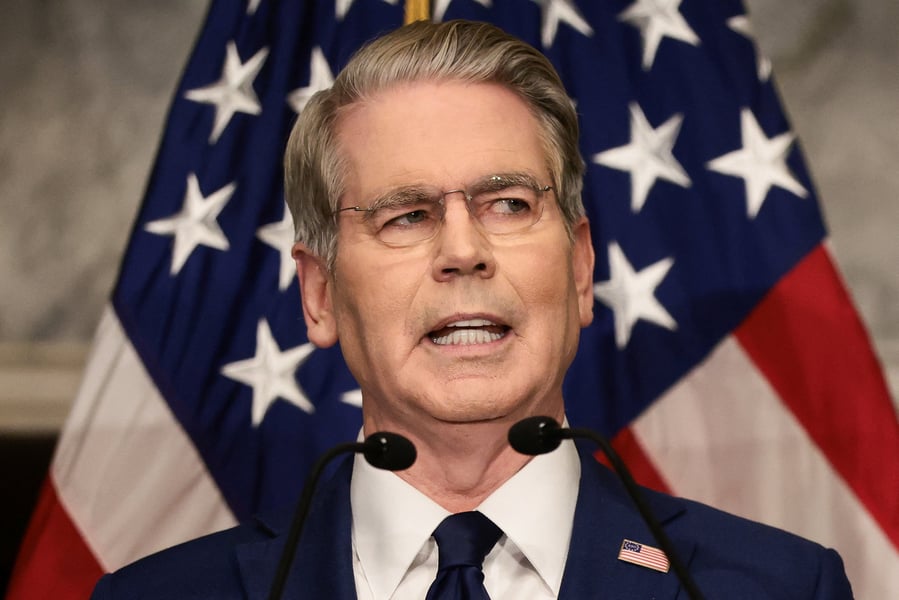
WASHINGTON – The Treasury Secretary called it “the greatest coordinated economic isolation in the history of the world.” The Iranian foreign minister called it nothing new. Both statements arrived on the same Monday, and the distance between them may be the most accurate measure yet of how the United States expects the economic war on Iran to end.
Treasury Secretary Scott Bessent unveiled what the Trump administration is calling Operation Economic Outcast on Monday, targeting 60 entities, vessels, and individuals across the UAE, Hong Kong, China, Singapore, and Switzerland with new designations. The announcement hit five sectors simultaneously: digital assets, technology, gold, aviation, and shipping. The explicit aim, Bessent said, is to “sever every economic lifeline” that Iran still has access to.
“No one is above the reach of US sanctions,” Bessent said. “Around the globe, our objective is to sever every economic lifeline.” The language was a direct escalation from earlier rounds, which targeted Iranian oil tankers and specific financial intermediaries. This set of designations reaches into the commercial fabric of three of the world’s largest trading economies, with China, Singapore, and the UAE among the primary targets, and the implicit threat that more will follow.
The Trump administration has been building toward this moment since February, when Israeli and American air operations began against Iran’s nuclear and military infrastructure. A naval blockade on Iranian ports followed in April, tightening the oil export valve but proving insufficient on its own. India’s shift to Russian crude accelerated as Hormuz Strait disruptions cut Iranian supply, but Iran continued to move oil through third-party networks, the exact networks Bessent is now trying to designate into nonexistence.
“We are giving everyone the opportunity to remedy bad behaviour,” Bessent said. The phrase was directed at trading partners who have continued commercial dealings with Iran despite earlier warnings. It was not lost on those partners that “remedy” has a specific meaning in Treasury’s vocabulary: you stop doing business with Iran, or you stop doing business in dollars.
China is the elephant that went unmentioned by name. Beijing buys the largest share of Iranian crude that still moves to market, through a network of independent refiners, opaque payment systems, and yuan-denominated transactions specifically designed to avoid the dollar-clearing infrastructure that gives US sanctions their teeth. Adding Hong Kong entities to the designation list is a pointed signal that narrows the corridors available to Chinese firms moving money for Iranian oil even when the crude itself flows through a different route.
Iran’s Foreign Ministry was contemptuous. Esmaeil Baghaei, the ministry’s spokesman, dismissed the measures as “an assertion of extraterritorial sovereignty” that reflected the same pattern Tehran has seen from Washington for decades. Mohsen Rezaei, secretary of Iran’s Supreme National Security Council, went further: “Any country that takes part in imposing economic restrictions on us will be regarded as an enemy.” The statement was directed at smaller nations still weighing compliance; it was also a clear message to the UAE, which on August 19 imposed an indefinite trade embargo on Iran, a move Riyadh and Abu Dhabi described as aligning with the international community but which Tehran described as an act of hostility.
The Pentagon weighed in alongside the Treasury announcement. Defense Secretary Pete Hegseth stated Iran had “no choice” but to return to nuclear negotiations, and added a line that drew attention in several European capitals: “If we need to use kinetic strikes, we’ll use them.” The phrase combined economic pressure and military threat in one sentence, which is how the administration has consistently framed its Iran-Israel war posture. Whether it moves the calculation in Tehran is a separate question, because Iran’s economy has been under US sanctions for much of the past two decades, and its leadership has repeatedly concluded that survival under pressure is preferable to the concessions Washington requires.
The Iran rial’s collapse to a record 2 million per dollar last week under the weight of earlier sanctions rounds suggests the pressure is registering in the civilian economy even when Tehran’s officials publicly dismiss it. That gap between official confidence and market reality is where Bessent is betting the campaign will produce results.
What Operation Economic Outcast cannot resolve is a structural problem with the US sanctions architecture: the dollar is still dominant, but it is not the only currency in which oil trades. Since 2022, Russia, China, and India have steadily expanded yuan, rupee, and ruble payment corridors for commodity transactions, corridors built precisely because the possibility of secondary sanctions was understood long before Monday’s announcement. How much of Iran’s remaining oil revenue flows through those corridors, and how much still requires dollar-adjacent infrastructure that US designations can actually reach, is not a number Bessent disclosed and is not one Washington reliably knows.
The administration’s confidence that isolation will work rests on the belief that no country, however large, can afford to be shut out of the US financial system entirely. That belief is correct for most countries and for most firms. Whether it is correct for China, which has been running a parallel exercise in financial decoupling from the dollar for over a decade, is the question that makes this “economic D-Day” more like the opening of a campaign than a decisive battle. The answer will not come from Washington. It will come from Beijing.