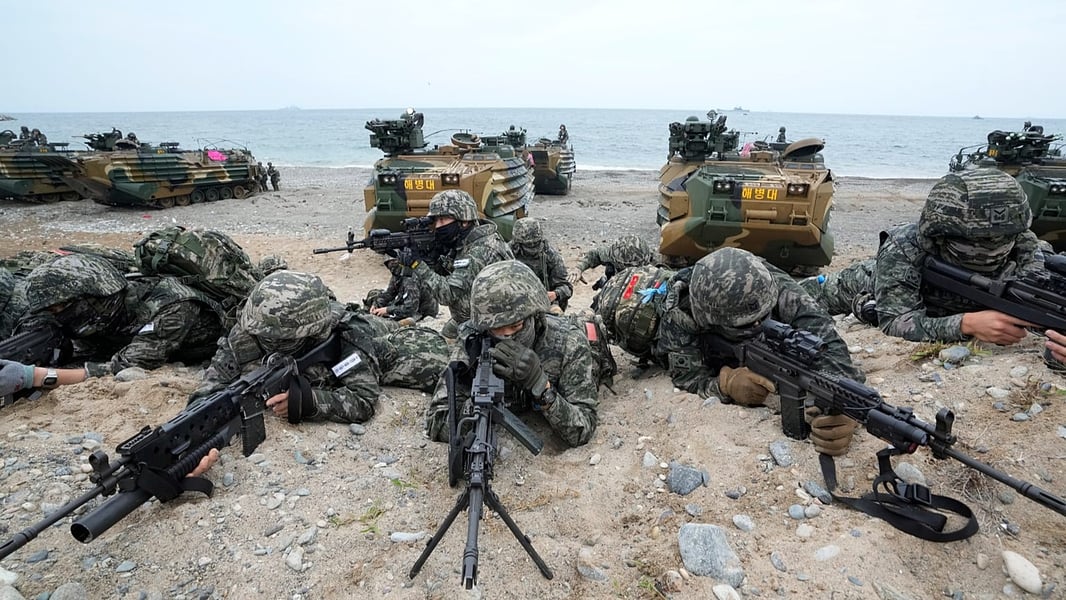

SEOUL — For the commanders of South Korea’s marine forces, June brought confirmation of something they had quietly feared. The United States Marine Corps had formally told Seoul it could not send forces to the Ssangyong exercise in September, the biennial amphibious landing drill that for years has served as the physical proof of the US-South Korea alliance’s readiness to fight on Korean soil. The Iran war had come for the exercise budget.
South Korean Marine Corps spokesman Han Seung-jeon disclosed the cancellation on Monday. “The US Marine Corps formally notified our forces in June that its ability to deploy forces during this year’s Ssangyong exercise would be constrained due to the situation in the Middle East,” he said, confirming what American commanders had apparently known since spring. Rescheduling discussions were underway, Seoul added. No new date has been set.
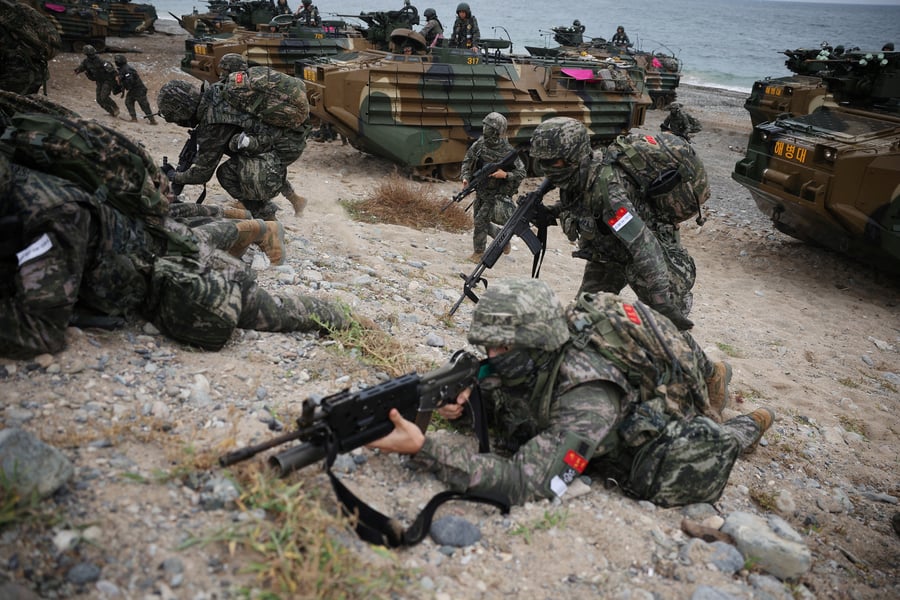
The Ssangyong drills are not a symbolic exercise. They simulate a contested amphibious assault, with marines from both countries rehearsing beach landings under combined command, deploying the kind of forcible-entry capacity that any credible defence of the peninsula would eventually require. The exercise is among the largest of its kind in the Pacific and has historically involved thousands of troops and dozens of naval and air assets. Its cancellation does not end US-South Korea military cooperation, but it removes a training cycle that cannot be replicated by a command-post alternative. It comes at a moment when Seoul cannot afford the ambiguity.
This is the second significant reduction in joint military activity in recent weeks. President Donald Trump last week ordered the separate Ulchi Freedom Shield exercise, an annual war-game simulating command decisions in a Korean Peninsula conflict, cut from eleven days to five, according to Al Jazeera. The White House cited costs. Trump added his own framing: South Korea, he suggested, had shown insufficient willingness to contribute to the Iran campaign that has consumed American military resources since the conflict began. Seoul has declined to commit forces to operations against Iran, a position it regards as both legally and politically sustainable. Washington appears to be recalibrating what that restraint costs in alliance commitments.
The dual rollback has not passed unnoticed in Pyongyang. North Korea launched ten ballistic missiles last week in what the South Korean military assessed as a deliberate provocation, timed to coincide with Trump’s announcement curtailing Ulchi Freedom Shield. The Kim regime had taken measure of the diminished deterrence posture. Trump has maintained a tone of deliberate warmth toward Kim Jong-un in recent weeks. He estimated at a press appearance that Kim possesses 57 nuclear warheads. Seoul’s assessment places that number between 80 and 120. The discrepancy reflects a pattern of downward political arithmetic that sits poorly with South Korean planners who need their principal ally to share the same baseline understanding of what they are deterring.
The costs of the Iran war are already being felt across multiple allied balance sheets. Iran war sanctions and the China détente have upended trade relationships across East Asia. For South Korea, where nearly all energy supplies arrive by tanker, the downstream effects of Saudi Arabia’s Hormuz oil talks carry direct industrial consequences. The region that the United States built its post-Cold War military posture around protecting is watching Washington make choices that systematically prioritise the Middle East over the Pacific.
The Iran conflict has produced what the Pentagon describes as “constraints on force availability,” a phrase the US-Iran war has rendered a near-universal explanation for American capability shortfalls across allied relationships. Applied to the Marine Corps, the translation is straightforward: expeditionary assets committed to Persian Gulf operations cannot simultaneously rotate into training exercises in the Western Pacific. The US military is large enough to fight the Iran war. It is not, at this force level, large enough to sustain its pre-war training tempo in East Asia at the same time.
What Seoul has not yet received is any clear statement of how Washington intends to compensate for the lost exercises. Extended deterrence commitments, specifically the assurance that a US nuclear umbrella covers the peninsula, require constant visible maintenance to remain credible to an adversary calculating whether American attention has drifted far enough to create an opening. Trump has provided neither the reassurance nor the visible maintenance in recent weeks. The consultation on rescheduling, which could easily extend into next year, leaves South Korean planners calibrating their readiness against an ally whose Pacific commitments are operating, at this moment, below the levels the alliance was designed to require.
Whether that gap narrows depends on a question Seoul cannot answer from Seoul: when does the Iran war end, and what is left of America’s Pacific military posture when it does.