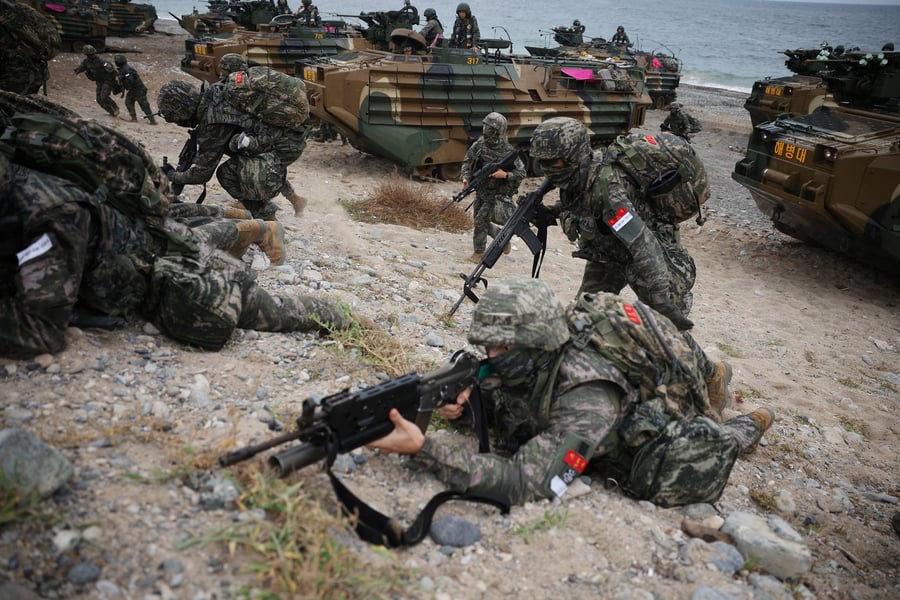

SEOUL — For the first time in the Ssangyong exercise’s two-decade history, South Korean marines will carry out their signature amphibious landing drills without American troops beside them. The reason, Seoul now confirms officially, is that the United States Marine Corps does not have the forces to spare: the Iran war has taken them.
South Korea’s Marine Corps said Monday that the United States had notified it in June that the biennial Ssangyong amphibious exercise, scheduled for this September, was being cancelled due to force constraints stemming from the ongoing conflict in Iran. The spokesperson, Han Seung-jeon, said South Korea would conduct its own separate amphibious drills, a quiet acknowledgment that the alliance’s shared training calendar, long a fixture of deterrence on the peninsula, is bending under the weight of Washington’s other wars.
The Pentagon declined to comment.
The Ssangyong cancellation is not the first sign of strain. Earlier this month, the annual Ulchi Freedom Shield exercise, the largest joint training event on the Korean calendar, was trimmed from eleven days to five. The Trump administration cited cost concerns and what it described as the message sent to North Korea, characterizing the extended format as inappropriate and hostile to diplomatic efforts. The cutback drew subdued but pointed concern from South Korean officials, who have long viewed the exercises as the most visible signal of American commitment to peninsula defense.
Seoul’s unwillingness to commit forces to Iran operations, a position it has maintained throughout the 2026 conflict, adds a further layer of diplomatic complexity. South Korea told Washington it would not participate in the Iran campaign, citing its own regional threat environment. That refusal has made the alliance’s logistical strains more visible: the burden of Iranian deployments falls entirely on American forces, leaving fewer available for Asian commitments.
The timing has not escaped North Korea’s attention. Pyongyang fired ten short-range ballistic missiles in the days following the Ulchi Freedom Shield cutback, according to South Korea’s Joint Chiefs of Staff, a pattern of calibrated provocation timed to perceived gaps in allied readiness. Sputnik reported that North Korea’s Foreign Ministry had already characterized the annual exercises as a “rehearsal for aggressive war,” language that intensifies whenever Washington appears distracted.
Trump, who met Kim Jong-un three times during his first term and has maintained an unusual personal cordiality toward the North Korean leader, has publicly estimated Pyongyang’s nuclear arsenal at 57 warheads. South Korean government assessments put that figure significantly higher, between 80 and 120, a range that analysts say almost certainly undercounts the pace of North Korean weapons production in recent years.
Neither side has said publicly when, or whether, the Ssangyong exercise might be rescheduled. Han Seung-jeon said the two militaries were consulting on a potential resumption but gave no dates. The exercise, conducted every two years since the early 2000s, involves beach landings on the Korean coast, the kind of combined-force rehearsal that is difficult to replicate without the US Marine Corps’s specialized airlift and amphibious assault ships.
What South Korea now faces is a readiness calculation it has not had to make in a generation: how much deterrence is generated by an alliance where the senior partner is openly managing its forces across multiple simultaneous conflicts. For decades, the presence of 28,500 American troops on South Korean soil, backed by regular joint exercises, was itself a deterrent. The exercises signaled not just capability but intention: that the United States would be present and ready if needed.
That signal is becoming harder to send clearly. The Iran-Israel war has consumed Marine Expeditionary Unit rotations, naval assets, and air power that would ordinarily be available for Pacific contingencies. American military planners have said publicly that the service is managing commitments across the Middle East, the Western Pacific, and the Ukraine war, with a force structure designed for fewer simultaneous demands.
South Korea’s response has been characteristic of its political style: measured public language, urgent private conversations. Seoul has not publicly criticized Washington’s decision, framing the cancellation as a scheduling adjustment. Behind that restraint is a more difficult reckoning with whether its defence posture, built around the assumption of American forward presence and rapid reinforcement, holds in a world where American military attention is finite.
North Korea, meanwhile, has continued to press. Beyond the ballistic missiles, Pyongyang has accelerated its nuclear weapons production program and publicly debated the doctrinal question of when preemptive nuclear use becomes justifiable. Kim Jong-un has framed the expanding arsenal as a deterrent against exactly the scenario South Korea is now navigating: an America too stretched elsewhere to mount a decisive response.
The United States has not changed its treaty commitments to South Korea. The mutual defense treaty remains in force, and American troops remain stationed in the country. What has changed is the visible texture of that commitment, the exercises that make the treaty legible to soldiers, planners, and adversaries alike.
Whether South Korea’s solo amphibious drills this September will carry the same deterrent weight as a combined landing with American marines is an unanswered question. It is one that planners on both sides of the demilitarized zone are assessing carefully, and in very different directions.