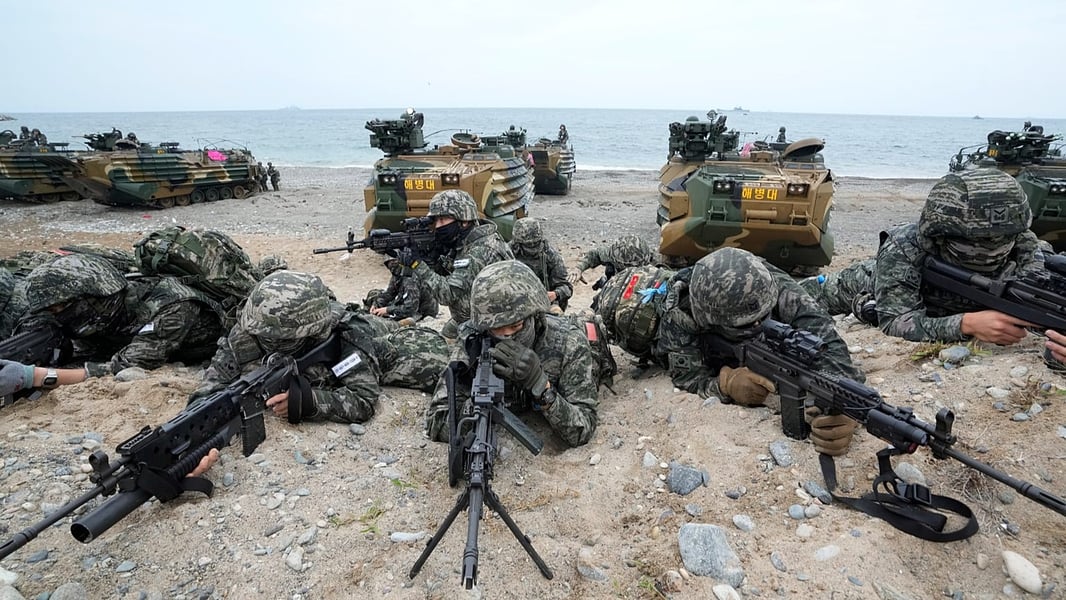

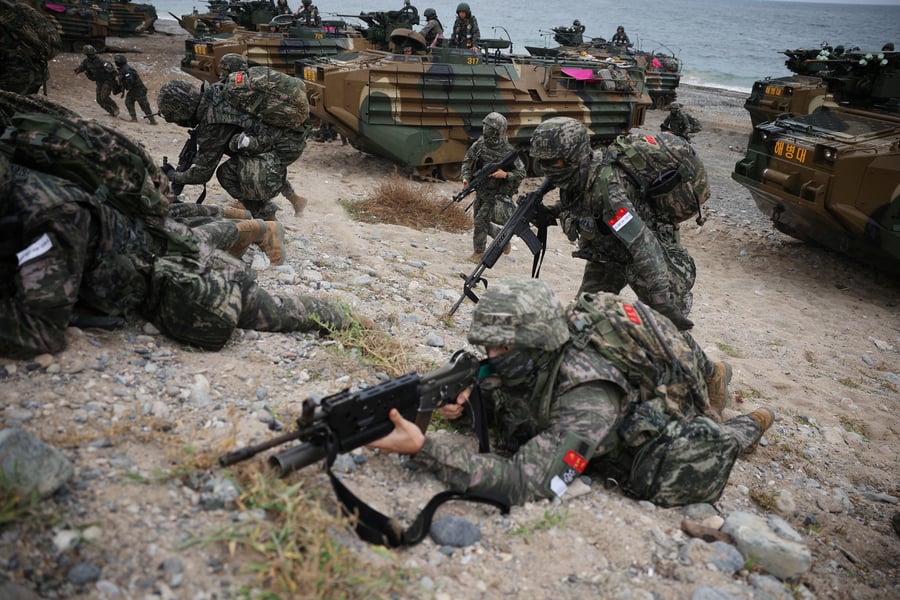
SEOUL — The United States Marine Corps notified South Korea in June. Quietly. No announcement. The Ssangyong exercises — the biennial amphibious landing drills that rehearse exactly the kind of combined military assault that defence of the Korean Peninsula would require — would not happen this September. The reason given was blunt: American forces were constrained. The Iran war had consumed them.
South Korea held the news for weeks before a Marine Corps spokesperson confirmed the cancellation publicly. “The US Marine Corps formally notified our forces in June that its ability to deploy forces during this year’s Ssangyong exercise would be constrained due to the situation in the Middle East,” the spokesperson said. Seoul and Washington were “continuing consultations” on whether the drills could be rescheduled. Neither side offered a timeline.
The Ssangyong cancellation landed on top of a contraction already underway. Earlier this year, President Trump ordered the Ulchi Freedom Shield exercises — the annual combined command-and-control drills — cut from eleven days to five. Trump’s stated rationale was cost and diplomacy. The exercises were expensive, he said, and sent an “inappropriate and hostile” signal to North Korea. He stressed the importance of maintaining his personal relationship with Kim Jong-un. The Pentagon offered no public detail on whether five days would sustain the readiness levels the original eleven were designed to produce.
Together, the two contractions amount to something more than a scheduling adjustment. Ssangyong exists for one specific reason: to demonstrate and rehearse a combined amphibious assault capability that would matter in a full-scale Korean contingency. Cancelling it tells Pyongyang — and Seoul — something about how the United States is currently prioritising its military commitments.
North Korea has not publicly reacted to the Ssangyong cancellation. Pyongyang rarely provides real-time commentary on exercises it monitors intensively. What it has done, in the years since the Hanoi summit collapsed in 2019, is accelerate its nuclear programme at a pace that has alarmed South Korean military planners. Seoul’s intelligence services estimate North Korea now possesses between 80 and 120 nuclear warheads. Trump, when pressed on the figure publicly, said 57. The gap between those two numbers reflects something more fundamental than a difference in arithmetic.
The Trump administration’s relationship with Seoul has been marked by recurring tension over burden-sharing — the question of how much South Korea pays for the US military presence on the peninsula. Trump has periodically threatened to reduce the American commitment if Seoul does not contribute more. The Iran war has introduced a different kind of burden-sharing problem: one where the constraint is not financial but operational. Marines and landing craft assigned to the Ssangyong exercise were needed elsewhere in June, and no one has specified when they will be available for Korea again.
The Iran war is the force behind the Ssangyong cancellation, but it is also what makes the cancellation more significant than it might otherwise appear. Iran’s capacity to draw American military attention has been a structuring fact of US foreign and defence policy for decades. What the current conflict has done is convert that gravitational pull into a concrete subtraction: units and vessels committed to Middle Eastern operations that were, in other planning cycles, available for Pacific exercises. Seoul is now calculating its security posture without knowing how large that subtraction is, how long it will last, or what conditions would reverse it.
The United States has declined to offer those details publicly. The Pentagon did not respond to South Korea’s disclosure of the cancellation — a silence that, like Seoul’s initially quiet handling of the news, reads as deliberate. Both governments are managing information to avoid a public confrontation that would serve neither. But it does not answer the underlying question, which is whether the US military capacity underwriting the Korean alliance is the same capacity it was before the Iran war began.
South Korea’s own defence posture has strengthened considerably in recent years. Seoul has expanded domestic weapons production, developed longer-range strike capabilities, and maintained one of the most capable conventional militaries in the region. The US alliance matters most not as a substitute for South Korean capability but as a multiplier — the combined force projection that no single partner could replicate alone. It is that multiplier that the Ssangyong cancellation calls into question.
The United States has made security commitments across the Indo-Pacific — to South Korea, Japan, Taiwan, the Philippines, and Australia — that were designed for a strategic environment in which American forces were not simultaneously absorbed by a major Middle Eastern war. They are now in that environment. The Iran conflict’s demand on American military resources, alongside US sanctions on Iran that have escalated the pressure campaign, has created a situation where Pacific allies are learning the real limits of commitments written before the Middle East became Washington’s consuming military priority.
Whether Ssangyong will be rescheduled for later in the year, pushed to 2027, or effectively suspended until the Iran situation resolves is the question Seoul is sitting with. None of the answers Washington has provided so far are specific enough to settle it. The exercise rehearses a scenario that has not happened and that everyone hopes will not happen. Its cancellation does not create a crisis on the Korean Peninsula. It creates a signal — and signals on the Korean Peninsula are read with extreme care by everyone who lives near one.