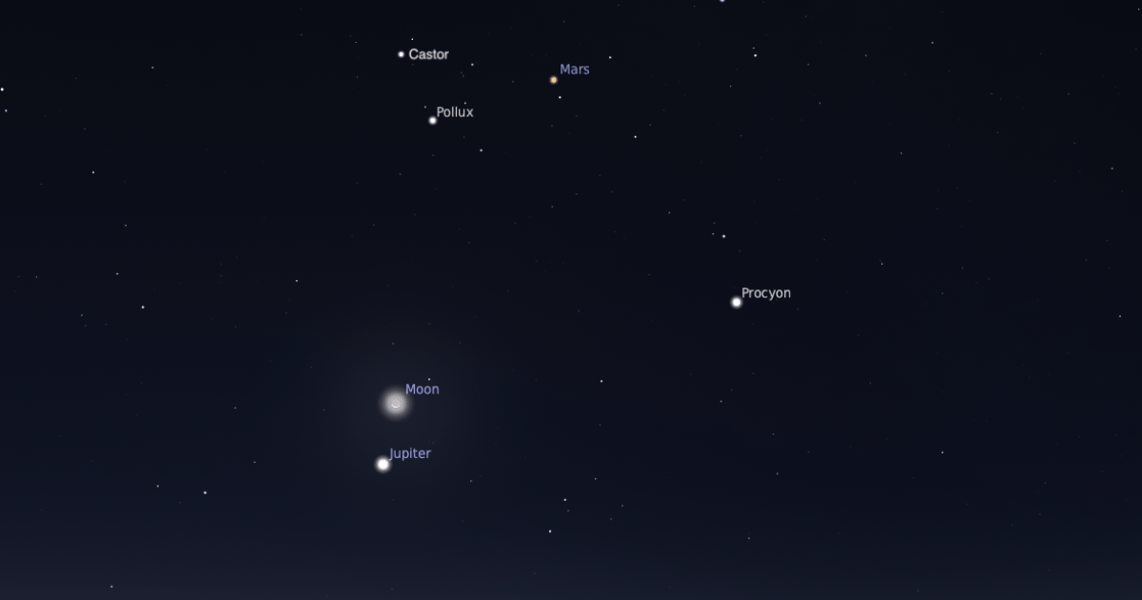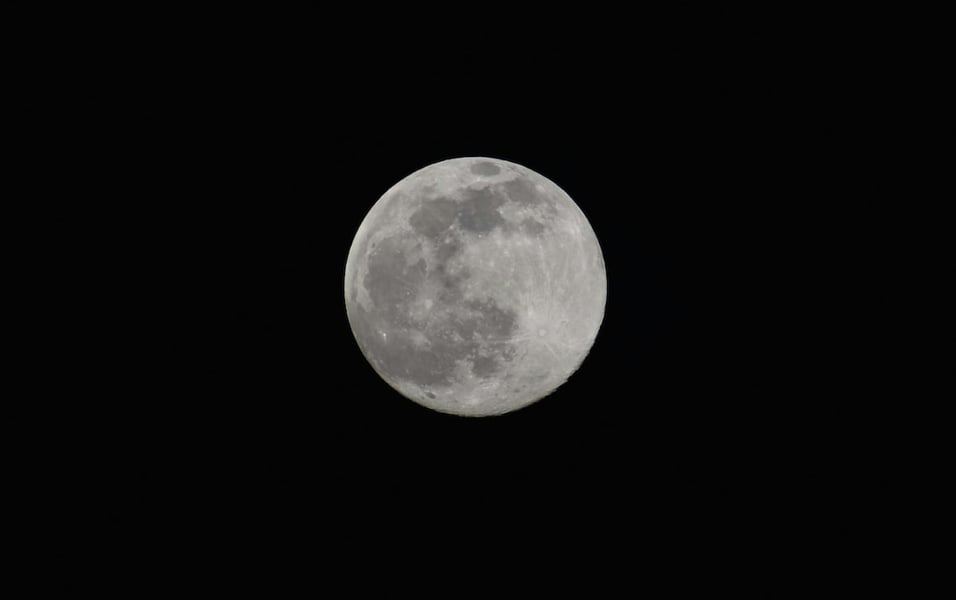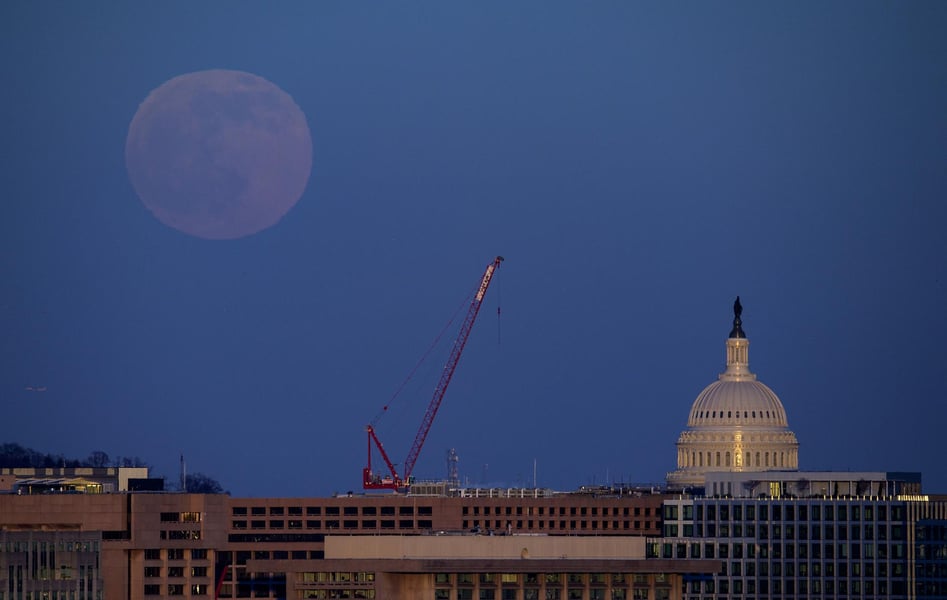

There is one night in every lunar month when the moon looks its best to the naked eye and its worst through a lens, and this is it. The moon phase today, August 26, 2026, is a Waxing Gibbous, about 95 per cent illuminated at midnight UTC and 98.6 per cent by the end of the day, fourteen days into the cycle that opened with the total solar eclipse of 12 August. The shadow line is finished. At 160 degrees of elongation from the sun by midday the terminator has run off the western limb, and with it every long shadow that made a crater rim look like a crater rim. What is left is not a landscape. It is a map, and the only thing on it with any contrast is the bright splash-work thrown out of two young impact craters roughly a billion years ago. That matters tonight in a way it will not matter again for a month, because in fifty-two hours the moon disappears into the Earth’s shadow, and the eclipse that does it is a great deal deeper than the word partial suggests. The NASA visualisation of the 27 to 28 August event puts 96.3 per cent of the lunar disc inside the umbra at greatest eclipse. All but a sliver of the southern limb goes copper.
| Quantity | 00:00 UTC | 12:00 UTC | 24:00 UTC |
|---|---|---|---|
| Illumination | 95.2% | 97.1% | 98.6% |
| Moon age since 12 Aug new moon | 13.3 days | 13.8 days | 14.3 days |
| Distance from Earth | 398,007 km | 396,367 km | 394,641 km |
| Apparent diameter | 30.06′ | 30.18′ | 30.31′ |
| Elongation from the sun | 154.7° | 160.4° | 166.2° |
| Declination | −20.30° | −18.09° | −15.67° |
| Ecliptic longitude | Aquarius 7.2° | Aquarius 13.4° | Aquarius 19.6° |
| Waxing gibbous throughout, and in Aquarius throughout. There is no sign change today; the moon reaches Pisces at 19:46 UTC on 27 August. Illumination climbs 3.4 percentage points across the day, which is why figures published for different time zones disagree. | |||
The distance figure in that table is the one to watch this week. The moon is falling away from the apogee it reached on 22 August at roughly 140 kilometres an hour, and by the moment of the full moon on Friday it will be 390,397 km out. That is not a supermoon by any definition, but it is close enough that the eclipsed disc will look appreciably larger than it did a week ago.
What the moon phase today actually gives you to look at
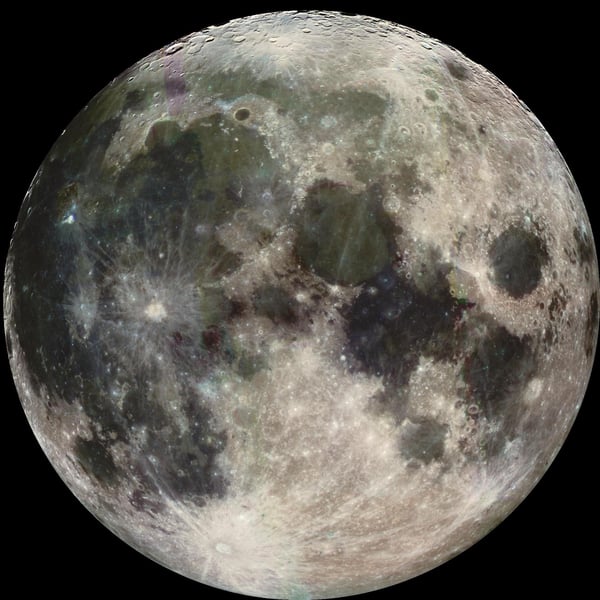
Forget the terminator. At this phase the sun is nearly overhead across the whole visible hemisphere, which kills relief and reveals something else entirely: albedo, the raw difference in how brightly one patch of rock reflects light compared with the patch beside it. Two features dominate. Tycho, in the southern highlands, is the youngest large crater on the near side, and the rays of pulverised rock flung out of it reach more than fifteen hundred kilometres across the disc. Copernicus, up in Oceanus Procellarum, does the same thing on a smaller scale. Both are close to invisible at half moon and unmissable now. Aristarchus, on the western limb, is the brightest single spot on the moon and is worth finding for that alone. The instrument advice inverts too. A telescope at high magnification gives you a flat white glare and a headache. Binoculars, braced against a wall or a fence post, frame the whole disc and let the ray systems read as the pattern they are. If you own a moon filter or a polariser, tonight is the night it earns its cost.
Moonrise and moonset times for August 26, 2026
Times are local and calculated for the city centre. The last column carries the argument, and this is the second-to-last day it points the way it does.
| City | Moonrise | Moonset | Above the horizon | Change on 25 Aug |
|---|---|---|---|---|
| London | 19:30 | 04:59 | 9h 29m | +59 min |
| New York | 19:01 | 05:34 | 10h 33m | +39 min |
| Tokyo | 17:19 | 03:51 | 10h 32m | +30 min |
| Delhi | 17:50 | 04:53 | 11h 03m | +22 min |
| Dubai | 17:45 | 05:00 | 11h 15m | +19 min |
| Johannesburg | 16:24 | 05:54 | 13h 30m | −22 min |
| Sydney | 15:37 | 05:42 | 14h 05m | −29 min |
| Moonset falls after midnight, so it belongs to the following calendar morning. London and New York are given in British Summer Time and Eastern Daylight Time respectively. The final column is the change in time above the horizon against 25 August, and its sign still flips at the equator. | ||||
London gains fifty-nine minutes of moon tonight, the largest single-night swing of the entire cycle so far, and the gains keep growing: sixty-three minutes tomorrow, sixty-five on Friday. Sydney loses twenty-nine and Johannesburg twenty-two. On 25 August the same table showed London at plus fifty-three and Sydney at minus twenty-four, so the divergence is itself accelerating.
The moon stops being a southern object on Saturday
For a fortnight the moon has belonged to the southern hemisphere. Its declination has been below the celestial equator since 15 August, which is why Sydney has been holding it above the horizon for hours longer than New York every night. That ends at 17:14 UTC on 29 August, when the declination crosses zero going north.
| Date | New York | Sydney | Sydney minus New York |
|---|---|---|---|
| 25 August | 9h 54m | 14h 35m | 4h 40m |
| 26 August (today) | 10h 33m | 14h 05m | 3h 32m |
| 27 August | 11h 15m | 13h 33m | 2h 18m |
| 28 August (full moon, eclipse) | 12h 00m | 12h 59m | 0h 59m |
| 29 August | 12h 45m | 12h 24m | −0h 21m |
| 30 August | 13h 30m | 11h 49m | −1h 41m |
| Computed from each rise to the next setting. The 29 August row is the first negative number of the cycle. It arrives because the moon’s declination crosses the celestial equator at 17:14 UTC that day, ending a fortnight in the southern sky. | |||
The 29 August row in that table is the interesting one, and it is the first negative number in a fortnight. New York overtakes Sydney by twenty-one minutes, and by the 30th the gap has opened to an hour and forty-one the other way. Nothing about the moon’s brightness or distance produces that. It is geometry alone, and it reverses completely every 13.6 days.
Friday’s eclipse is not an ordinary partial
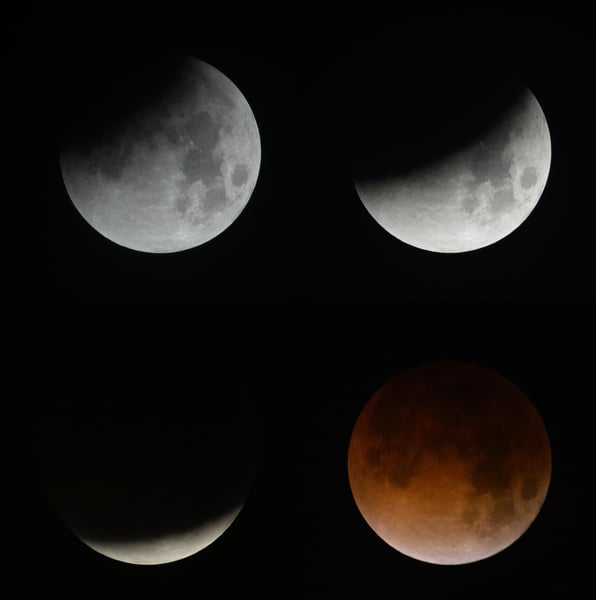
A partial lunar eclipse usually means a bite taken out of one limb, noticeable if you are told to look and easy to miss if you are not. This one is different. The canonical contact times published by Fred Espenak give an umbral magnitude of 0.93187, which is the fraction of the moon’s diameter that enters the dark central shadow. That is where the two numbers in circulation come from, and they are both right. Take 0.932 of the diameter, work out how much of a circle that covers by area rather than by width, and you get 96.3 per cent, which is the figure NASA publishes and the one our astrology desk used when it previewed the eclipse in Pisces last weekend. Diameter and area are simply two ways of measuring the same shadow. The practical consequence is that all but a thin crescent of the southern limb will glow the same copper as a total eclipse, with a hard bright edge that no total eclipse has.
| Contact | UTC | What happens |
|---|---|---|
| P1, penumbral begins | 01:23 | The moon enters the outer shadow. Almost nothing is visible |
| U1, partial begins | 02:33 | The umbral bite starts on the northern limb |
| Greatest eclipse | 04:13 | 96.3 per cent of the disc is inside the umbra and coppery |
| U4, partial ends | 05:52 | The last of the umbra leaves the disc |
| P4, penumbral ends | 07:02 | The event is over |
| Umbral magnitude 0.93187, penumbral magnitude 1.96645, gamma 0.49644. The partial phase runs 3 hours 18 minutes 48 seconds. This is eclipse 29 of the 82 in Saros series 138. | ||
Who can actually see it
This comes down to one number: at greatest eclipse the moon stands overhead near 64.5 degrees west, which is over the western Atlantic. The Americas get the whole thing in darkness. Western Europe and West Africa catch everything up to and including greatest eclipse and then lose the moon to sunrise. Asia, the Gulf and Australia get nothing at all, because for them the moon has already set.
| City | Local time at greatest | Moon altitude | What you get |
|---|---|---|---|
| New York | 00:12, 28 Aug | 38° | The whole eclipse, high in a dark sky |
| São Paulo | 01:12, 28 Aug | 68° | The whole eclipse, near the zenith |
| Los Angeles | 21:12, 27 Aug | 21° | Everything from just after U1 onward |
| Lagos | 05:12, 28 Aug | 21° | Everything up to greatest, then moonset |
| London | 05:12, 28 Aug | 8° | Greatest eclipse low over the rooftops; moonset at 06:15 cuts off the exit |
| Johannesburg | 06:12, 28 Aug | 2° | Greatest eclipse right on the horizon, if the horizon is clear |
| Dubai | 08:12, 28 Aug | −30° | Nothing. The moon sets at 05:56, before the umbral bite deepens |
| Delhi | 09:42, 28 Aug | −49° | Nothing. Below the horizon for the entire event |
| Tokyo | 13:12, 28 Aug | −57° | Nothing |
| Sydney | 14:12, 28 Aug | −37° | Nothing |
| Altitudes are geometric, computed for the city centre. A negative altitude means the moon is below the horizon. NASA gives the visibility region as the Americas except Alaska and northwestern Canada, western Europe and western Africa. | |||
London is the case worth planning for. Greatest eclipse falls at 05:12 BST with the moon eight degrees above the western horizon and the sky already brightening, and moonset at 06:15 arrives before the umbra finishes clearing at 06:52 BST. It will be low, it will be washed out, and it will still be the deepest eclipse visible from Britain until 2029. Find a western horizon.
Why the illumination figure you read elsewhere may not match
Three reasons, none of them anybody being wrong. The lit fraction moves 3.4 percentage points across this particular day, so a figure computed at midnight and one computed at noon genuinely differ. Which midnight also matters, since a page written for a reader in Delhi and a page written for a reader in Chicago are describing different moments of the same day. And some publishers round the moon’s age to whole days and derive illumination from that, which is a rougher method than computing the phase angle directly. The figures here come from the standard Meeus algorithms evaluated at 00:00, 12:00 and 24:00 UTC on 26 August, and each is labelled with the moment it belongs to. The eclipse circumstances are taken from NASA’s decade table of lunar eclipses rather than computed here. The daily horoscope column tracks the same lunar positions from the astrological side, including the void-of-course windows between ingresses.
What this page does not know
The colour of Friday’s eclipse cannot be predicted from geometry, and anyone telling you what shade of red to expect is guessing. The eclipsed portion of the moon is lit entirely by sunlight bent through the Earth’s atmosphere, so its brightness and hue depend on how much dust and volcanic aerosol is sitting in the stratosphere on the night. Eclipses after major eruptions have come out almost black. Clean-air eclipses come out bright orange. There is no way to know in advance which one this will be. The observing notes above also assume a clear sky and steady seeing, which no almanac can promise. For London in particular, an eight-degree altitude in a brightening sky means the difference between a memorable morning and nothing at all is a single band of low cloud over the western horizon.
Moon phase today: frequently asked questions
A waxing gibbous, about 95 per cent illuminated at 00:00 UTC and rising to 98.6 per cent by the end of the day. The moon is 13.3 days past the new moon of 12 August and sits in Aquarius all day.
28 August 2026 at 04:18 UTC. It is also a deep partial lunar eclipse and the last full moon of the northern summer.
Deep enough that the word partial undersells it. The umbral magnitude is 0.93187, meaning about 93 per cent of the moon’s diameter enters the dark umbra, which works out to 96.3 per cent of the visible disc by area. Only a thin bright sliver on the southern limb stays out of the shadow.
The penumbral phase begins at 01:23 UTC, the umbral bite at 02:33 UTC, greatest eclipse falls at 04:13 UTC, the partial phase ends at 05:52 UTC and the penumbral phase at 07:02 UTC. For the eastern United States that puts greatest eclipse just after midnight on the 28th.
No. The moon is below the horizon across India for the whole event, and the same is true for the Gulf, China, Japan, Southeast Asia and Australia. There is no partial view to chase and no amount of altitude helps.
11 September 2026 at 03:27 UTC. The last quarter falls first, on 4 September at 07:51 UTC.
It closes from 398,007 km at midnight UTC to 394,641 km by the end of the day. The next perigee is on 6 September at 368,259 km.
Aquarius, for the whole of 26 August on the tropical reckoning used by Western almanacs. It entered Aquarius at 09:46 UTC on 25 August and reaches Pisces at 19:46 UTC on 27 August. Sidereal calculations used across most of India place the ingress at a different moment and in a different sign.
Not for craters. At 160 degrees of elongation there is effectively no shadow line left, so nothing on the surface casts relief. It is worth binoculars for the bright ray systems around Tycho and Copernicus, which only show up when the sun is high over them.