
DAMASCUS — One day after Syria and Israel sat across a table in Jordan for the first US-mediated direct talks in living memory, Israeli Defence Minister Israel Katz crossed into Syrian territory, stood before Israeli troops on occupied Syrian soil, and announced he was not leaving.
The Syrian Foreign Ministry issued a statement Tuesday condemning the visit as a flagrant violation of Syria’s sovereignty and territorial integrity — a breach of international law, the UN Charter, and the 1974 Disengagement Agreement that Israel itself had declared void eight months earlier. Damascus called on the international community to force Israel to end what it called “repeated violations” of Syrian territory and demanded a complete withdrawal from all positions occupied since the fall of the Assad government in December 2024.
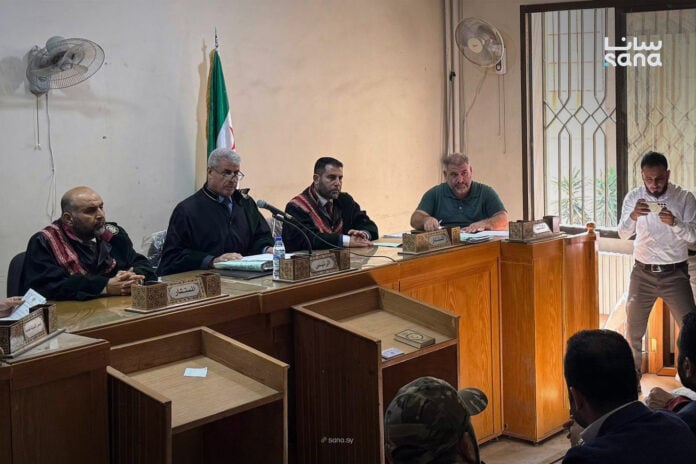
The timing made the statement more pointed than most. On Monday, Syrian Foreign Minister Asaad al-Shaibani had met Israeli Mossad chief Roman Gofman in Amman in talks brokered by Washington — the first direct Syrian-Israeli contact since the transition. The session, according to Al Jazeera, focused on halting Israeli airstrikes inside Syria, ending arrest and targeting operations, and exploring whether the 1974 framework — the one Israel declared dead — might be revived. Syria arrived at the table demanding withdrawal to pre-December positions. Israel arrived with different priorities.
Katz’s visit the next morning closed the gap between those two positions rather than narrowed it. In video remarks directed at Syrian President Ahmed al-Sharaa, he described Israeli military presence on Mount Hermon as a permanent security arrangement rather than a temporary measure: “When you wake up in the morning in the palace in Damascus and look up at Mount Hermon and see the Israeli forces, you know that we are here to defend our communities and our border.” Israel would not leave the mountain or the buffer zone, he added, as long as what he described as jihadist threats remained.
The framing recurred throughout. Since the Assad government collapsed in December, Israel has consistently characterised its presence on Syrian soil as a defensive response to instability rather than a territorial acquisition — a framing that depends on the 1974 Disengagement Agreement remaining voided. The agreement, signed under US and UN auspices after the Yom Kippur War, had set the ceasefire line and created a demilitarised buffer zone monitored by the UN Disengagement Observer Force. Israel declared it null and void immediately after the regime change, and then advanced its forces into the buffer zone and onto the Syrian side of Mount Hermon.
Syria’s condemnation addressed that legal sequence directly. The Foreign Ministry statement cited the UN Charter’s prohibition on the acquisition of territory by force, called the visit an “illegal” crossing of an international border, and demanded the UN Security Council take action to compel compliance with international law. Israel attacks on Syria drew formal Security Council condemnation in April 2025, but enforcement action has not followed.
The week leading to Katz’s visit had already been turbulent. On August 22, Israeli aircraft struck the Abu Duhur airbase in northern Syria’s Idlib region — a move that US Special Envoy Tom Barrack described as an “unnecessary escalation,” suggesting it was designed to provoke Turkish involvement. Katz denied it. The next day, Barrack retracted a separate comment in which he had described Syria’s Golan as “occupied” — the first time a senior US official had used that language in public — before walking it back under Israeli pressure. The episode drew attention to the contradiction embedded in Washington’s position: pushing for a negotiated de-escalation while declining to name what Israeli forces are doing in Syria as occupation.
TRT World reported that Katz also told al-Sharaa that the message from the Israeli military’s position on Mount Hermon was a signal of both deterrence and permanence — an explicit rejection of the withdrawal framework Syria brought to Jordan on Monday.
The Jordan talks broke up without a framework. Israel’s conditions included a guarantee that no Turkish military forces operate near the Syria-Israel border and that Golan demilitarization occur on Israeli terms. Syria and Turkey both rejected the Turkish-forces condition. Syria-Israel indirect talks from a year ago followed a similar path: engagement without resolution, followed by Israeli unilateral action that moved the facts on the ground.
Syria’s formal position remains what it has been since December: Israel must withdraw to its pre-December positions, the 1974 framework must be revived, and the UN must enforce it. What Syria lacks is a mechanism to compel any of that without military escalation it cannot mount and a diplomatic partner willing to name the situation for what it is. Tuesday’s visit made neither of those constraints more tractable.