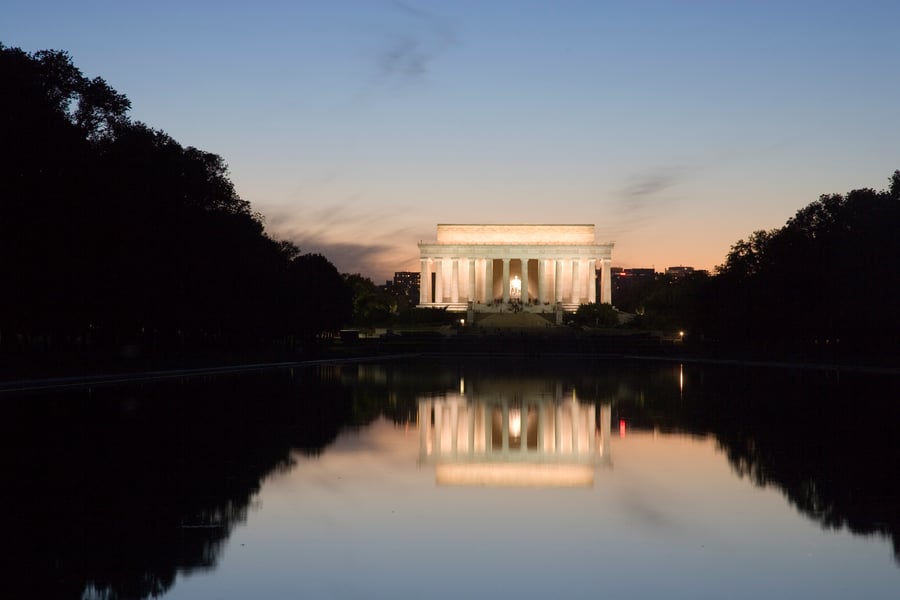

WASHINGTON — Sixty-three years after Martin Luther King Jr. stood before the Lincoln Memorial and spoke of a dream yet to be realized, tens of thousands of people returned to that same ground on Thursday — not to celebrate but to defend what remains of the democratic machinery that made his vision legally enforceable.
The March on Washington 2026, anchored at the Lincoln Memorial and organized under the banner “Defend the Vote,” drew crowds from across the country to the National Mall. The immediate targets were a federal proof-of-citizenship requirement for voter registration that the Trump administration pushed into law earlier this year, a Supreme Court ruling issued last April that stripped key enforcement provisions from the Voting Rights Act of 1965, and a wave of state-level legislation that voting rights groups say is designed to suppress participation by Black, Latino, and low-income voters.
“The right to vote, the very foundation of our power, is being chipped away in statehouse after statehouse,” the Reverend Al Sharpton told the crowd, his voice carrying across the reflecting pool. Sharpton, who organized the march alongside the National Urban League, the NAACP, and other civil rights organizations, framed the gathering as a direct continuation of the 1963 original — not a commemorative exercise but a political emergency, convened on the same date King delivered his speech because the calendar itself was an argument.
The April 2026 Supreme Court ruling was the galvanizing moment. In a 5-4 decision, the court struck down the preclearance formula that had required states with histories of voter suppression to get federal approval before changing their voting laws. The provision had survived decades of legal challenges after its last reauthorization in 2006. Once it fell, Republican-led state legislatures that had been chafing under its oversight moved quickly: early voting cutbacks in Georgia, aggressive voter-roll purges in Texas, polling-place closures in rural Arizona. The list, as Marc Morial put it, was not a coincidence.
“We know in this fight we’re fighting powerful forces,” Morial, president of the National Urban League, told the assembled marchers. “But this is why we rally today.” His organization had spent the months since the ruling documenting its practical consequences state by state, as Al Jazeera documented in photographs from the event, and the numbers were not abstract: millions of voters potentially removed from rolls or deterred from registering, in states where margins in recent federal elections had been measured in the tens of thousands.

Senator Bernie Sanders, who has watched the courts increasingly insulate the Trump administration from accountability, addressed the crowd from the podium at the Lincoln Memorial. “We have a president carrying out the most significant assault on voting rights since segregation,” he said, drawing a standing ovation from marchers who had traveled from Georgia, Texas, Wisconsin, and Pennsylvania — states where new restrictions have already taken effect or are pending in legislatures. Sanders’ framing was deliberate and specific: what is happening is not policy disagreement but a structural effort to determine who gets to participate in American democracy at all.
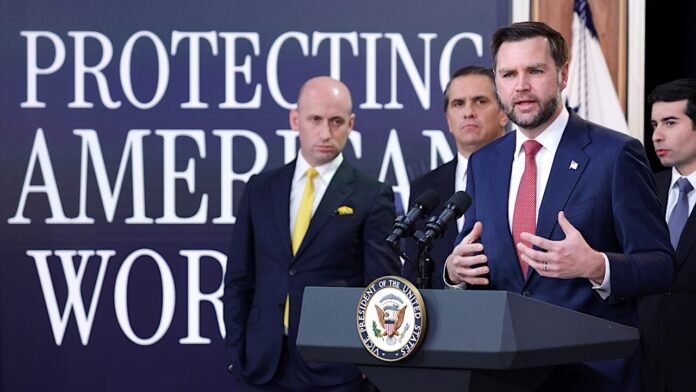
The proof-of-citizenship requirement — signed by Trump in February and already being challenged in federal courts that have repeatedly rebuffed the administration’s legal overreach — requires voters registering for federal elections to provide documentary proof of citizenship, such as a passport or birth certificate. Voting rights advocates estimate that roughly 21 million Americans lack ready access to those documents, a group that skews younger, poorer, and more racially diverse than the electorate as a whole. The administration has argued the requirement is a safeguard against noncitizen voting, for which evidence of any meaningful scale has never been produced.
Yolanda Renee King, the 18-year-old granddaughter of Martin Luther King Jr., spoke near the end of the program. Her age was its own argument. “My grandfather did not die so that we could be told we are not eligible to vote,” she said. Civil rights attorney Benjamin Crump connected the march to a pattern he described as deliberate: voting rights weakened, police accountability reduced, federal civil rights enforcement hollowed out — not as separate policy choices but as related withdrawals from the promises the federal government made in the mid-1960s. Filmmaker Spike Lee also addressed the crowd. Arndrea Waters King, daughter of the late civil rights leader, spoke before her daughter took the stage.
What Thursday’s march cannot yet answer is whether it will produce anything beyond solidarity. The Supreme Court’s April ruling came down when Republicans hold the Senate and face no legislative pressure to pass a new Voting Rights Act reauthorization. Federal challenges to the proof-of-citizenship requirement have so far produced divided rulings across circuit courts, and the case is likely headed to the same Supreme Court that just dismantled the preclearance mechanism. The administration has shown little appetite for negotiation on any front where it perceives executive authority to be absolute.
The Trump White House has framed its voting policies as a restoration of electoral integrity. What that framing cannot account for is the historical continuity on display at the Lincoln Memorial on Thursday: the same monument, the same coalition of civil rights groups, the same argument that the mechanics of political participation are being narrowed in ways that fall heaviest on communities that have always faced the highest barriers to the ballot. In sixty-three years, the specific legal instruments have changed. The argument has not.