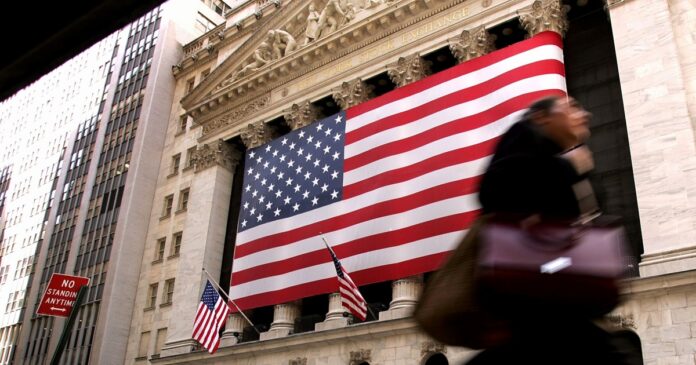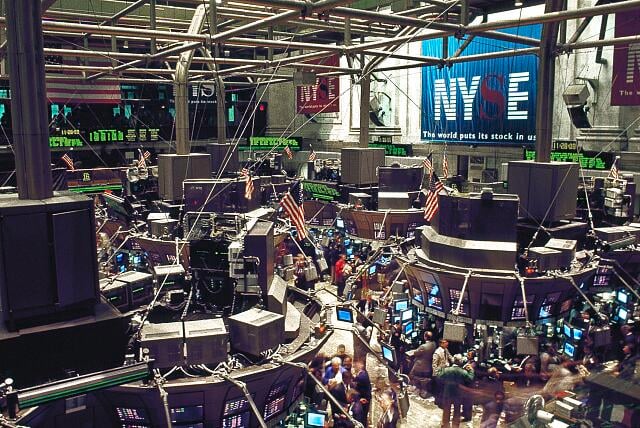

NEW YORK — The Dow Jones Industrial Average finished nearly unchanged on Friday, leaving the blue-chip index as the session’s oddest outcome: the equity benchmark that moved least while the rate argument raged loudest around it.
The Dow closed down 0.02 percent at 53,559.99, a decline of fewer than 10 points that obscured the degree of turbulence hitting the rest of the market. The S&P 500 fell 0.25 percent to 7,711.76. The Nasdaq composite dropped 0.52 percent to 26,402.42, extending Thursday’s losses as traders continued adjusting rate expectations in the wake of Federal Reserve Governor Kevin Warsh’s remarks at Jackson Hole the day before.
This was a rotation, not a rout. The Dow’s composition, which runs heavy in industrials, healthcare, and financial services companies, kept it largely insulated from the selling that concentrated in rate-sensitive technology names. Goldman Sachs Group, JPMorgan Chase, and Caterpillar each posted modest gains on Friday while Nvidia and Apple weighed on the Nasdaq and, by extension, the broader market. The divergence had a clear logic: traders were not abandoning equities across the board; they were trimming the assets most exposed to an environment where high borrowing costs persist longer than expected, and rotating into names that earn money through the economic cycle rather than on the assumption of cheap capital.
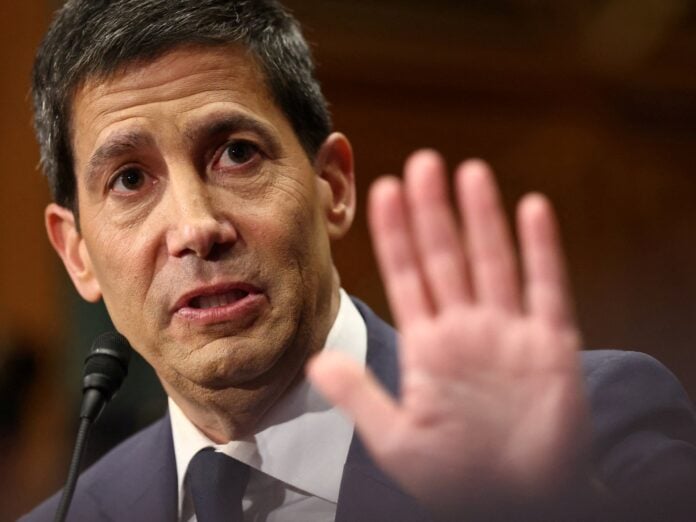
Warsh told attendees at the Federal Reserve’s annual Jackson Hole symposium on Thursday that the central bank still had “work to do” on inflation and gave no indication of a near-term pivot toward easier policy. The tone was sharper than markets had anticipated, NPR reported, prompting a repricing in technology stocks that had spent much of the summer pricing in at least two Fed rate cuts before year-end.
The Dow’s relative calm on Friday was less about confidence in its underlying companies than about the mechanics of where rate sensitivity lands. Industrials and healthcare names carry lower price-to-earnings multiples and are less dependent on cheap financing than the growth-oriented technology companies that define the S&P 500 index and the Nasdaq. When Warsh made clear that the Fed’s tightening chapter was not yet closed, the Dow’s defensive composition acted as a buffer. The companies that make up the 30-stock index were not the companies traders were selling.
Friday’s close preserved a positive weekly gain for the Dow, a result that had looked precarious midweek before financials and industrials steadied. The Nasdaq composite, which had absorbed most of the initial Warsh-driven selling in Thursday’s session, was still finding its level on Friday as options desks adjusted positioning and bond yields ticked up slightly in afternoon trading. All three major indices entered the final session of the month carrying the weight of an altered rate outlook: a market that began August expecting the Fed to ease by fall was ending it preparing for the possibility that the first cut may not arrive until well into 2027. The September Federal Open Market Committee meeting was taking shape as the next major market inflection point.
Fortune’s analysis of the Jackson Hole conference noted that Warsh had cast the Fed’s role in deliberately restrained terms, emphasizing a “quieter Fed” philosophy that placed institutional credibility above the kind of forward guidance that had come to define recent central banking. For equity markets, that shift in posture carries a practical implication: a Fed that commits to saying less gives traders a narrower window in which to price rate movements before they happen, increasing the premium on each piece of economic data that follows.
What Friday’s session did not resolve is whether the rest of the Federal Open Market Committee shares Warsh’s tone. Jackson Hole gathered a significant share of the FOMC’s voting members in Wyoming, but the public statements that followed Warsh’s address were limited. Until the committee’s members are on the record individually, via speeches, interviews, or the September meeting statement, the extent to which Warsh’s hawkishness reflects the full board’s view rather than one prominent voice within it remains unclear. That ambiguity is the real overhang heading into September.
The Dow Jones Industrial Average‘s near-flat finish on August 29 amounts to a pause rather than a verdict. The industrials and financial services names that carry the index were not celebrating anything on Friday; they were simply less exposed to the rate sensitivity that punished the Nasdaq. Whether that distinction holds through September depends on economic data the market has not yet seen: the August jobs report, the core PCE inflation index, and the FOMC minutes from the July meeting all land before September’s rate decision. What those numbers say about the trajectory of inflation will determine whether the Dow’s calm on August 29 was a reprieve or simply the index catching its breath before the next leg of adjustment.