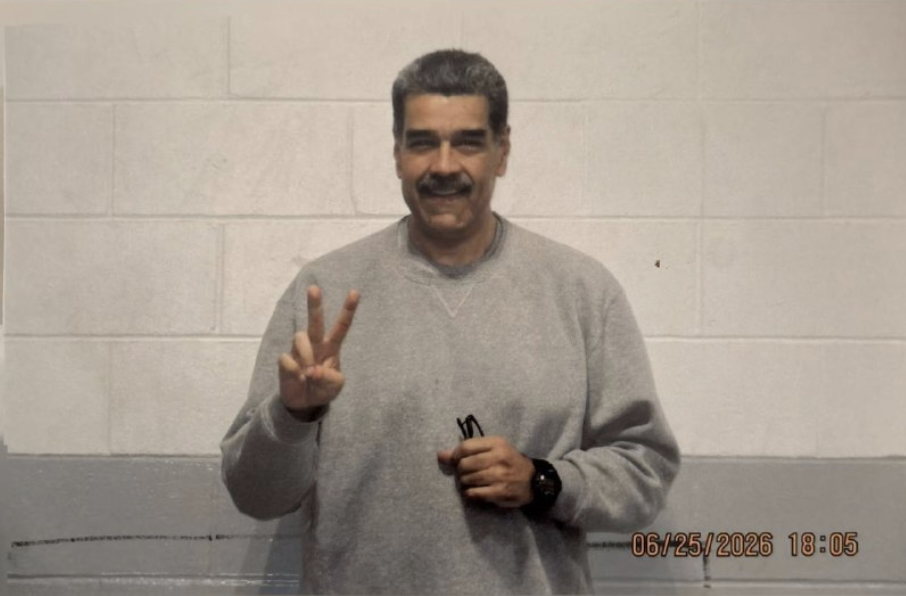

NEW YORK — The images arrived on social media late Saturday: Nicolás Maduro, Venezuela’s ousted president, standing in a gray tracksuit inside a federal detention facility in Brooklyn, flashing peace signs at the camera. His government framed them as defiance. The metadata told a different story.
The photos were taken on June 25, 2026 — the day after Venezuela was struck by twin earthquakes measuring 7.2 and 7.5 in magnitude that killed an estimated 1,700 to 2,295 people and left hundreds of thousands without shelter in northern Venezuela. While his country’s deadliest natural disaster in decades was unfolding, Maduro was posing for pictures in a federal holding cell more than 2,000 miles away.
The images, posted August 30 to Maduro’s official accounts on X and Telegram by loyalists running the accounts on his behalf, were accompanied by a message in his name: “We are standing firm, with our hearts full of your love.” A second post described the photos as “a small gift to our grandchildren.”
Maduro, 63, has been held at the Metropolitan Detention Center in Brooklyn since his capture on January 3, 2026, in an operation the Trump administration called Absolute Resolve — a midnight raid on Caracas involving more than 150 US military aircraft. Cuba’s government announced that 32 Cuban nationals were killed in the operation. The US government has not confirmed or denied that figure.
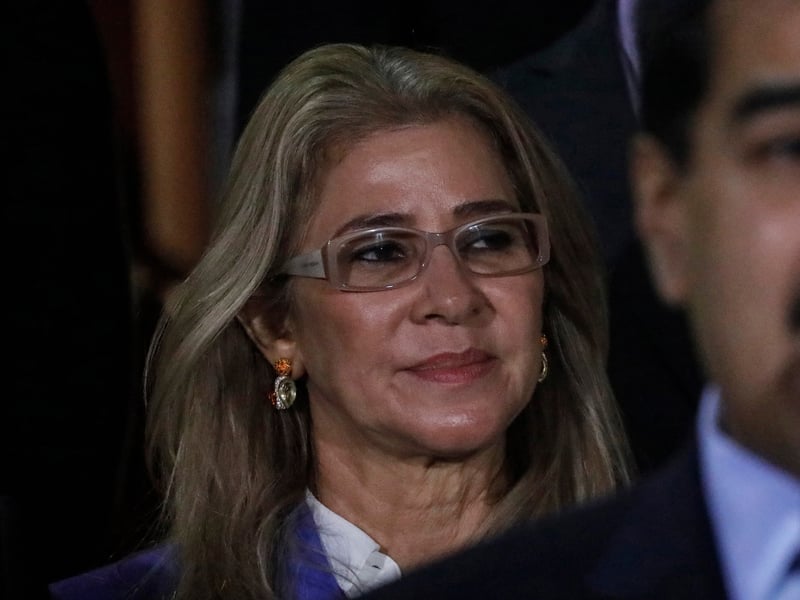
He faces charges of narco-terrorism conspiracy, cocaine importation, and weapons possession, including machine guns. His wife, Cilia Flores, was detained alongside him and faces the same charges. Both are scheduled for trial on June 1, 2027, in the Southern District of New York.
“He looked thinner,” one former Venezuelan diplomat who watched the video said, speaking on condition of anonymity because they remain in contact with individuals still inside Venezuela. “Thinner than we have seen him in years. But his team wanted people to see that he is alive.”
The release of the photographs is almost certainly not spontaneous. Federal detainees at MDC Brooklyn have limited but real access to outside communication through attorneys and approved contacts, and images taken inside the facility would require some degree of institutional handling before reaching social media. Neither Maduro’s legal team nor the Bureau of Prisons responded to requests for comment.
MDC Brooklyn itself carries a troubled institutional history. Courts have repeatedly cited the facility for inadequate medical care, overcrowding, and infrastructure failures — a federal judge once described it as “not fit for pre-trial detention.” Ghislaine Maxwell spent time there before her transfer. Conditions have improved marginally since a 2022 oversight push, but the facility remains under scrutiny.
In Venezuela, power has formally passed to Jorge Rodríguez, the National Assembly president, and Diosdado Cabello, who now controls day-to-day government operations. Both were close Maduro allies and have maintained the government’s position that his capture was an illegal act of war by the United States.
At a pretrial hearing in New York on July 22, Maduro’s lawyers mounted a direct challenge to the legality of the operation itself, arguing that the use of military force to seize a sitting head of government on foreign soil violated both domestic and international law. No ruling has been issued. The government’s position is that Maduro had already been designated a narco-terrorism target under the Foreign Narcotics Kingpin Designation Act, removing any sovereign immunity protections.
The earthquake photos add an uncomfortable dimension to a story the Venezuelan government has worked hard to control. The twin earthquakes of June 24 struck the country’s most populated coastal region, collapsing buildings in Caracas and leaving coastal towns in Vargas state in ruin. Response was complicated by the political vacuum at the top — Venezuela’s new acting leadership was less than six months old, untested, and facing its first major domestic crisis without the person who had dominated the country’s emergency response apparatus for nearly a decade.
International aid arrived slowly, according to reports, in part because of confusion about who in Caracas had authority to authorize access. That the photographs of Maduro at peace inside an American jail appeared on social media while the recovery was still ongoing did not go unnoticed by opposition figures.
“He was not there for Venezuela when Venezuela needed him most,” said one opposition official in Caracas, who asked not to be named. “That is what those photos actually show.”
Maduro’s government did not comment on the timing.
Related Posts