
WASHINGTON — Every single day in August, the American driver paid more than four dollars for a gallon of gasoline. Not on the worst day. Every day.
That had never happened before. The national average sat at $4.08 on Monday and the monthly average cleared the previous August record of $3.97 set in 2022, according to AAA, which attributes the persistence to expensive crude and the unresolved situation around the Strait of Hormuz. It is against that backdrop that the White House confirmed the missing piece of the deal it has spent four days calling the biggest in the history of oil.
The company is North American Blue Energy Partners. Under the arrangement, the Pentagon takes a 35 percent ownership stake in a new venture built around it, and the State Department secures a guaranteed right to buy 20 percent of the output at cost. The venture receives 100-year rights over 17 fields carrying a claimed 65 billion barrels. NABEP has committed to invest $100 billion in new infrastructure.
Read that structure again, because the headline number is the least interesting thing in it. The United States Department of Defense is becoming an equity holder in a foreign oil producer. That is not a sanctions waiver or a supply agreement. It is ownership, and the reported mechanism makes it cheaper still: the Pentagon’s Office of Strategic Capital is expected to take its position through penny warrants, an instrument requiring almost no capital outlay to acquire the stake.
NABEP is not a household name in oil trading, but it is not a shell either. It is Venezuela’s second-largest private producer, pumping roughly 200,000 barrels a day, and it is controlled by the Venezuelan businessman Alejandro Betancourt. Its ownership shifted only weeks ago. The Florida energy tycoon Harry Sargeant III agreed in August to sell the minority interest he held through an offshore vehicle in a transaction reported at about $300 million, with the buyer a party close to Betancourt. Bloomberg reported the exit followed a pressure campaign to push Sargeant out. The company that will now sit alongside the Pentagon on a capitalisation table consolidated its ownership in the same month the deal was struck.
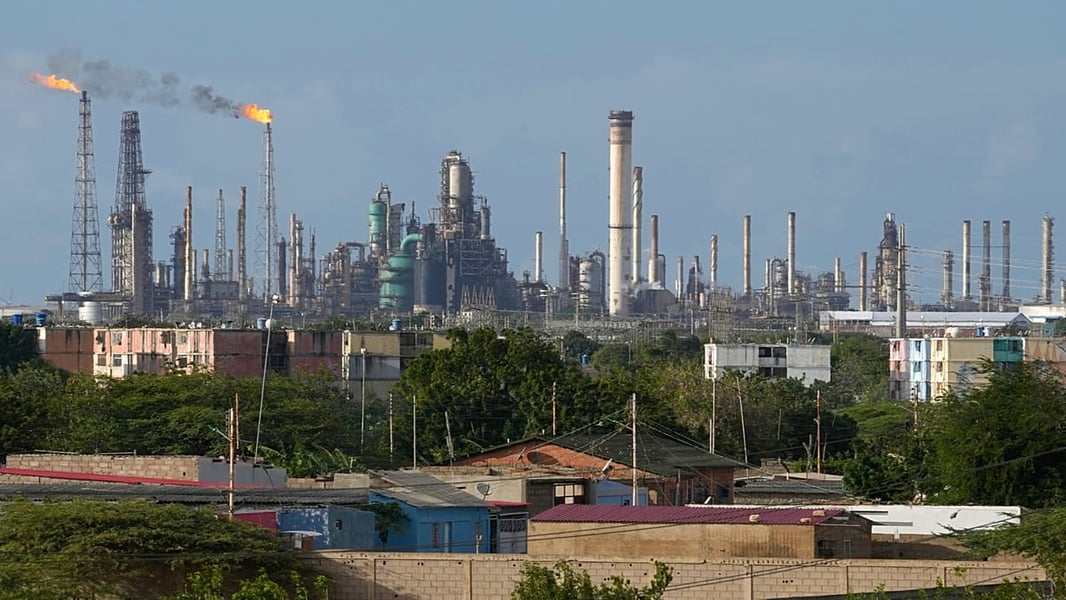
Then there is the 65 billion barrels, a figure that deserves to be handled with tongs. Venezuela’s officially proven reserves run to roughly 303 billion barrels on OPEC and US Energy Information Administration figures, the largest declared holding on earth. Rystad Energy’s independent estimate of what is actually producible puts the number closer to 29 billion. That is not a rounding difference. It is an order of magnitude, and it exists because the Orinoco Belt holds extra-heavy crude so viscous it requires imported diluent, blending and upgrading before it behaves like oil a refinery can take. Analysts who study the belt have argued for years that most of the declared barrels are not reserves in any commercial sense at current prices. Which of those two numbers the 17 blocks resemble has not been independently audited, and no agreement text has been released.
The timeline is the part that touches the driver. Much of the acreage in the deal is greenfield, and bringing greenfield extra-heavy production onstream is a seven to ten year exercise. Analysts canvassed since the announcement put the lag before Venezuelan barrels move the US pump price at anywhere from five to fifteen years. President Donald Trump said the transaction would substantially lower gas prices for all Americans. Secretary of State Marco Rubio, who brokered the agreement with Secretary of War Pete Hegseth and Venezuela’s interim president Delcy Rodriguez, called it a huge win that would secure stable, low-cost oil and lower prices at home. Neither claim is compatible with the engineering.
That gap is the story. The deal is being sold on a consequence it cannot produce inside a decade, to voters experiencing that consequence right now.
Meanwhile the barrels that could move quickly are the ones already moving. Chevron, the only American major actively producing in Venezuela, runs joint ventures at about 260,000 barrels a day and is targeting 375,000. Two Chevron-chartered cargoes reached Port Arthur and New Orleans on August 21, the first US imports of Venezuelan crude in months, under a restricted Treasury licence issued in late July. Chevron declined to comment on the new venture. The industry, by and large, is waiting for paper.
There is a second transfer buried in the fine print. Reuters reported that several of the 17 fields were previously operated by Chinese and Russian companies. Venezuela’s heavy grades have for years been the discount lifeline of China’s independent refiners in Shandong, which imported roughly 389,000 barrels a day of Venezuelan crude in 2025 and bought Merey at around $10 to $15 a barrel below Brent. Those flows were already projected to fall by as much as 74 percent this year. What Washington has acquired is less a reserve base than a redirection of who gets cheap heavy crude, and at whose discretion.
The risks are being named by people who used to do this job. Former US government energy advisers have cautioned that a 100-year concession signed by an interim government nine months after the capture of Nicolas Maduro is exposed to challenge by any future administration in Caracas or Washington. Inside Venezuela the reaction has been hostile across the board, with the arrangement denounced across Venezuela’s political spectrum as unconstitutional by opposition figures and Maduro loyalists alike. Euronews noted that basic terms remain unpublished, including who funds the investment and how the American stake breaks down, while Al Jazeera reported the announcement came through Trump’s own social media account rather than a signed instrument. The Department of Energy has published a fact sheet on the administration’s Venezuela policy, though it does not resolve the commercial terms.
None of this moved the crude price much, which is its own verdict. Brent is where it is for reasons that have nothing to do with Caracas, having settled above $90 on Hormuz mine risk. Traders are pricing a strait, not a concession.
The politics are less patient than the geology. Gasoline above $4 through a full month is already registering as a liability heading into the midterms, and a deal whose benefits arrive in the 2030s does not fix a number voters see weekly on an illuminated sign.
What remains unknown is not a detail. Nobody outside the negotiating rooms has seen the agreement, nobody has published an audit of the 17 blocks, and nobody has explained where a company producing 200,000 barrels a day finds $100 billion. Until one of those three things exists on paper, the biggest oil deal in world history is a press release with a defence department attached.