
SEOUL — The decisions that now most affect South Korea’s economy are not made in Seoul. They are made in the data-center planning offices of Google, Amazon and the other technology companies whose relentless AI infrastructure spending has remade the country from a diversified industrial exporter into something close to the world’s primary chip depot.
August’s trade figures, released Tuesday by the Ministry of Trade, Industry and Resources, quantified exactly how complete that transformation has become. South Korea shipped $46.65 billion worth of semiconductors abroad last month, up 209% from a year earlier and a record by a widening margin. Chips now account for 47.5% of every dollar South Korea earns from exports — memory products, logic dies, and the high-bandwidth stacks the AI industry has made into its defining hardware input.
The overall August total: $98.25 billion in outbound shipments, a 68.7% annual increase. The trade surplus for the month reached $34.75 billion, the second-highest ever recorded, as imports climbed 22.6% to $63.51 billion.
For the third consecutive month, semiconductor exports exceeded $40 billion. That milestone had not been crossed before June. It has not dipped below it since.
The hyperscaler buildout driving those numbers shows no sign of the inventory correction that has historically followed Korean chip surges. Google, Amazon and their peers are expanding AI data-center capacity at a pace that has not been seen in any prior compute-infrastructure cycle — not a bounce from depleted stockpiles, not a catch-up after production delays, but a structural commitment to hardware at a scale that keeps absorbing supply faster than supply can expand. The chips best suited to that expansion, high-bandwidth memory products in particular, are produced at scale by Samsung Electronics and SK Hynix and by relatively few others.
The memory architecture central to that demand is high-bandwidth memory, or HBM — chip dies stacked vertically and connected through silicon to deliver the data-transfer rates that large language models and AI inference engines require. Samsung and SK Hynix together produce the overwhelming majority of global HBM supply. Micron Technology’s own HBM3E ramp, which has drawn attention in equity markets as the U.S. counterpart to Korean output, confirms the same underlying demand dynamic without displacing Korea’s volume lead.
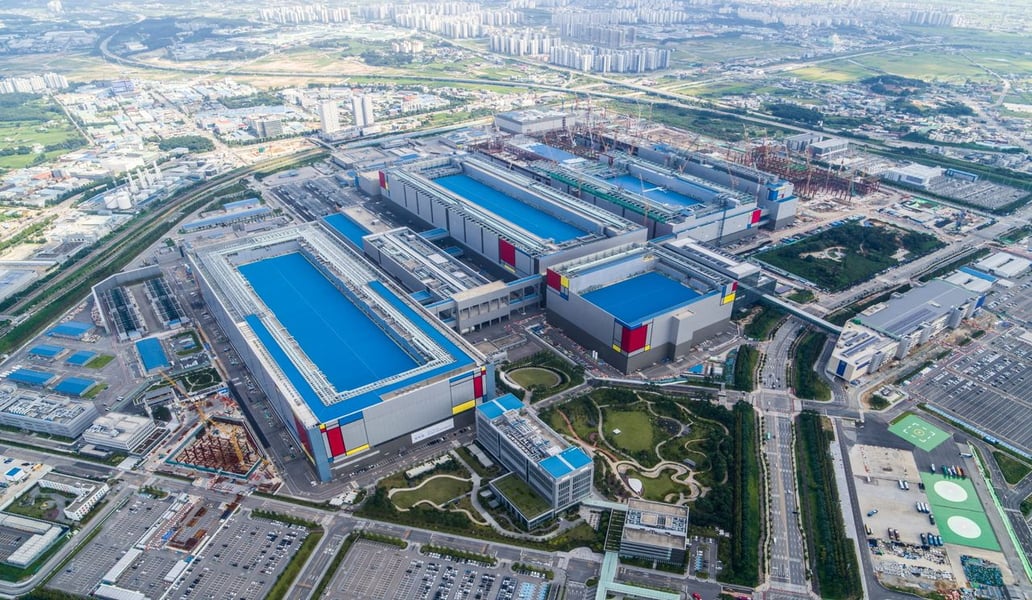
That concentration is both South Korea’s extraordinary advantage and its most visible exposure. August’s mix makes the exposure legible in a single number: 47.5 cents of every export dollar earned abroad now flows from a product category controlled by two domestic companies and demanded by a handful of foreign ones. A recalibration in hyperscaler capital spending — delayed construction cycles, budget resets, or a shift in chip architecture — would register immediately in South Korea’s trade accounts.
The question the August data cannot answer is whether a correction is coming. Samsung and SK Hynix have not released updated demand guidance ahead of their next quarterly reports, and analysts tracking both companies flag the concentration in hyperscaler customers as the variable that matters most. The current spending pace reflects capital plans approved roughly twelve to eighteen months ago; what was approved for the following buildout cycle is not yet visible.
A trade surplus of $34.75 billion in a single month carries its own complication. The Bank of Korea, navigating between inflationary pressures and growth support through the Iran war’s oil-price shock, now faces a strengthening won and rising market expectations of rate tightening. The August export data arrives as a complicating factor for a monetary committee that has signaled it is watching labor-market and consumer indicators more closely than headline export volumes.
Beyond the monetary dimension, South Korea’s fiscal position has shifted markedly. Record export earnings feed directly into corporate tax receipts, which the government has relied on to finance infrastructure investment and social spending without widening the deficit meaningfully. The semiconductor supercycle has become, in effect, a fiscal stabilizer — one that makes planning comfortable and withdrawal painful.
The regional dimension of the AI hardware boom has been clarifying all year. Hong Kong’s re-export trade hit a 42-year high earlier in 2026 as AI chip orders routed through its trading infrastructure rewrote the flows. China’s own export machinery has absorbed years of U.S. chip restrictions by redirecting into sectors where those restrictions do not apply. South Korea’s chip dominance fits inside a broader Asian manufacturing realignment that the AI build-out is accelerating faster than trade policy can track.
Semiconductor exports topped $30 billion for the first time in March. They crossed $40 billion for the first time in June. Xinhua reported August’s $46.65 billion as the third data point on what is still an ascending curve. What the Ministry of Trade, Industry and Resources did not say on Tuesday is where that curve inflects.