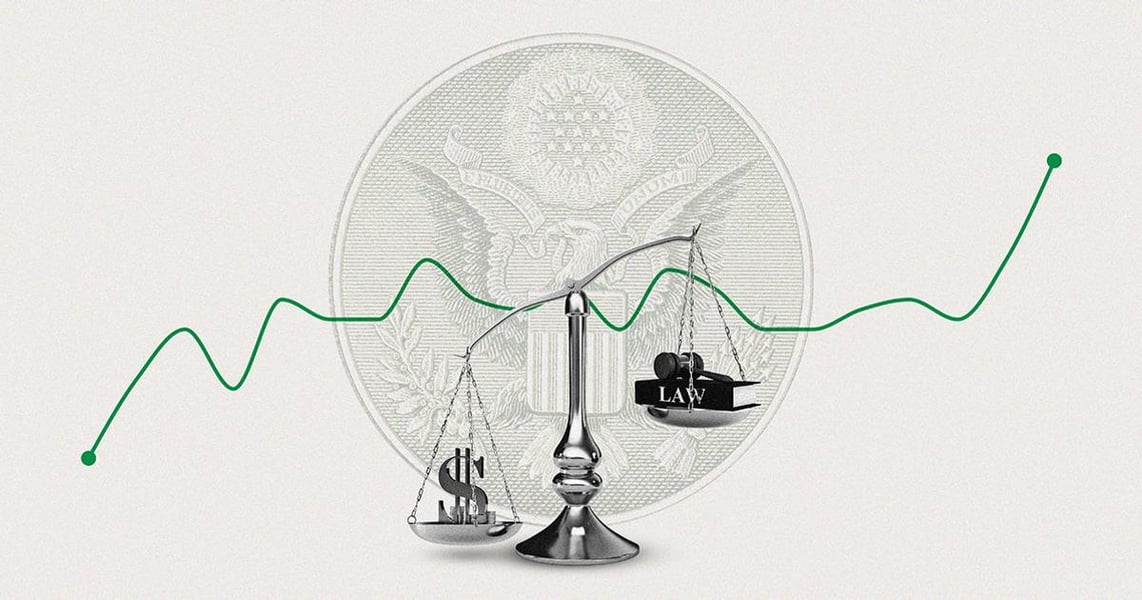

WASHINGTON — For two decades, Gallup has asked Americans whether corruption is widespread in their government. The answer this year landed with rare bipartisan weight: nine in ten said yes.
A new Gallup survey found that 89 percent of U.S. adults now describe government corruption as widespread, the highest reading in the organization’s two decades of polling on the question and a 10-point jump from 79 percent just one year ago. The surge erased what had historically been a reliable partisan divide on the issue, leaving Democrats, Republicans, and independents aligned in ways that are unusual in contemporary American politics.
The poll, conducted May 1 through June 10, 2026, surveyed 1,000 U.S. adults by telephone and carries a margin of error of plus or minus 4.1 percentage points.
The partisan breakdown tells a more complicated story. Democrats reached 91 percent, a number that has moved in striking tandem with the change in administration. In the final year of Joe Biden’s presidency, only 57 percent of Democrats said corruption was widespread in government. That figure climbed to 76 percent in 2025, Trump’s first year back in office, and has now jumped another 15 points to 91 percent. Independents followed a similar trajectory, rising 12 points since 2024 to reach 90 percent.
Republicans registered 83 percent, actually down four points from their 2024 reading under Biden, consistent with what Gallup analyst Benedict Vigers called a pattern where Republican concerns appear less tied to which party controls the White House. “In a country where many are polarized across a wide range of issues,” Vigers wrote, “this is one case where bipartisanship reflects shared alarm as much as shared consensus.”
The timing gives the figure weight beyond the number itself. The polling window, May 1 through June 10, closed before a series of developments that subsequent months produced: the resignation of Army Secretary Dan Driscoll after a reported feud with Defense Secretary Pete Hegseth, the latest escalation in the Strait of Hormuz, and continuing Democratic pressure over White House commercial projects. The 89 percent figure may already be an undercount of where American opinion stands today.
The figure is not merely a record domestically. Among the 132 countries where Gallup has tracked corruption perceptions since 2023, only Lebanon in 2024 at 92 percent, Peru in 2025 at 92 percent, and Ghana and Nigeria in 2024, both at 90 percent, have registered numbers above the United States’ current reading. That places the U.S. atop the OECD rankings for perceived government corruption for the first time, above every advanced democracy in Europe and Asia.
The survey tracked perceptions across two domains. Government corruption registered at 89 percent. Perceptions of widespread corruption in business came in at 71 percent, itself an eight-point increase from the prior year but still 18 points below the government reading. Gallup notes that an 11-point gap between the two has been typical historically; the current 18-point spread is the largest recorded, suggesting Americans have become specifically, not generally, pessimistic about public institutions.
That specificity has concrete grounding. The documented events of the past year gave respondents named things to point to: Iran war opacity managed for political effect, White House ballroom construction challenged even by the Supreme Court’s conservative chief justice, and reported conflicts inside Pentagon leadership that stripped civilian command during an active war. Those are not abstract complaints about a distant government.
The political implications for the 2026 midterms are not speculative. Democrats have identified corruption as their primary organizing message for November, and the Gallup numbers provide statistical grounding for a campaign argument that has previously relied on anecdote and energy. NBC News reported in June that Democrats were treating corruption as the party’s central argument in competitive districts, betting that a bipartisan reading of the issue could pull enough Republicans and independents to matter.
The strategic challenge for Republicans is harder to define. Their own voters have registered corruption concerns at 83 percent, a figure that, under a Democratic administration, would be treated as a crisis signal. That it now coexists with continued electoral support for Trump-aligned candidates suggests either compartmentalization or a calculation that the answer to government corruption is not the opposing party. Republican senators breaking ranks on the Iran war in recent weeks offer one early signal that the coalition’s edges are not as stable as election maps suggest.
The poll question Gallup posed was deliberately broad, asking whether corruption is widespread rather than whether specific officials are corrupt. That framing captures institutional mood more than prosecutorial finding. A number near 90 percent, held across party lines in a country that rarely agrees on anything, is not a fringe position. It is the closest thing American politics has to consensus.