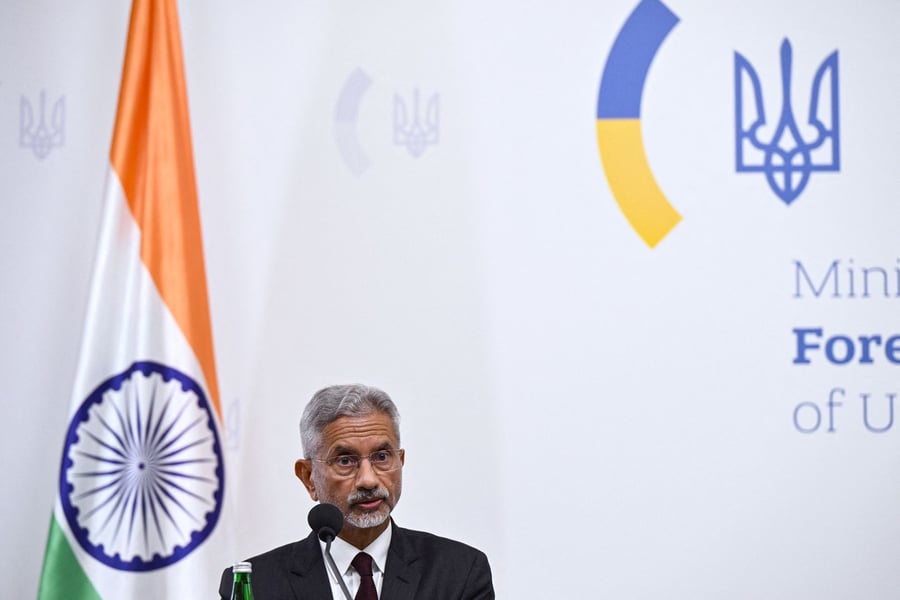

KYIV — Nine days after sitting across from Vladimir Putin at the Kremlin, India’s External Affairs Minister S. Jaishankar arrived in the Ukrainian capital on Thursday to hear the other side, and to deliver a message that New Delhi has been careful to keep identical in both places.
The visit, the first-ever standalone bilateral trip by an Indian foreign minister to Ukraine, placed Jaishankar in an unusual position: defending in Kyiv the very commerce that Western governments have spent two years trying to throttle. India is Russia’s second-largest buyer of crude oil, a trade that has deepened throughout the Russian operation in Ukraine, and the question of whether that commerce amounts to complicity has followed Indian diplomats into every conversation about the conflict.
Jaishankar did not retreat from it. “This conflict, which is today in its fifth year, will not dissolve because somebody is buying or not buying oil or alumina or minerals or metals,” he told reporters after meeting Ukrainian Foreign Minister Andrii Sybiha, as the Kyiv Independent reported. “This conflict will be solved by dialogue, by diplomacy, by negotiations.”
Sybiha chose to emphasize the value of having New Delhi at the table. “We rely on India’s authoritative voice in peace efforts,” the foreign minister said. The line treated India’s refusal to economically isolate Russia as a feature rather than a flaw, the advantage of an interlocutor that both sides still receive.
The visit came at an inflection point for India’s positioning on the conflict. Prime Minister Narendra Modi, speaking at the Shanghai Cooperation Organisation summit in Bishkek two days earlier, declared that “endless war must now give way to the end of war.” The clearest signal New Delhi has sent that it intends to move beyond studied neutrality, it was followed almost immediately by Jaishankar’s flight to the Ukrainian capital.
The circuit of the past ten days has its own internal logic. Following talks with Putin at the Kremlin in which India’s energy partnership with Russia was discussed at length, a visit to Moscow cannot go unbalanced by one to Kyiv. Jaishankar has maintained this symmetry for years: the same language in both capitals, the same emphasis on dialogue and negotiation, the same refusal to endorse any formula that would require New Delhi to choose.
Jaishankar also met President Volodymyr Zelenskyy on Thursday afternoon. Zelenskyy expressed gratitude for India’s push to end the war. Jaishankar told reporters the conversation centered on “approaches to end the ongoing conflict,” a formulation he had used in Moscow as well. Neither visit produced a joint statement with specific commitments. Neither side has pressed publicly for one.
That absence matters more than it might appear. India’s offer of help, as Jaishankar framed it, is deliberately open. “If India can be of any help in any manner, we are ready,” he said, a sentence that commits New Delhi to nothing while leaving every door nominally open. What Ukraine’s side actually asked for, which channels, which pressure points, what specific role in any formal framework, has not been disclosed by either delegation.
The American variable presses on all of this. India has been operating under 18-percent tariffs tied to the Graham Russia Sanctions Act, a legislative mechanism Washington introduced partly to disincentivize Indian purchases of Russian crude. Jaishankar’s answer in Kyiv, that buying Russian oil does not extend the war, is a formal rejection of the premise behind those tariffs. He delivered it not in Washington, not in a multilateral forum, but in front of the government the sanctions were designed to support.
India’s simultaneous engagement with China on the Himalayan boundary adds another layer of parallel diplomacy that no single partner can fully track from its own vantage. Each capital sees only its slice of the Indian diplomatic schedule. New Delhi sees the whole, which is precisely what gives it the leverage it deploys in each.
What India has not done, despite the trajectory of the past two weeks, is move toward any formal mediation role with an institutional structure behind it. No special envoy for the conflict has been named. No framework document has been circulated or endorsed. The dialogue that Jaishankar advocates has been a consistent refrain for five years across multiple forums. It has not yet acquired a shape that would require either Moscow or Kyiv to engage with it as a proposal rather than a posture.
Ukraine’s calculation in opening its doors to this visit is not difficult to read. Any functional channel to Moscow that runs through a government whose relationship with Russia remains intact is worth maintaining, even when that government refuses sanctions and keeps buying Russian crude at scale. India’s weight in the Global South, and its standing in forums where Moscow remains present, gives it a form of access that European governments surrendered when the conflict began.
Whether this first-ever bilateral visit by an Indian foreign minister to Ukraine proves historic as a turning point or merely as a fact depends on what comes next. And on that question, neither Moscow nor Kyiv nor New Delhi has offered an answer.