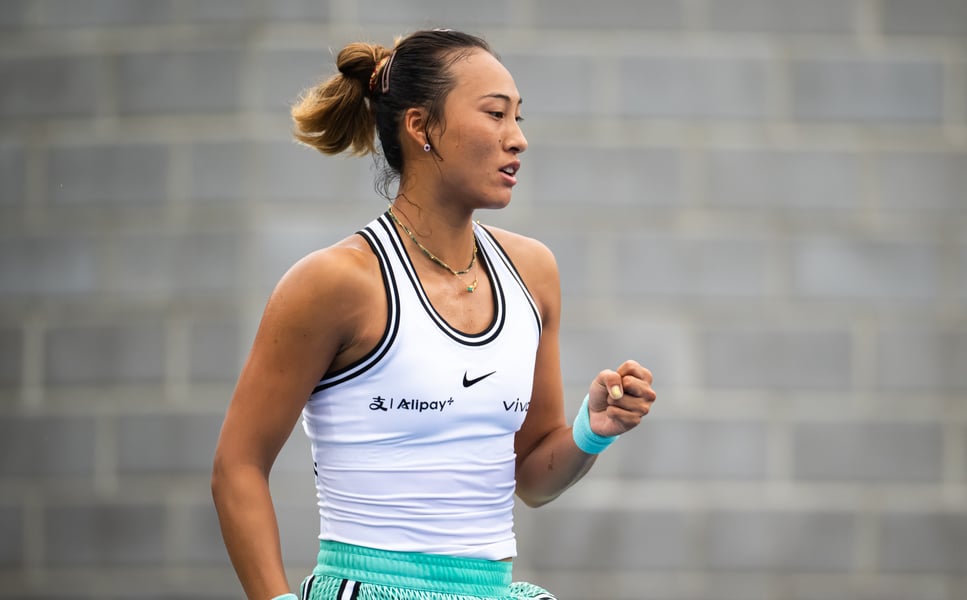

NEW YORK — She had just won the second-round match and Zheng Qinwen could not stand. The 23-year-old Olympic champion sank to the hard court at the USTA Billie Jean King National Tennis Center, pressed her face into her hands, and cried. Not from exhaustion. Not from pain. From something closer to relief: confirmation that the competitive hunger she had feared was permanently lost had finally come back.
“When you get sick, you are weak,” Zheng said afterward. “This weakness made me feel like, ‘Oh, I finally got it.'” She won the match 6-4, 2-6, 6-1 over Yulia Putintseva. And she meant the sentence in every possible direction.
Nine months ago, Zheng was a top-10 player in the world, a gold medalist from the Paris Olympics who had established herself as the most compelling women’s tennis story to emerge from China in a generation. She had won gold on clay in the most watched women’s tennis match of 2024, carried a physical game and a competitive personality that set her apart on the WTA Tour, and arrived at hard-court Slams as a genuine title threat. Then the elbow gave out. Surgery followed. And with it came something more disabling than any procedure: the absence of the internal fire that had defined her game since she first walked onto a professional tour court.
Her ranking did not need elaboration. It fell to No. 121. Low enough that she had to qualify just to enter a Slam she’d once threatened to win outright. She came into the 2026 US Open not as a seeded contender but as someone who had fought her way back through the qualifying draw, match by match, before she ever reached the main stage.
That qualifying path ended in Putintseva on Thursday, a tough Kazakhstan representative who has long made life difficult for higher-ranked opponents and who has beaten players far above her seeding throughout her career. Putintseva took the second set comfortably, flattening the contest into the kind of grinding, pressured third set that tests exactly what Zheng said she had been trying to find again. Zheng was sick. She said so afterward plainly, describing nausea and weakness in language that carried no complaint, only context. She won the third set 6-1.
The collapse on court afterward was not theater. It was the punctuation on a story that had been building since the first day she returned to practice after surgery and felt nothing where the competitive drive used to be. She described going through the motions without it: the fist pump, the loud self-encouragement between points, the intensity that had rattled opponents during her rise, all of it muted, not by choice, but by the prolonged absence of the thing that makes elite tennis feel worth fighting for.

She had been working to reclaim it piece by piece. Her arrival at the Nottingham Open in June, ranked well outside the top 100 and navigating a difficult stretch in her coaching setup, illustrated how much ground the surgery had cost her. That grass-court qualifier’s grind was the first chapter. Flushing Meadows, with its harder surfaces and higher stakes, is where the story either turns or stalls.
The third round brings Madison Keys, who reached this stage by saving five match points in a grueling second-round match of her own. Keys is powerful and precise on hard courts, her forehand among the best weapons in the women’s game on this surface, and she will give Zheng exactly the kind of pressurized, hard-hitting situation that Thursday’s win suggested Zheng is now ready to welcome rather than endure. Keys has her own complicated relationship with this tournament and brings the kind of baseline intensity that does not ease up when it senses uncertainty across the net.
There is some comfort in the setting. Zheng mentioned after her win on Thursday that she prefers larger courts, and her third-round slot puts her on a main stage at Billie Jean King National Tennis Center. The energy the crowd generates on those courts has historically elevated her game rather than rattled it. She knows how to use the noise.
Whether the elbow has genuinely healed is the question Thursday’s match left open. Zheng offered no clinical update, and her level during the Putintseva match, leaning heavily on competitive instinct and fighting spirit rather than the power baseline game that carried her to her ranking peak, did not settle it. A single three-set win over a qualifier-section opponent is a data point, not a confirmation. Yahoo Sports reported from inside Billie Jean King National Tennis Center as Zheng described reclaiming the screaming, the adrenaline, the willingness to inhabit the pressure that had quietly abandoned her during months of forced rest.
It showed up on Thursday in a way that brought her to her knees. Keys awaits. The main court is there. And Zheng Qinwen, for the first time in close to a year, seems certain she wants to be there.