
BRUSSELS — Armenia set a date. The European Commission declined to agree with it.
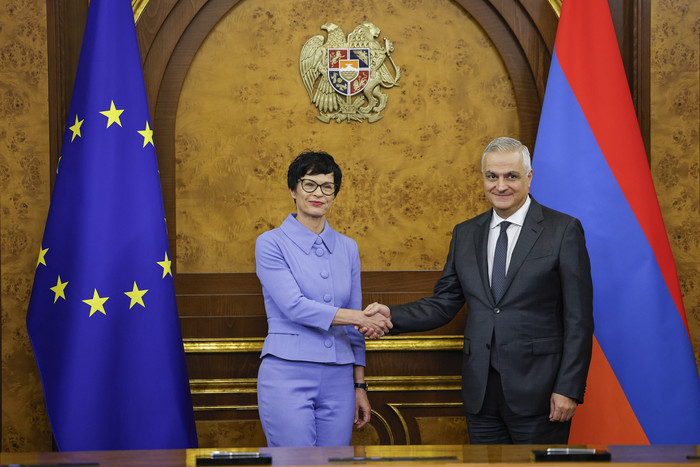
Speaking at a regular Brussels briefing on Sunday, EU Commission spokesperson Paula Pinho was asked whether visa liberalization for Armenia would be achieved by 2029, the timeline Yerevan had written into its national government program the previous month. Pinho’s answer was precise in its imprecision: “Isn’t it too early to predict that 2029, or any other date, will be the moment of visa liberalization? I would say it is still far too early for that level of precision.”
Yerevan had presented that 2026-2031 program to parliament on August 24, with visa-free travel to the European Union listed as one of the government’s headline deliverables. The response from Brussels was not a rejection, but it was close to a correction. Armenia gets to set its own ambitions. The Commission will decide whether they are achievable.
The dynamic has become something of a pattern in EU enlargement policy. Small countries making their westward pivot publicly announce timelines that the bloc privately considers premature. The announcements serve a domestic political function: they tell voters that change is coming, and they signal to Moscow that the direction is irreversible. Brussels, which controls the actual calendar, says almost nothing specific in return. The visa dialogue with Armenia launched in September 2024. An action plan was presented. The process, the Commission has repeated, is merit-based, tied to benchmarks in governance, rule of law, and document security. There is no automatic transition and no guaranteed end date.
Armenia’s EU membership ambitions have accelerated significantly since 2024. The first EU-Armenia summit took place in Yerevan on May 4 and 5, with European Commission President Ursula von der Leyen, European Council President António Costa, and Prime Minister Nikol Pashinyan all in attendance. The EU announced €52 million in support and tariff-free access for 80 percent of Armenian exports. A Connectivity Partnership was signed. Von der Leyen, speaking again on July 2, praised Armenia’s progress and announced a new EU evaluation mission planned for autumn 2026.
Pashinyan had told reporters in May that visa-free travel would arrive “within two years at the latest.” By August, Armenia’s parliament was being presented with a government program placing the target at 2029, three years beyond Pashinyan’s May estimate. Whether that represents a quiet acknowledgment that the timeline had slipped, or simply more cautious official framing compared to his campaign-style optimism, was not explained.
What the action plan requires in practice is a country working through a checklist the Commission controls. Armenia must demonstrate progress on document security, including biometric passports and secure identity registration, as well as on border management, migration cooperation, and rule-of-law reforms the EU deems sufficient. These requirements are not assessed on a fixed schedule. When the EU’s evaluation mission travels to Yerevan this autumn, it will produce a report. That report will inform a recommendation. The recommendation will eventually feed into a Commission decision that could, if conditions are met, open a visa liberalization dialogue in a meaningful sense. The 2029 date assumes every step of that process goes smoothly and quickly.
What the pace of progress has not resolved is the structural reality of Armenia’s position. The country spent three decades inside Russia’s orbit, a member of the Collective Security Treaty Organization and the Eurasian Economic Union. The CSTO alliance crisis deepened in June 2026, when Armenia’s seat at the Kazan foreign ministers meeting was left empty. Russia has responded to Armenia’s westward drift with mounting public criticism, and according to Armenian officials, with active efforts to undermine bilateral cooperation.
Moscow’s pressure on Yerevan has not slowed the pivot. Armenia’s relations with Russia are now openly strained in ways that would have been unthinkable five years ago. Pashinyan announced in August that Armenia could begin a formal EU membership bid “in the near future.” The CSTO, for practical purposes, has stopped functioning as Armenia’s security guarantor.
What Brussels offers in return is something the Commission is careful not to call a guarantee. Enlargement Commissioner Marta Kos has not publicly indicated where Armenia currently stands in the evaluation sequence. The autumn mission has not yet been scheduled.
Pinho’s briefing on Sunday was a small moment in a longer process. But the phrasing “far too early for that level of precision” carries specific weight when the country in question has staked its political direction on that precision being achievable. Armenia has broken from its post-Soviet alliances to pursue European integration. What it has received so far is encouragement, trade access, and development funding. Freedom of movement for its citizens remains on the Commission’s terms, on the Commission’s timeline. The evaluation mission is coming. Brussels will decide what it finds.