
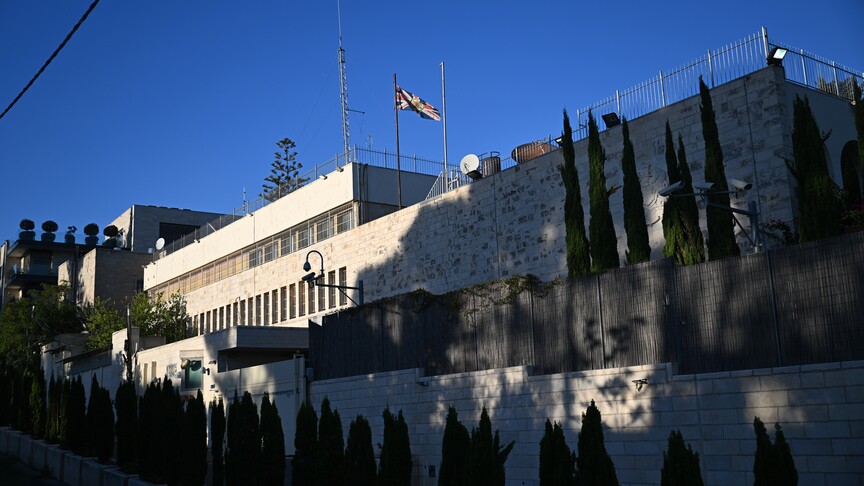
LONDON — For decades, the British consulate in East Jerusalem served as one of the last direct diplomatic channels between the United Kingdom and Palestinians in the occupied West Bank. On Tuesday, Israel ordered it closed.
The decision came hours after British Foreign Secretary Ed Miliband told Parliament that Britain would impose a comprehensive ban on goods imported from Israeli settlements. He also accused Israeli settlers of carrying out what amounted to ethnic cleansing, using language no senior Western official had previously employed publicly.
Twelve countries signed the announcement: Britain, France, Canada, Denmark, Finland, Iceland, Ireland, Norway, Poland, Portugal, Spain, and Sweden. Their foreign ministers cited an “unprecedented level of settler violence and settlement expansion,” specifically pointing to the decision to advance tenders for the E1 settlement project east of Jerusalem. If built, the project would sever the geographic continuity required for a viable Palestinian state.
Israel’s response was swift and punitive. Foreign Minister Gideon Sa’ar ordered the British consulate closed, imposed entry bans on 12 British nationals—including Labour members of Parliament—and expelled British officials from the International Gaza Support Center in southern Israel and a Palestinian police-training program in the West Bank. Sa’ar described Miliband’s characterization of the situation as ethnic cleansing as “outrageous lies” and called the import ban “hostile” and “anti-Israel.”
Sa’ar did not address the pattern of state-backed settler violence that led to the announcement.
Settler attacks in the West Bank have reached systematic levels this year, according to United Nations documentation, as coordinated displacement, arson, and land seizures accelerated under members of Prime Minister Benjamin Netanyahu’s coalition who have publicly advocated removing Palestinians from Area C. The violence has not been incidental to Israeli policy; it has been enabled by it. In September alone, Israeli forces fired tear gas into a mosque during evening prayers while settlers set fire to another. The incidents form part of a pattern of settler arson and mosque attacks that has damaged or destroyed 13 places of worship this year. Britain, France, and their European partners have documented the incidents through United Nations and diplomatic channels. Tuesday’s announcement was the result of that accumulation.
Miliband, who has spoken publicly of his Jewish heritage, did not reach for softer language. Beyond the import ban, Britain would impose targeted sanctions on Israeli businesses and individuals providing “construction, infrastructure, financing, or real estate” services for settlement expansion — names yet to be listed publicly, but indicating the UK intends to follow the money behind the settlement enterprise rather than merely restrict its products.
The E1 settlement project runs northeast of occupied East Jerusalem toward the Ma’ale Adumim settlement bloc. European governments warned Israel in August that advancing E1 tenders would constitute a threshold violation. Israel advanced them. The 12-country coalition’s announcement is the formal response — a shift from diplomatic warnings to trade restriction that the E1 decision specifically triggered.
Miliband’s predecessor-warning exchange with Israel is itself instructive. When Britain signaled its intentions on September 2, Sa’ar threatened retaliation without naming what form it would take. Britain proceeded. The retaliatory closure of the consulate is now the answer. Its most direct victims are Palestinian holders of British travel documents in the West Bank and Gaza who relied on the East Jerusalem consulate for services — a function Israel has removed as an act of political pressure.
According to Al Jazeera, the ban does not affect goods from Israel proper, limiting its immediate commercial bite. But the political threshold crossed on Tuesday is not measured in trade volume. What the 12-country coalition has demonstrated is that coordinated, formal Western trade sanctions on Israeli settlement activity are now operationally possible — a precedent Netanyahu’s government cannot reverse by closing a consulate.
What the coalition has not yet tested is whether the ban holds under Israeli and American pressure, and whether it expands. The United States under Trump has not joined, has not endorsed, and has given no indication it will. That insulation matters to Israel’s calculation. Netanyahu almost certainly factored it into the decision to close the consulate rather than seek de-escalation. But the twelve countries that signed Tuesday’s announcement are not a fringe — three of them write the G7’s joint communiqués.
The East Jerusalem consulate closure is Israel’s answer to being sanctioned by allies. The Palestinians whose consular services were withdrawn on Tuesday did not sanction anyone.