
LONDON — Ed Miliband did not send a letter. He summoned Israel’s charge d’affaires to hear Britain’s position in person — the most emphatic diplomatic signal the UK has deployed against Israeli settlement expansion in more than a decade. Six other Western governments joined a coordinated statement published Thursday. What they were protesting was twelve square kilometres of Palestinian land east of Jerusalem, and what Israel intends to build on it.
The E1 project has been on Israeli planning books since the 1990s, approved in principle by successive governments and blocked in practice by American diplomatic pressure for most of that period. What changed on August 18 was that Israel’s housing ministry published an active tender — more than 1,200 housing units in the first round, confirmed by the land-tracking organisation Peace Now — with a bidding deadline of October 19. Israeli elections are scheduled for October 27.
France, Germany, Italy, the Netherlands, Norway, Canada, and the United Kingdom signed the statement demanding that Israel “retract these plans immediately and end its expansion of settlements in the West Bank,” as Euronews reported. The statement described the settlement programme as generating “grave instability” and “unprecedented levels of violence by settlers” against Palestinian communities in the occupied territory.
The UN Secretary General called E1 an “existential threat” to a contiguous Palestinian state. Belgium’s foreign minister, Maxime Prevot, separately described the tenders as “unacceptable” and warned that the project “would seriously undermine the viability of the two-State solution.”
Israel’s foreign minister, Gideon Sa’ar, rejected the coordinated criticism outright. He said the Jewish people have the right to live throughout the Land of Israel “just as the British have the right to live in London and throughout the United Kingdom” — a formulation that applies a domestic sovereignty framing to territory that the International Court of Justice ruled last year is under illegal military occupation. Sa’ar also accused Britain specifically of “blaming only Israel while ignoring Palestinian extremism.”
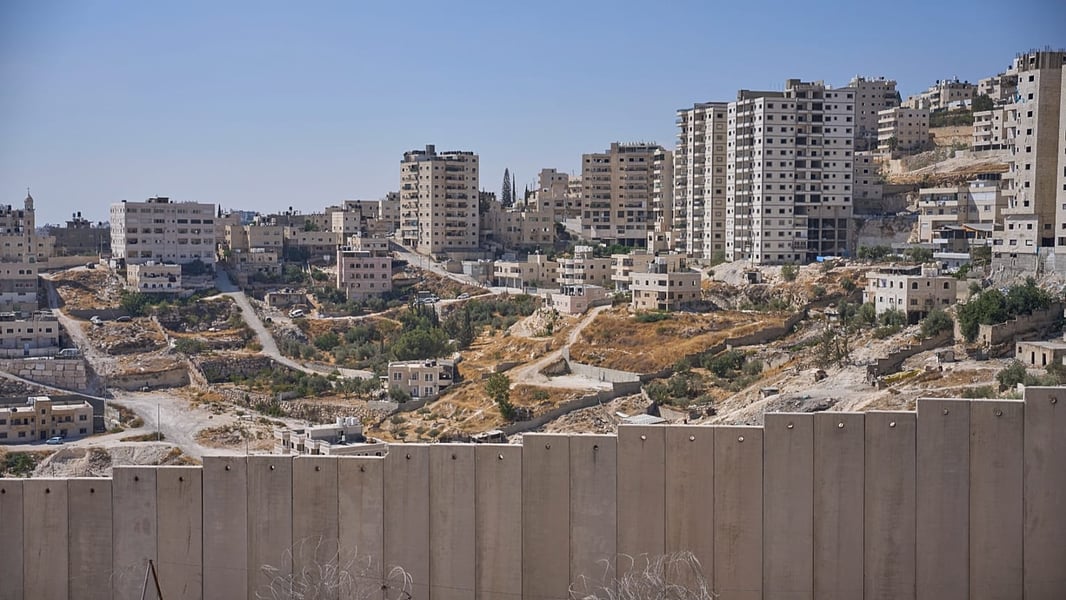
The geographical logic driving E1’s importance is straightforward. The development sits on the corridor between occupied East Jerusalem and the large Israeli settlement of Maale Adumim, approximately eight kilometres to the east. Built to its full scope of approximately 3,400 homes across twelve square kilometres, it would physically link those two built areas and sever the West Bank at its centre. A Palestinian state requires territorial continuity through exactly this strip of land to be viable. E1 forecloses it.
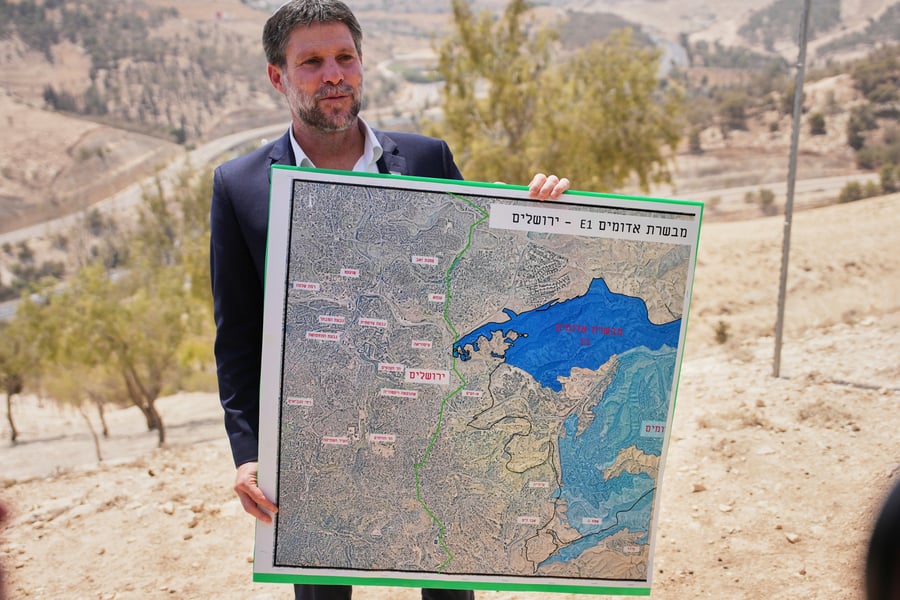
That is the strategic reality the seven nations are protesting. Their objection is not new — Washington blocked E1 tenders under previous Israeli governments going back to the early 2000s, and European leaders have condemned the project in successive rounds. What is different now is Germany’s decision to attach its name to a statement of this directness. Berlin’s willingness to join stands in contrast to its earlier position: as recently as late July, Chancellor Merz had ruled out EU Israel sanctions, citing the country’s historical responsibility.
The day before the seven-nation statement was issued, a separate coalition announced parallel condemnation in sharper language, as TRT World reported. The foreign ministers of Türkiye, Egypt, Indonesia, Jordan, Pakistan, Qatar, Saudi Arabia, and the United Arab Emirates described E1 as a “dangerous escalation” advancing “settlement expansion and annexation” that “threatens the viability of an independent and contiguous Palestinian state based on the 1967 lines.” The two statements arrived on consecutive days, addressed the same housing ministry tender, and came from governments that rarely coordinate this explicitly.
Whether the combined diplomatic front produces any practical change in Israeli settlement policy is the question both statements leave unanswered. Approximately 500,000 Israeli settlers now live in the West Bank alongside roughly 3 million Palestinians. Previous rounds of condemnation have not altered Israeli construction trajectories — the Gaza genocide and statements from Israeli ministers calling for mass Palestinian killings have intensified the international standoff without producing policy change. The October 19 tender deadline creates procedural momentum that operates independently of diplomatic responses.
Sa’ar’s formulation frames the disagreement as a matter of cultural rights. International law and the ICJ’s 2024 advisory opinion frame it as an illegal act under the Geneva Conventions governing occupied territory. That gap — not the bidding deadline — is what seven Western governments are now formally asking Israel to close. Whether a government formed after October 27 halts the construction or accelerates it remains, as yet, unknown.