MOSCOW — Vietnamese President To Lam signed seventeen documents in the Kremlin on Wednesday before boarding a flight to Paris. The documents will outlast the flight.
At the center of the package is a formal advancement of the agreement to build Vietnam’s first nuclear power station, a project whose scope makes it the most consequential single commitment in the Russia-Vietnam energy relationship in decades. Russia’s state nuclear corporation Rosatom will construct two VVER-1200 pressurised water reactors at Ninh Thuan province in southern Vietnam, rated together at 2,400 megawatts, with the first unit targeted for completion before the end of 2031. The project was first conceived in 2009, cancelled by Vietnam’s National Assembly in 2016 on cost grounds and in the shadow of Fukushima, and revived when the assembly reversed that decision in November 2024. The intergovernmental construction agreement was first signed during Prime Minister Pham Minh Chinh’s visit to Moscow in March. Wednesday’s summit consolidated and extended the technical and regulatory architecture around it, adding a new agreement on cooperation in nuclear and radiation safety.
Beyond the nuclear plant, Russia and Vietnam formalized a framework to cooperate on establishing a strategic crude oil reserve at Dung Quat, Vietnam’s main refining hub on the central coast, along with production sharing agreements for specific blocks on Vietnam’s offshore continental shelf. Vietnam’s Deputy Foreign Minister Le Thi Thu Hang had described the energy and nuclear goals of the visit as expected to yield a “breakthrough.” Seventeen documents represent the operational content of that claim.
Rosatom’s pattern in Southeast Asia follows the same architecture the state corporation has deployed in South Asia, the Middle East, and Africa: an intergovernmental framework first, a construction contract next, then a fuel supply and long-term operating relationship that can run sixty years past the reactor’s first power. The model gives Moscow a strategic footprint that no subsequent shift in diplomatic relations can quickly unwind. Vietnam is the newest country to accept that arrangement in full.
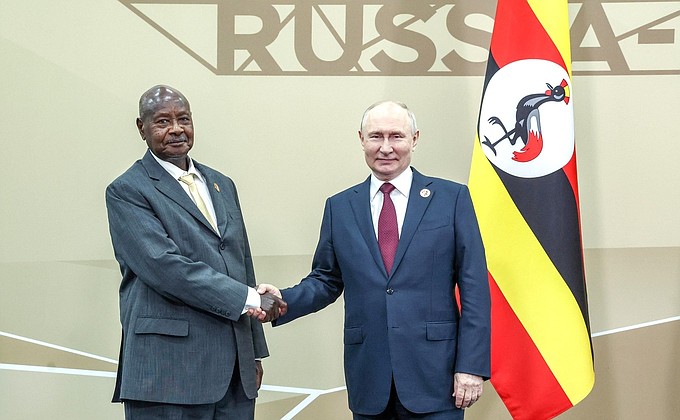
Vladimir Putin described the summit as yielding a “substantial package of important, mutually beneficial agreements,” TASS reported. He framed the relationship in the language of history, invoking the “combat brotherhood” that Russia and Vietnam trace to the Soviet period, when Moscow backed Hanoi against the United States. To Lam said the visit was aimed at turning “commitments into action” across energy, defence, and science. Both formulations served their purpose. The specific deals had already been signed before either leader spoke.
What gives the summit its wider significance is what came next on To Lam’s calendar. From Moscow, his delegation flew to Paris, where Vietnam’s leader was due to attend the International Space Summit on September 9 and 10. The Moscow Times reported that To Lam’s itinerary continues to New York later this month for the United Nations General Assembly, and then to Canada. A White House official said Trump’s schedule for the UNGA period had not been finalised, leaving the question of a US-Vietnam bilateral meeting unresolved.
Vietnam calls its approach to major-power competition “bamboo diplomacy”: flexibility without commitment, bending toward each power center without breaking toward any single one. The strategy has worked during periods when that competition could be managed. It is under greater strain now. US-Vietnam trade relations are under pressure from Trump’s drive to cut bilateral deficits; Vietnamese exports to the United States have reached record levels, and the tariff exposure attached to that surplus hangs over every calculation Hanoi makes about its Western relationships.
Russia has been assembling parallel economic infrastructure designed to insulate bilateral commerce from Western financial architecture, including legislation enabling cross-border trade settlement in cryptocurrency that took effect September 1. The Vietnam energy agreements serve the same structural logic from Hanoi’s side: supply chains and energy dependencies routed away from Western-aligned providers, toward bilateral arrangements that no sanctions framework can easily interrupt.
Whether the Paris stop and the UNGA speech can absorb the signal that seventeen Kremlin documents send to Washington and Brussels is the question To Lam’s itinerary cannot itself answer. Russia has worked carefully to build a network of Asian strategic partnerships, with India, with China, and now more formally with Vietnam. Each partnership serves as a demonstration of Moscow’s continued reach independent of Western pressure. Ninh Thuan 1, once construction begins, will be the newest anchor in that network, and with a timeline running through 2031 and beyond, one of the most durable.
The bamboo in Hanoi’s foreign policy is bending under considerable weight this week. Whether it holds depends in part on what To Lam finds waiting for him in New York.