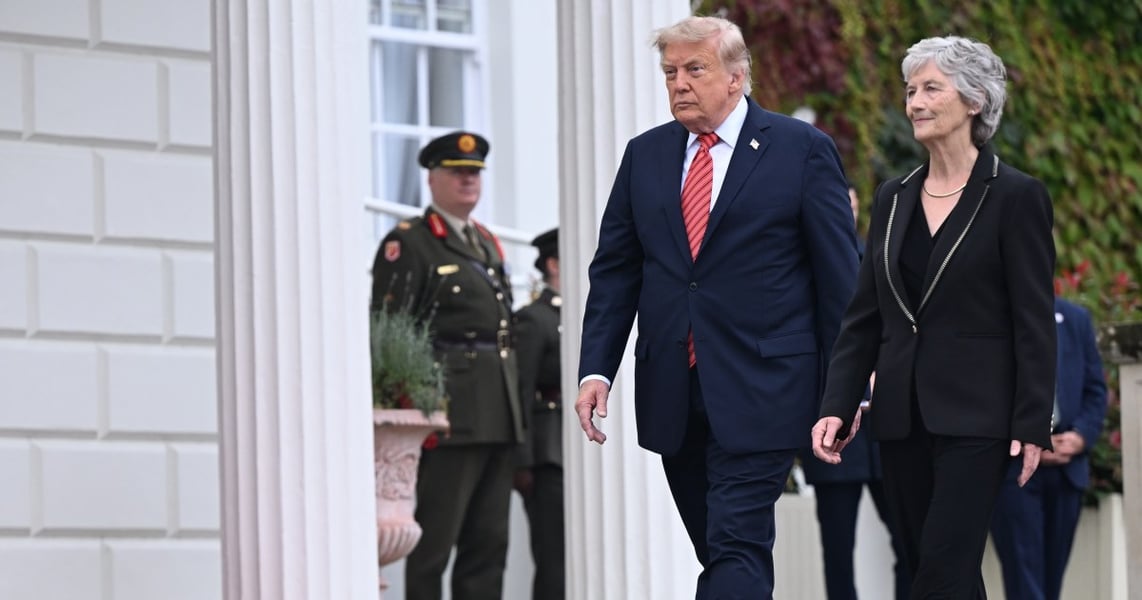

DUBLIN — Donald Trump arrived in Ireland on Saturday to meet the country’s leaders and attend a golf tournament at his own resort, and said something in a bilateral meeting that no sitting American president had publicly said in the quarter-century since the Good Friday Agreement: that he would “love” to see Ireland reunified with the United Kingdom’s Northern Ireland.
Speaking to reporters after a meeting with Taoiseach Micheál Martin at Farmleigh House in Dublin’s Phoenix Park, Trump said: “I don’t want to cause any problems, but I will tell you, I’d love to see it unified. It’s going to happen eventually. It may as well happen now.” He pointed at Martin and added: “You’ve got the right man over here to get it moving.” He allowed, almost as an afterthought, that “the UK will have something to say about it, obviously.”
The remarks broke across the political communities with the most to lose before Trump had left Dublin. Gavin Robinson, who leads the Democratic Unionist Party — the movement built on the conviction that Northern Ireland will remain part of the United Kingdom — said the question would be decided by the people of Northern Ireland alone. “As unionists,” Robinson added, “we are not interested in the destruction of our country by joining with the Irish republic.” He stressed that Northern Ireland remained British “because that is the settled democratic will of its people.”
Kemi Badenoch, leader of Britain’s Conservative Party, was equally direct. On X, she wrote that Trump was “shooting from the hip as usual” and called his remarks “deeply unhelpful” and said they “create unnecessary tension.” Badenoch said Northern Ireland is part of the United Kingdom and demanded a government that would “defend the Union clearly and confidently.” Even Nigel Farage, until recently one of Trump’s closest British allies, broke with him on the point — a measure of how far the comment landed outside acceptable bounds in British unionist politics.
The American position for the twenty-seven years since the Clinton administration helped broker the 1998 Good Friday Agreement has been consistent neutrality on the constitutional question. The US has supported the peace process and its institutions, but has declined to endorse any particular outcome on whether Northern Ireland stays British or eventually joins a unified Irish state. Presidents from both parties have held that line, aware that breaking it becomes a propaganda instrument for whichever side benefits.
Trump’s statement did not come from a speech or a formal diplomatic document. It came from a bilateral session squeezed into a trip whose primary stated purpose was the Irish Open golf tournament, hosted this year at Trump International Golf Links in Doonbeg, County Clare. The president had marked the 25th anniversary of the September 11 attacks at the Pentagon the same morning, framing the Iran war as the war on terror’s unfinished chapter, then flew to Dublin for what the White House described as a diplomatic courtesy call before the weekend’s golf. He met not only with Martin but also with Irish President Catherine Connolly, then drove west to Doonbeg.
The resort visit has drawn scrutiny since Trump’s first term. Doonbeg stands to benefit from the international attention and security presence that accompanies a presidential trip; the Irish Open, broadcast globally, provides promotional exposure that no advertising budget could replicate. The pattern of overseas engagements aligning with Trump’s commercial properties has been documented repeatedly across both of his terms.
Taoiseach Martin’s public response to the reunification remark was careful. He thanked Trump for the meeting and spoke warmly of the bilateral relationship without directly endorsing or discouraging the presidential commentary. That silence may be its own answer: there is no political cost in Ireland for a US president endorsing unification, and considerable cost for Martin in publicly pushing back against a remark that nationalists in his own constituency would welcome.
What Trump’s statement is not: a policy instrument, a legal commitment, or a diplomatic intervention with any mechanism attached. The Good Friday Agreement took decades of violence, negotiation, and American mediation to produce. It enshrines a consent principle — any change to Northern Ireland’s constitutional status requires majority support from its population. A remark in a bilateral meeting room alters none of that.
What the statement is: the first time a sitting American president has publicly said he wants to see Ireland unified. That it arrived in passing, from a trip that also included a tee time at his own golf resort, tells something about the register in which Trump treats the sensitivities of allied governments — including one, the United Kingdom, that has been among his most consistent diplomatic partners.