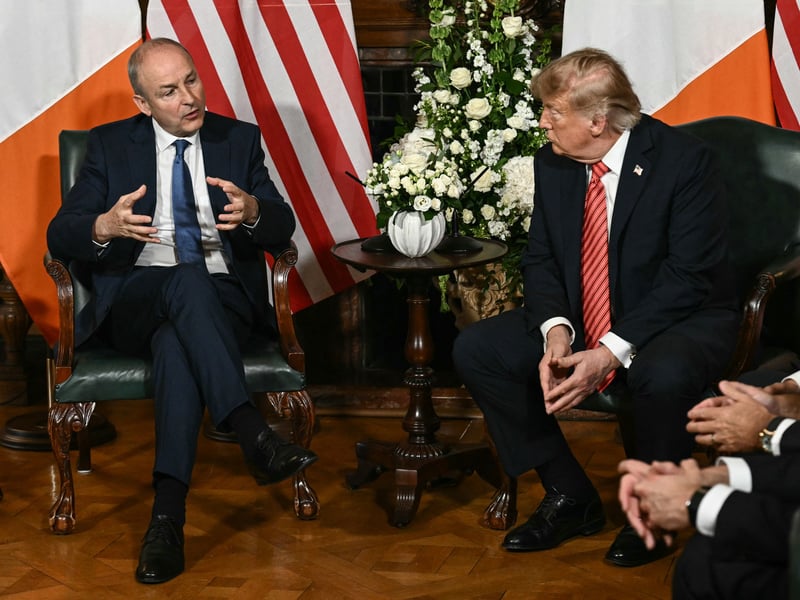

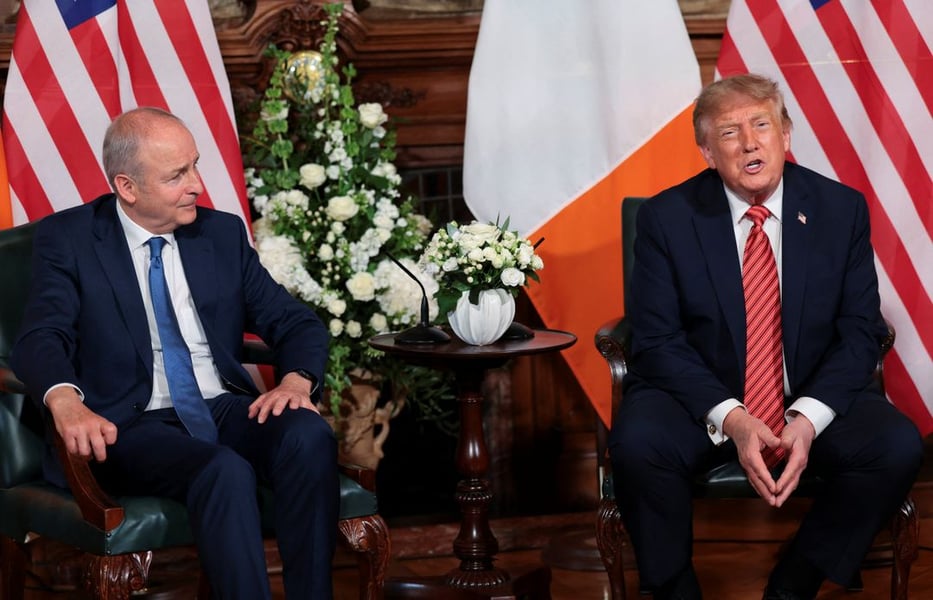
DUBLIN — The gifts were chosen carefully. Catherine Connolly, the Ceann Comhairle of the Irish parliament, presented Donald Trump on Friday with two items from a country that has particular reason to read his words closely: a copy of “Navigatio Sancti Brendani,” the medieval text recounting an Irish monk’s legendary voyage to a distant island in the north Atlantic, and a collection of Michael Longley’s verse that includes “Ceasefire,” a poem about the Northern Ireland peace process. The Greenland reference in the first gift and the Northern Ireland reference in the second were not accidental. Trump did not appear to notice either.
He had arrived in Dublin the previous afternoon with a remark that landed harder than most of his overseas improvisations: Irish unification, he told reporters, would be “fantastic.” It was “going to happen eventually,” he added, in a statement that contradicted a founding principle of the Good Friday Agreement, the 1998 accord brokered by British Prime Minister Tony Blair and US President Bill Clinton that ended three decades of political violence in Northern Ireland. The agreement is constitutionally explicit: Northern Ireland’s status can only be resolved by a majority vote of its people. The US government has consistently supported that framework across every administration since 1998. Until Friday.
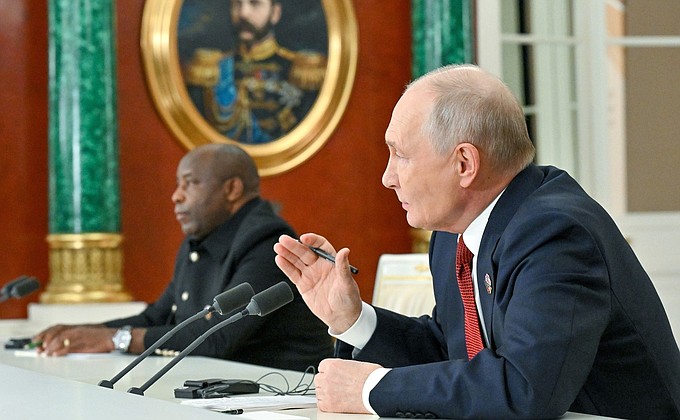
Trump was in Dublin for a two-day state visit. He met with Taoiseach Micheal Martin at Government Buildings on Friday morning, where the talks covered trade tariffs and the Gaza genocide. Martin raised Gaza directly, urging the United States to press Israel to allow humanitarian aid into the strip, before Trump broke with protocol on the way out, telling reporters that a unified Ireland would be a wonderful thing. He offered no timeline, no mechanism, and no acknowledgment that he had just walked into one of the more sensitive constitutional questions in European politics.
The reactions arrived quickly. Nigel Farage, the leader of Reform UK and one of Trump’s closest political allies in Britain, welcomed the comments without reservation. “I think we will have a united Ireland in the future,” Farage told a broadcaster, a statement that provoked immediate fury from the Democratic Unionist Party, the largest unionist party in Northern Ireland. Gavin Robinson, the DUP’s Westminster leader, called Trump’s remarks “inflammatory,” “inappropriate,” and an unwarranted interference in Northern Ireland’s constitutional future. He used the word “disgrace.”
Claire Hanna of the Social Democratic and Labour Party offered a different register. “We know how to get there without your help,” she said, a line that captured something particular about Irish nationalist politics: the goal of unification and the path to it are not improved by an impulsive American endorsement that arrives with no diplomatic follow-through.
Trump’s Dublin visit also produced a moment that had nothing to do with Ireland. At a reception Friday evening, he returned to Joe Biden unprompted, describing the former president’s cancer diagnosis as something Biden had tried to hide, characterising Biden as a “disgrace,” and suggesting the illness had impaired his predecessor’s decision-making in office. The remarks were delivered on foreign soil, at a diplomatic event attended by Irish officials. The convention against attacking domestic political opponents while abroad is among the more established norms of American diplomacy. Trump has treated it as optional since his first term, and his administration has shown a consistent willingness to discard diplomatic conventions that constrain his messaging.
What remains unresolved is whether any of this produces consequence beyond the weekend’s political noise. Trump’s comments on unification carry no policy mechanism and no formal American commitment. The Good Friday Agreement has survived greater stresses than a presidential aside on a Dublin doorstep, and the consent principle remains what it has always been. But the architecture of the agreement depends partly on the United States playing a careful and consistent role rather than a destabilising one, and Trump’s pattern of making sweeping foreign policy statements without diplomatic scaffolding has produced cascading consequences elsewhere this week. For the DUP, an endorsement of Irish unification from the American president is a political headache for everyone trying to manage Northern Ireland’s still-fragile institutions.
Connolly’s poem was not subtle. “Ceasefire” was written by Michael Longley in 1994, when a ceasefire first began to feel possible in Northern Ireland, and it ends with a vision of former enemies exchanging the bodies of their dead. Whether Trump understood what was being handed to him on a Friday afternoon in Dublin was not reported. The monk’s voyage text, with its island in the northern Atlantic, he also left without comment.