
TEHRAN — Seven months into the war, Iran brought out a number that was meant to answer a question no diplomat has dared ask aloud: how many Iranians are willing to fight?
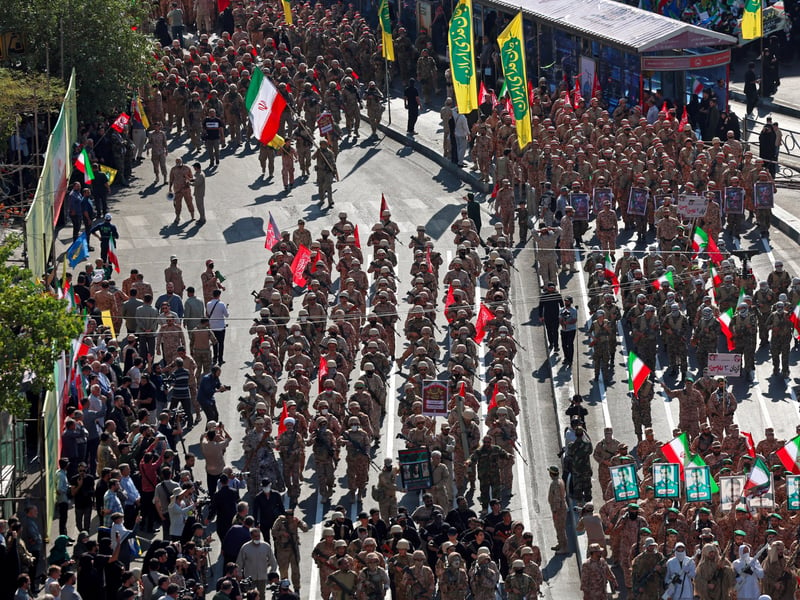
The answer, at least as the Islamic Republic chose to frame it on Thursday, was hundreds of thousands. They gathered in Tehran at a rally organized under the banner of “Janfada,” a Farsi word that roughly translates as “sacrifice for Iran,” the name of a nationwide campaign that Iranian authorities say has already registered more than 600,000 volunteer recruits for a paramilitary reserve force. President Masoud Pezeshkian stood with them. So did Hossein Taeb, head of the Basij, the ideological militia that forms the IRGC’s volunteer arm. Drone units and anti-aircraft batteries lined the ceremonial grounds. Rows of female IRGC members in uniform, carrying machine guns, stood in formation that was filmed and broadcast.
Hassan Hassanzadeh, commander of the Islamic Revolutionary Guard Corps, told state broadcaster IRIB that the Janfada force would exceed one million trained volunteers once the registration and training program reaches its projected targets. He did not specify what training the volunteers would receive, or under what command structure they would be integrated into Iran’s existing military apparatus.
Iranian authorities placed attendance at 313,000 in Tehran alone. That figure came from official sources and could not be independently verified.
The rally was, by nearly any measure, the largest public event Iran has staged since the war with the United States and Israel began in February 2026. What made it different from prior gatherings was not the crowd size but the hardware. The presence of military equipment at a civilian mobilization event, combined with banners depicting Donald Trump in crosshairs bearing the words “We will kill,” suggested a deliberate message about the direction of the conflict. Crowds chanted “Death to America” and “Death to Israel” throughout.
For seven months, Iran has fought a war that has reshaped both its economy and its geography. The United States Navy has maintained a blockade of Iranian ports, disrupting oil exports and supply chains in ways that have compressed the ordinary rhythms of daily life. The Strait of Hormuz, one of the world’s most consequential shipping lanes, through which roughly a fifth of all global oil transits, was closed by Iranian authorities early in the conflict, a move that sent Brent crude prices surging and triggered immediate supply disruptions across Asian markets. Both blockades remain in effect.
What the Janfada rally represents, beyond spectacle, is a structural question about whether Iran is preparing for a prolonged ground-phase of the war, or whether the mobilization is primarily a domestic signal, with the government demonstrating to its own population that the state is organizing rather than collapsing. The IRGC’s integration of civilian volunteers into military training programs has precedent in Iranian history, most recently in the Iran-Iraq war of the 1980s, when the Basij mobilized hundreds of thousands for the front.
The comparison carries weight and limits. The 1980s Basij deployments were conducted against a neighboring country across a defined front. The current conflict involves a naval and air-power asymmetry against two adversaries, the United States and Israel, that operate at a different order of military capability. What training, weapons, and command structure a million-strong volunteer reserve force would realistically bring to that conflict remains entirely unaddressed in the state’s public communications.
The Pentagon announced earlier this week the withdrawal of additional US ground forces from European NATO bases to redirect them toward the Middle East theater, a signal that Washington is preparing for the possibility that the conflict’s geographic scope may yet widen.
According to Al Jazeera’s reporting from Tehran, the atmosphere at the rally combined the disciplined choreography of a state-organized event with moments of evident spontaneous intensity. The crowd’s chants ran consistent through the afternoon. Female IRGC members armed with heavy weapons, a visible departure from prior public military displays in Iran, were deployed in formation in front of the main platform.
Pezeshkian, who has governed during what is simultaneously the most dangerous and most economically constrained period of the Islamic Republic’s history, has maintained public backing for the war effort without, until Thursday, having a vehicle for mass civilian military engagement. The Janfada campaign gives the government that vehicle and gives the Iranian public a role that is more than passive.
What 600,000 registered volunteers and a crowd of hundreds of thousands in Tehran actually signals about Iran’s military capacity, its willingness to absorb further escalation, and the war’s next phase remains impossible to assess from the outside. The attendance figure is unverified. The training program’s scope and timeline are undisclosed. What is clear is that the Islamic Republic chose, on September 18, 2026, to put both the crowd and the weapons in the same frame and to broadcast that frame as widely as possible.
Whether Washington and Tel Aviv read that as a signal of strength or desperation may matter less than whether ordinary Iranians do.