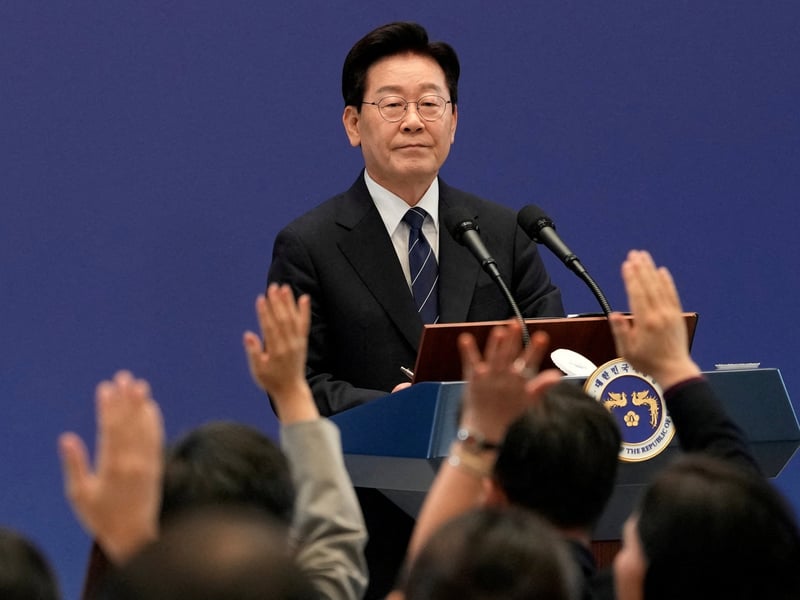

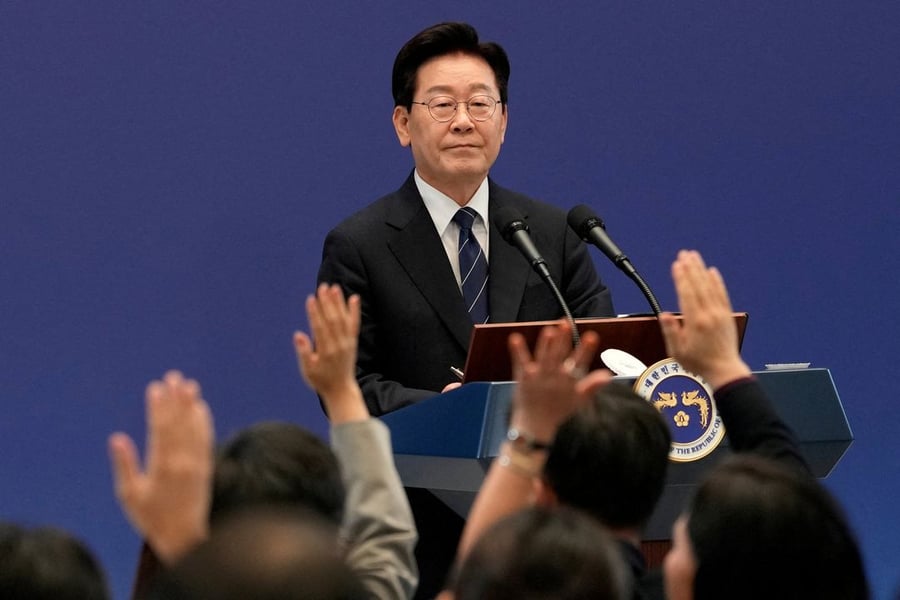
SEOUL — The diplomatic hedging ended on Friday. South Korean President Lee Jae-myung stood before cameras and made it plain: his country would not send troops or military assets to participate in the Iran war, and that position was not subject to outside pressure.
“There will not be a dispatching of troops for involvement or intervention in the war. This I can state clearly,” Lee said at a press conference, drawing a line Seoul had spent weeks avoiding. The statement came after Donald Trump publicly complained that South Korea was refusing to help defend the Strait of Hormuz while American forces remained on the Korean Peninsula to guard against the North Korean threat — a formulation Trump has returned to repeatedly as his administration looks for coalition partners in a war that has resisted military resolution.
Lee’s answer to that framing was equally direct: “We should not buckle under pressure or coercion.”
The stakes behind that sentence are significant. About 70 percent of South Korea’s crude oil imports pass through the Strait of Hormuz, which has been closed since a pipeline attack on September 10. Refining margins are under pressure. Industrial energy costs are rising. For an export economy built on energy-intensive manufacturing, the closure is not a distant geopolitical inconvenience — it is an immediate supply-chain problem. Lee acknowledged the exposure while refusing to treat it as justification for military involvement: “Like other countries, we need to undertake the minimum activities necessary to protect our merchant ships and crude oil shipping routes, as well as the lives and safety of our citizens.”
That minimum — protecting South Korean vessels and nationals — is where Lee drew his limit. One mechanism he left open is expanding the operational scope of the Cheonghae Unit, South Korea’s navy anti-piracy force currently deployed near Somalia. Under the expansion Lee appears to be considering, the unit’s destroyer and support ships would patrol closer to the Red Sea or the Strait’s approaches, staying near South Korean-flagged oil tankers without entering a combat role. It is a compromise that allows Seoul to tell Washington it is doing something while telling its own public and Tehran it is not joining a war.
Lee’s government appears to have concluded that Trump will not make that trade. Public opinion in South Korea runs sharply against military involvement — polls show broad opposition to any Hormuz deployment, particularly among supporters of Lee’s ruling Democratic Party of Korea. The South Korean constitution requires parliamentary approval for overseas military deployments, and the legislature would not easily pass that bar given the state of public sentiment. The domestic political cost of joining the war lands squarely on Lee’s government; the diplomatic cost of refusing has, so far, remained diffuse.
South Korea’s earlier steps toward deployment also encountered resistance from Tehran. In the weeks before Friday’s statement, when Seoul was actively reconsidering its Hormuz timetable after sending an assessment team to the UAE, Iran’s foreign ministry warned explicitly that any military presence near the Strait would constitute “direct support for US aggression and will have serious consequences.” The fact that Lee nonetheless hardened his refusal on Friday suggests Seoul calculated the Iranian threat as more credible than the American pressure, or that the domestic political calculus left no other path.
What Lee added at Friday’s press conference — almost as a footnote, though analysts noted it carefully — was that Trump had signaled interest in reopening dialogue with North Korea. Seoul has long regarded a return to US-North Korea diplomacy as a strategic priority, partly because reduced tension on the peninsula eases the domestic pressure that makes Lee’s coalition vulnerable. If Trump is genuinely moving toward Pyongyang even as he publicly criticizes Seoul’s Hormuz stance, the picture is more complex than a simple alliance dispute over burden-sharing. The two tracks — pressure on Hormuz, opening on North Korea — suggest a White House operating on different logics simultaneously, as Al Jazeera reported.
The longer context is one Seoul has navigated before. South Korea has not deployed combat forces in a foreign conflict since the Vietnam War and has maintained that principle across administrations of both parties. The Cheonghae Unit, which Seoul dispatched to Somali waters in 2009 and has maintained since, was designed precisely to allow South Korea to contribute to maritime security without crossing into combat roles. The architecture is not new; what is new is an American president who dispatched an explicit pressure campaign to make Seoul abandon it.
What remains unresolved is the operational question the Cheonghae expansion cannot fully answer. Whether Washington treats it as adequate — whether it satisfies the political need for Seoul to be seen as a coalition partner — is a judgment the Trump administration has not made publicly. Whether Iran views an expanded Cheonghae presence near its waters as hostile, despite Lee’s framing, is a question with consequences Seoul cannot fully control. Lee’s press conference settled one thing: South Korea will not send troops to fight in the Iran war. What happens at both ends of the alliance — in Washington’s response and in the Strait’s next escalation — is not settled yet.