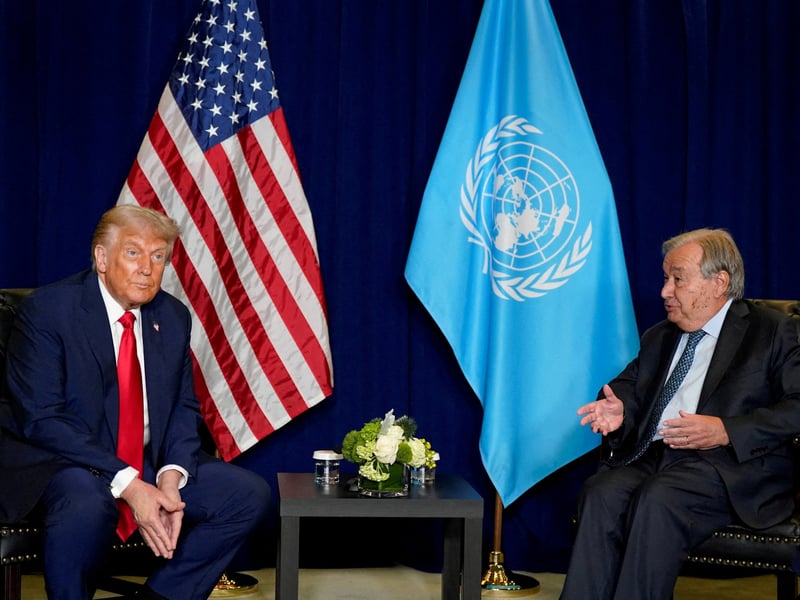

NEW YORK – When the United Nations General Assembly opens its high-level week on Tuesday, Mahmoud Abbas will not be in the room. The Palestinian Authority president was denied a visa to enter the United States for the second consecutive year, barred from traveling to New York by the same government that, one day later, guaranteed safe passage to Masoud Pezeshkian, the president of a country America has been actively bombing for seven months.
The State Department confirmed this week that it approved visas for Iran’s “core delegation” to attend High-Level Week, including Pezeshkian and Foreign Minister Abbas Araghchi, along with essential staff. The delegation will operate under strict constraints: travel limited to routes between their accommodation at the Millennium Hilton Hotel, the United Nations headquarters, and the airport. Purchases of luxury goods are prohibited. The total size of the entourage was scaled down significantly from prior years. Washington described the approval as consistent with its “host country obligations” under the 1947 United Nations Headquarters Agreement, which requires the United States as the UN’s host nation to facilitate access for foreign diplomats attending official functions.
That legal framework was applied, this week, to the country Washington is at war with. It was not applied to the delegation of a UN-recognized observer state whose president has been attempting to address the General Assembly for two consecutive years. The Palestinian Authority’s full delegation, including Abbas and senior Palestinian Liberation Organization officials, was refused entry visas, forcing Abbas to address world leaders via pre-recorded video. The European Union publicly urged Washington to reverse the Palestinian ban, citing the same 1947 Headquarters Agreement that the State Department invoked for Iran the following day, according to Middle East Eye. Washington did not respond to those requests publicly.
Pezeshkian is scheduled to address the General Assembly on Wednesday, his first appearance at UNGA as Iran’s president. The visit arrives seven months into a US-Iran war that began in February following the killing of Supreme Leader Ali Khamenei. Trump told Axios this week that he faces a “big decision” over whether to “annihilate” the Iranian regime, describing his deliberations while his administration simultaneously processed the Tehran delegation’s travel documents. “Do I want to go in and annihilate them, or do I not?” Trump said. “It’s a big decision. Anything could happen with me.” Neither the visa approval nor Trump’s statement acknowledged any tension between the two.
The war provides the heaviest context for Pezeshkian’s visit. A United Nations fact-finding mission report released this week found reasonable grounds that the United States committed war crimes in at least two February strikes on Iranian territory, including a strike on a school in Minab that killed at least 120 children. Washington disputed the finding. The Strait of Hormuz remains under restriction. A US naval blockade continues. None of that prevented the visa approval; in Washington’s interpretation of its international legal obligations, an active armed conflict does not suspend a foreign government’s right to UN representation.
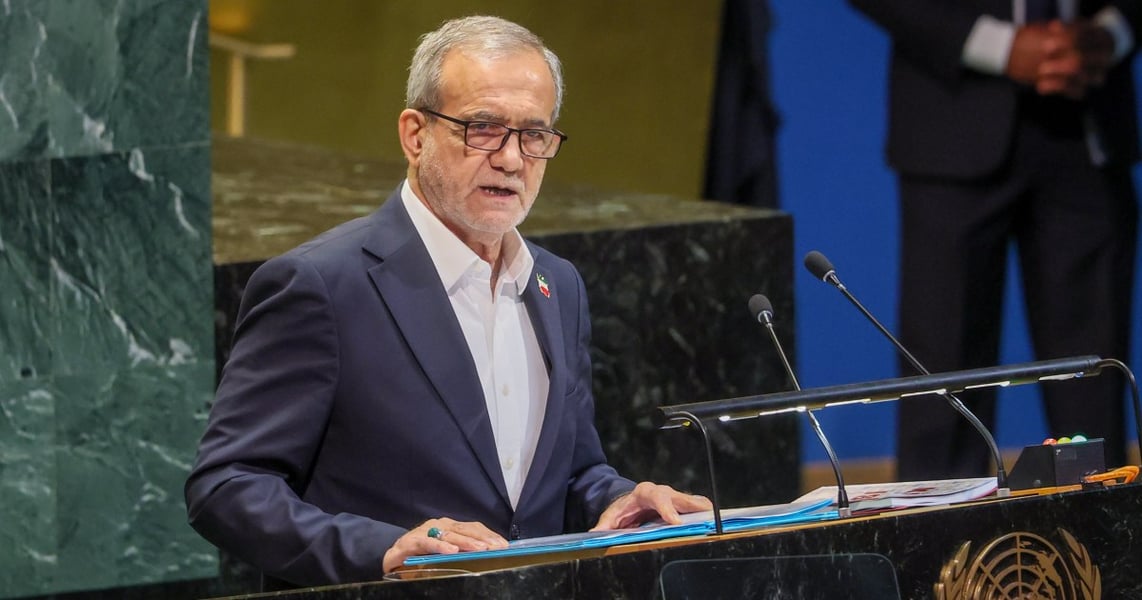
Iran had rejected US diplomatic overtures in September after Trump publicly described Iran as a “failing nation,” with the Iranian foreign ministry calling the characterization an insult incompatible with any genuine negotiation. Araghchi, who will accompany Pezeshkian to New York, is the official most closely identified with Iran’s diplomatic track. Whether that track revives in the margins of UNGA is a question the delegation’s presence in New York does not answer.
Earlier reporting established that hardline factions within the Islamic Revolutionary Guard Corps had launched unauthorized attacks on Hormuz shipping specifically to derail peace negotiations Pezeshkian’s government was pursuing. He arrives in New York as a reformist president in a war that elements of his own security apparatus have been extending. The diplomatic margins available to him are constrained by that internal reality as much as by any position Washington takes.
The Headquarters Agreement the State Department cited has been invoked many times, compelling US visa issuance for Soviet officials during the Cold War, Cuban officials through decades of embargo, and North Korean diplomats. The standard American position has been that the legal obligation holds regardless of political disagreement. As NBC News reported, the State Department described the Iran approval as consistent with that long-standing policy. On Wednesday, that policy will place Iran’s wartime president in front of the General Assembly.
What it will not do, for the second consecutive year, is place the Palestinian Authority’s president in the same hall. The Palestinian Authority has held UN observer state status since 2012. Its delegation has a recognized right to participate in General Assembly proceedings. For two consecutive years, Abbas has been refused entry while his country is described at the International Court of Justice as a site of genocide and his counterpart from a country actively at war with the United States presents his government’s case in person. The State Department offered no comparison of the two cases. The sequence of decisions offered one on its own.