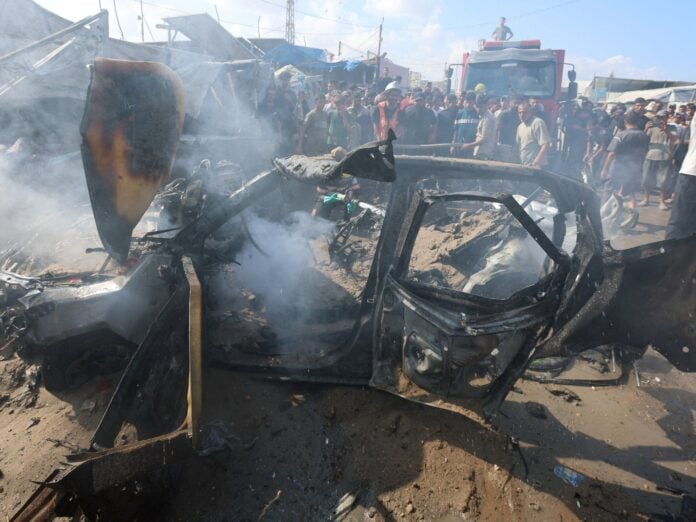
GAZA CITY — Around 2:15 in the morning on Wednesday, the al-Saada building on Al-Sina’a Street collapsed into itself. Inside were roughly 100 people, half of them children, who had moved into the six-storey block on Gaza City’s southwestern edge because the alternative was a tent, or nowhere at all. Twenty-one of them died. Twelve were children.
The building had already been struck by Israeli bombardment. Its walls were cracked, its floors slanted. Residents knew it. Local officials knew it. The Palestinian Ministry of Public Works, which has assessed more than 2,000 similar structures across Gaza as dangerous and still occupied, knew it too. But the materials that could have replaced the building as shelter, 36,960 pieces of timber and 660 emergency shelter kits approved by Israeli authorities in August, were blocked at the crossing on August 26, and again on September 2, after the United Nations filed a renewed coordination request that Israeli authorities denied, Al Jazeera reported.
COGAT, the Israeli military body responsible for coordinating aid entering Gaza, said it “regularly facilitates and encourages the entry of shelter supplies into the Gaza Strip in coordination with international organizations.” It also cited “a genuine security concern” that Hamas could use some shelter-construction components to strengthen its capabilities and rebuild its infrastructure.
The families sleeping in the al-Saada building were not part of that calculation. They died inside it.
The Norwegian Refugee Council, which documented COGAT’s approvals and rejections, said the collapse illustrated the human cost of what it described as systematic restrictions on rebuilding shelters across Gaza.
“People remain in appalling conditions because Israeli restrictions are preventing even the most basic housing materials from entering Gaza,” NRC Secretary-General Jan Egeland said. The council has called for construction materials to be allowed into Gaza immediately and continuously, without exception.
The urgency is measurable. A Shelter Cluster report based on 1,951 household interviews conducted between June 14 and June 28 in accessible areas of North Gaza, Gaza City, Deir al-Balah and Khan Younis found that 94 percent of the estimated population required shelter or basic household assistance. It classified 84 percent of assessed households as facing Critical or Catastrophic domestic living conditions, meaning they lack the basic capacity to sleep, cook, wash, store food and water, or maintain a safe living environment. Those findings were published in August, weeks before the timber and shelter kits were blocked.

Dr. Ramiz Alakbarov, the UN Humanitarian Coordinator for the Occupied Palestinian Territory, said he was “devastated by reports of people trapped under the rubble,” and called on Israeli authorities to approve the immediate entry of heavy machinery, specialized equipment, engine oil and fuel, items that, like timber, have been subject to repeated restriction at the crossing. OCHA separately warned that funding shortfalls and Israeli entry restrictions were slowing the emergency response to the collapse itself, not just the conditions that produced it.
The approaching winter adds a deadline the restriction policy has not accommodated. Gaza’s rainy season typically begins in November. An estimated 800,000 people live in areas prone to flooding, according to a UN assessment. UNICEF has warned that children in Gaza and the West Bank face acute new dangers as the season arrives, with hundreds of thousands sheltering in tents described as being in poor or very poor condition. COGAT, following international pressure after the September 16 collapse, announced it had approved additional winter equipment, including tents and tarpaulins, for entry. Whether those approvals clear the crossing, or are blocked again as the August timber and shelter kits were, remains to be seen.
The al-Saada building’s collapse is not an isolated incident. It is the most recent in a pattern that humanitarian organizations have documented since the ceasefire: materials approved on paper, blocked at the crossing, re-approved under pressure, blocked again. As the United States approved a $2.8 billion arms package to Israel in the same week and simultaneously denied Palestinian officials entry to the United Nations General Assembly, the political architecture sustaining the blockade has shown no sign of weakening. Twelve nations have moved to ban Israeli settlement goods, a coordinated step that stopped short of conditioning the broader relationship on shelter access to Gaza.
The Palestinian Ministry of Public Works figure of more than 2,000 occupied buildings assessed as dangerous is almost certainly an undercount, a product of limited assessment capacity in a territory where the instruments for such work have been systematically kept out. What is documented is that one of those buildings collapsed at 2:15 in the morning, with 100 people inside, and 21 of them, 12 of them children, did not survive.
Whether the timber and shelter kits approved in August will arrive before the next collapse is still not known.