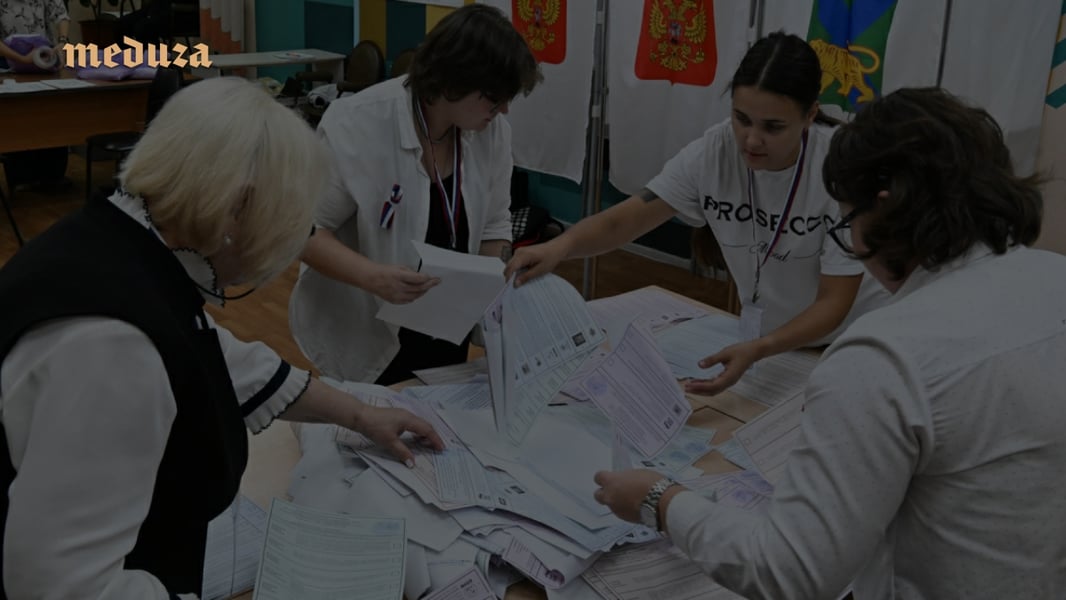

MOSCOW — Before a single precinct had reported its count on Sunday evening, Russia’s Central Election Commission knew what the final outcome of the State Duma election would look like. The only question was the margin.
By Monday morning, the party organized around Vladimir Putin held 57.82 percent of the party-list vote with more than 83 percent of precincts tallied — a result above the roughly 50 percent United Russia won in 2021 and comfortably on track to give the Kremlin’s legislative vehicle the two-thirds majority it needs to pass constitutional amendments without coalition partners. It was the first parliamentary election Russia had held since the full-scale phase of its military operation in Ukraine began four years ago.
The election produced no surprises about which parties would enter the lower house. Four other formations crossed the five-percent threshold alongside United Russia: the Communist Party at 13.84 percent, the nationalist Liberal Democratic Party of Russia at 8.77 percent, and the center-left New People at 7.07 percent. A Just Russia, the social-democratic party that had held seats in the outgoing Duma, was hovering at 4.99 percent with counting still under way — one hundredth of a percentage point below the threshold for entry. Official results are not expected before September 25.
The three-day vote was conducted entirely without competition from parties outside the sanctioned political spectrum. Genuine opposition networks, including those affiliated with imprisoned Kremlin critic Alexei Navalny, were legally prohibited from fielding candidates. No international observers with a mandate to conduct independent monitoring were admitted. Meduza, the independent Russian outlet, reported that the same five parties set to enter the new Duma were the same five that had won seats in 2021 — an outcome reflecting a political structure in which the permissible range of results had been determined before the polls opened.
United Russia’s strength in single-member constituencies underscored the breadth of its structural advantage. Its candidates led in 208 of 225 such districts as of Monday morning. Single-member seats contribute half of the Duma’s 450 total seats; the party-list results contribute the other half. Even with some precincts still counting, the arithmetic pointed unambiguously toward a final seat count well above the 300-seat threshold that constitutes a constitutional majority.
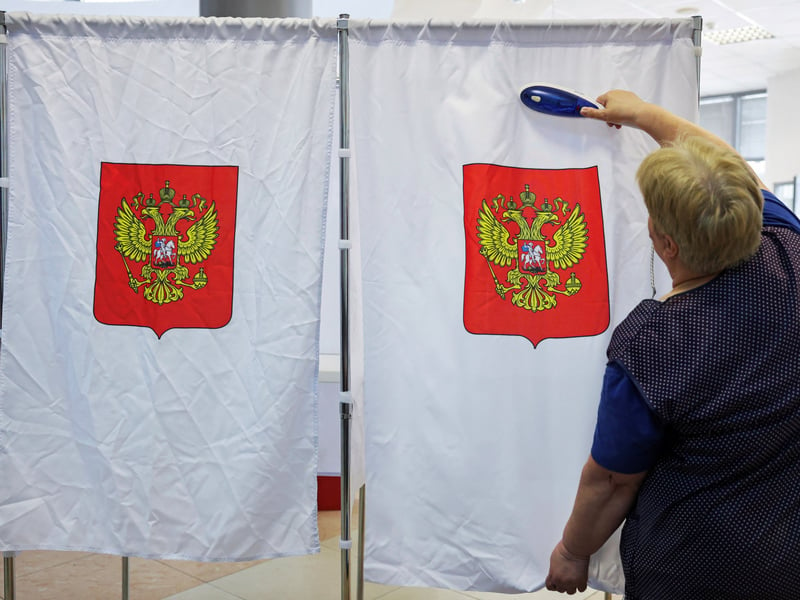
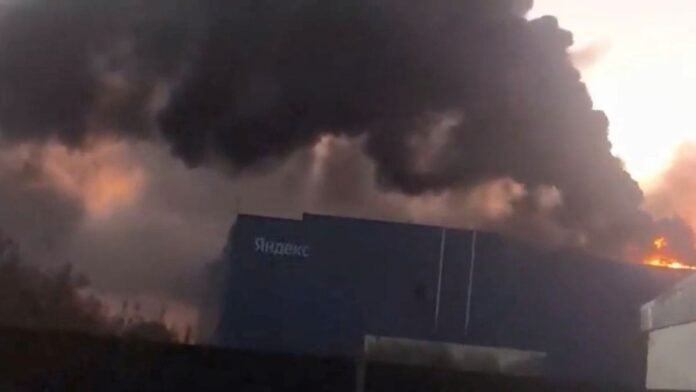
The final day of the election vote provided the most dramatic backdrop of any Russian national poll in decades. As voters cast ballots on September 20, Ukrainian forces launched the largest drone attack in the war’s history against the Russian capital, with more than 1,000 drones fired at Russia overnight and approximately 450 intercepted before reaching Moscow. The Kapotnya oil refinery caught fire. Two people were killed in the Moscow region. Mayor Sergei Sobyanin said the attack had been “clearly planned with the aim of disrupting the elections,” though polling continued on schedule and no disruptions to voting were reported.
That the attack did not change the outcome was, in one sense, beside the point. What it illustrated was the scope of the strategic reality the incoming Duma will inherit: Russia’s capital is within range of Ukraine’s increasingly long-range strike arsenal, and the legislature being sworn in this autumn has no formal mechanism for dissenting from the military course the Kremlin has set.
The Communist Party and the LDPR will return to their customary roles as controlled opposition — parties that occasionally criticize specific social policies but have voted consistently with the Kremlin’s major legislative priorities for years. The LDPR, now led by Leonid Slutsky after Zhirinovsky’s death in 2022, has positioned itself as a nationalist harder-liner on the operation. The Communists have backed it on patriotic grounds while articulating complaints about the domestic social safety net. Neither presents a structural challenge to the political direction the Kremlin is pursuing.
New People, a centrist party created in 2020 that won seats for the first time in 2021, appears to have expanded its share modestly. The party has cultivated a base among younger urban professionals and positioned itself as reform-minded within the constraints the system permits. Its presence provides a degree of visible pluralism without legislative friction.
The fate of A Just Russia, pending the last precincts, carries a separate significance. If it falls below the five-percent threshold in the official count, the party will lose parliamentary representation and a portion of its state funding — a further contraction of even the nominal diversity within Russia’s legislative structure.
The Organization for Security and Co-operation in Europe declined to deploy a full election monitoring mission after Russia refused to provide it adequate access. The incoming Duma will be legislating for a country at war, certifying a defense budget that exceeds what Russia has spent in any period since the Soviet era, and ratifying whatever diplomatic agreements eventually emerge. That its composition was effectively determined before the first ballot was cast does not diminish the practical authority it will hold.