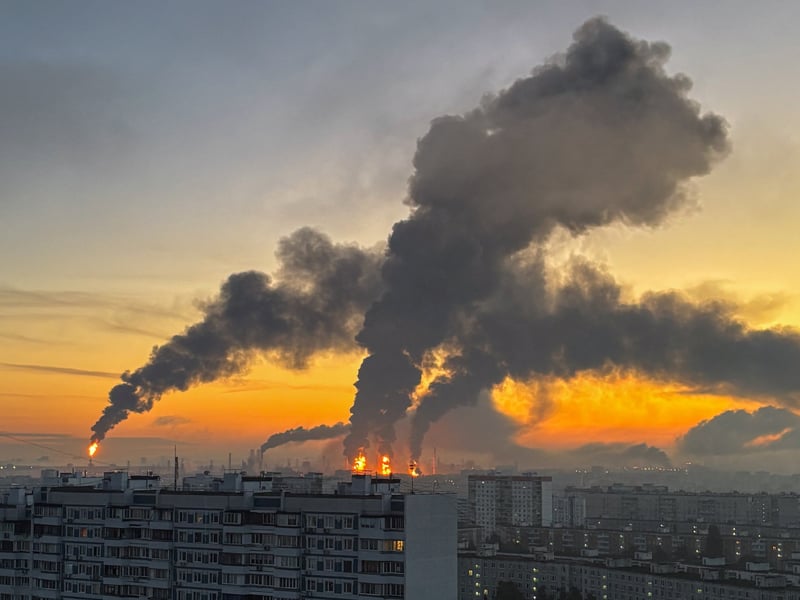

MOSCOW — At dawn Saturday, firefighters were still working through a 21-story residential building on Moscow’s southern edge when Mayor Sergei Sobyanin confirmed what the smoke above Kapotnya had already made clear: Ukraine’s overnight drone campaign had reached the Russian capital again, this time at an unprecedented scale.
Ukraine launched more than 1,000 drones at targets across Russia overnight—the largest single-night barrage either side has attempted during the conflict. Roughly 450 were aimed at the Moscow region.
The most consequential strike hit the Kapotnya oil refinery, operated by Gazprom Neft about 15 kilometers from the Kremlin. The refinery’s AVT-6 crude-distillation unit, integrated refining block, and isomerization unit were reportedly damaged.
Russia’s Defense Ministry said its air defenses intercepted 1,110 drones during the night, the highest number it has ever disclosed for a single engagement.
Sobyanin reported two deaths — a 74-year-old man and a 44-year-old woman in the Moscow region — and 20 wounded. The residential building fire forced the evacuation of roughly 400 residents before dawn. Ukraine’s General Staff named the drone systems it deployed: FP-1, RZ-100, MICH-2000, Palianytsia, Vendetta, Liutyi, Bars, Flamingo, Sich, and Pelican.
Volodymyr Zelenskyy responded on Telegram with language that made no distinction between the refinery and its surrounding neighborhoods. “Our long-range responses had a very significant impact in the Moscow region last night,” he wrote. “One of Russia’s key oil industry facilities and the aggressor’s logistics facility were hit. These are billions of dollars that sustain the war machine.” He added: “Moscow must end its brutal war and choose peace instead of building layered rings of air defense at the expense of other regions.”
CBS News reported that Zelenskyy separately said “Moscow will burn” if Putin continues the Russian military operation in Ukraine.
The timing carried its own message. Saturday was the third and final day of Russia’s State Duma elections — a three-day parliamentary vote conducted across eleven time zones, with Gazprom Neft’s refinery burning in Moscow as polls opened for their final morning. Preliminary turnout data released by Russia’s Central Election Commission showed 44.75 percent participation as of early Saturday. United Russia, the party aligned with the Kremlin, was expected to retain its supermajority in the new parliament.
“This unprecedented attack was clearly planned to disrupt the elections,” Sobyanin said. “The enemy did not succeed.”
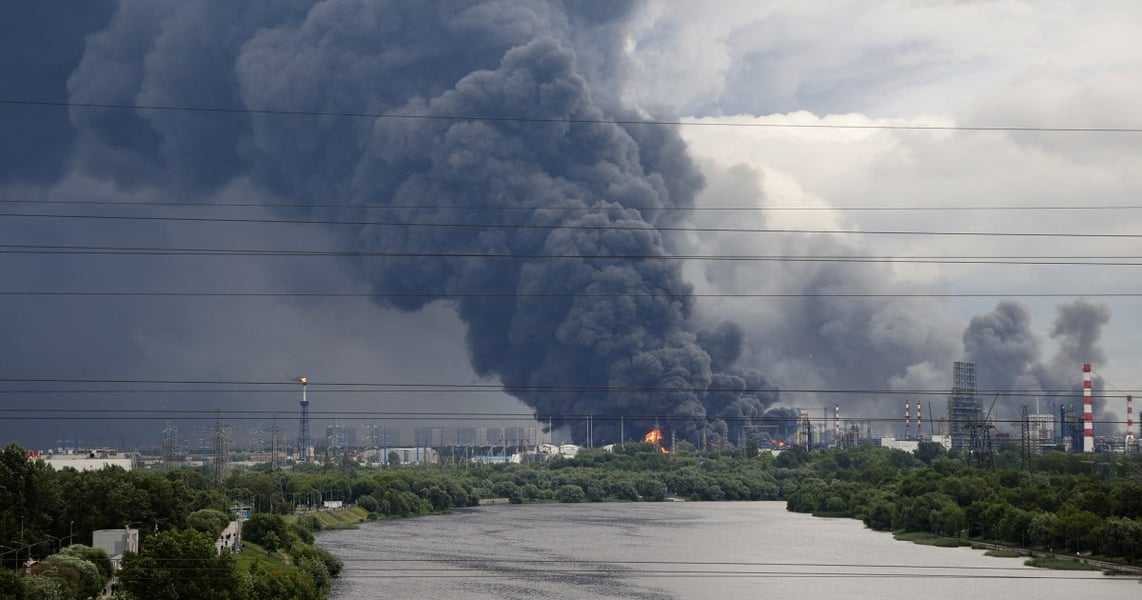
Al Jazeera confirmed the two-death toll and the breakdown of the night’s drones — 450 targeting Moscow, the remainder scattered across Russia. The Moscow Times, reporting from outside Kremlin editorial channels, noted the refinery fire required several hours for emergency services to contain. Gazprom Neft issued no statement on production capacity or repair timelines as of Saturday afternoon.
Earlier drone attacks on Moscow — including a June 2026 strike that also targeted Kapotnya — involved dozens to a few hundred aircraft and were largely absorbed by air defenses. Russia’s disclosure of 1,110 intercepts Saturday is itself a measure of the campaign’s scale: even a near-total defensive success at that volume leaves openings for the drones that reached the refinery and the residential building.
The attack arrived one week after Polish Prime Minister Donald Tusk issued a warning, based on intelligence from Polish, American, and NATO services, that Russia had a documented plan to conduct drone strikes on NATO states disguised as accidents. Tusk’s warning, which cited CIA assessments, described a strategy of calibrated ambiguity designed to paralyze NATO’s collective defense commitment. What Russia’s air defense absorbed Saturday night — 1,110 drones over a single metropolitan area — is the mirror image of that pressure: both sides are expanding the range and mass of what they are willing to attempt from the air.
Zelenskyy has also said separately that it is “time the war ended” without attaching a territorial condition to the statement. The Kremlin did not respond to it. Talks on a possible Trump-Putin summit remain unscheduled; Kyiv has not been offered a seat at any proposed table.
The Kapotnya refinery’s repair schedule, and whether Moscow’s fuel supply is affected in the coming weeks, is information that neither government is in a hurry to confirm.