
WASHINGTON — The court order arrived early Thursday morning. By the time reporters from CNN, MS NOW and Politico reached the White House gate with it in hand, the Secret Service had already been given different instructions.
For roughly six hours after U.S. District Judge Timothy Kelly issued a 14-day temporary restraining order requiring the Trump administration to immediately restore press credentials to the three news outlets, White House security turned the journalists away, confiscating hard passes from some who had not yet had their credentials seized. Three organizations that had won in court could not get through the door.
The episode, extraordinary even by the compressed timeline of Trump-era press confrontations, landed Judge Kelly in the position of demanding a written explanation from the administration by 12:30 p.m. ET on why it had not complied with his order. By midday, reporters from all three outlets were back inside. The White House, having briefly tested how far contempt of court could go uncontested, retreated.
What the morning revealed, stripped of the procedural complexity, was something simpler: an administration that intends to comply with judicial directives only when the cost of defiance becomes immediate.
Judge Kelly, nominated by President Trump in 2017 and confirmed that year, had ruled overnight that the three outlets were likely to succeed in showing their credentials were revoked without due process. The ruling was narrow, grounded not in the First Amendment arguments the plaintiffs had led with, but in Fifth Amendment procedural due process: the administration had given no notice, no opportunity to respond, and no written justification before stripping accreditation from reporters of three major news organizations.
“The court is skeptical, at least on this record, that Defendants’ interest in safeguarding national security is the actual motivation for, or is even advanced by, the revocation of Plaintiffs’ hard passes,” Kelly wrote.
The Justice Department, which had argued at an emergency hearing Wednesday that White House press access is a privilege the executive branch can extend or revoke at will, did not immediately move to stay the order. But neither did the White House comply.

The administration’s legal position had rested heavily on a claim that drew open skepticism from Kelly at Wednesday’s hearing: that national security concerns justified the ban. The outlets had been banned on September 18, when Trump announced via Truth Social that CNN, MS NOW and Politico would be stripped of their White House credentials because they “purposely write negative news.” Karoline Leavitt, the White House press secretary, had held no formal briefings since the ban took effect.
The legal foundation for restoring revoked credentials dates to 1977, when the U.S. Court of Appeals for the D.C. Circuit ruled in Sherrill v. Knight that the government cannot revoke press access without notice, an opportunity to respond, and a written explanation. The DOJ, in defending the ban at Wednesday’s hearing, asked Judge Kelly to reconsider that precedent, a request Kelly indicated he was unlikely to grant on the record before him.
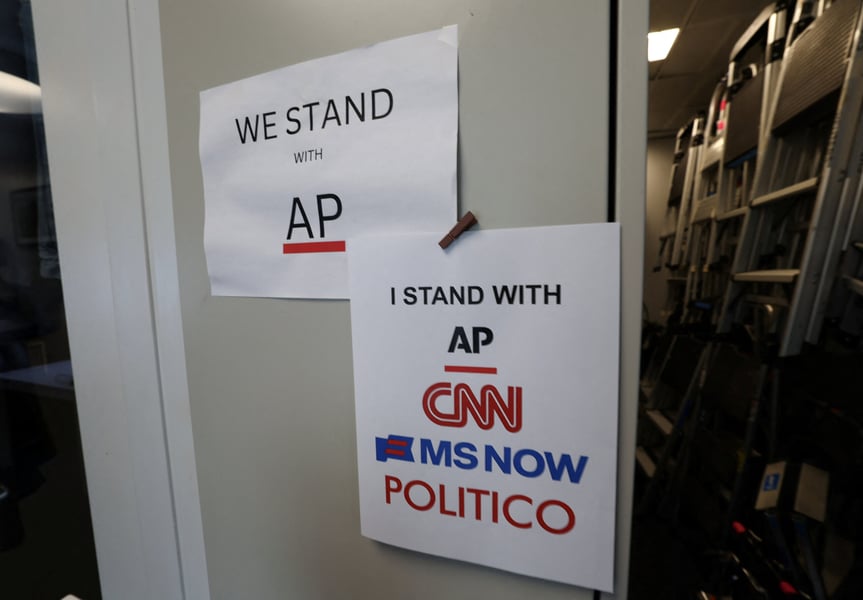
The lawsuit has drawn a parallel the administration has declined to address directly: in 2025, Trump banned the Associated Press from the White House after the outlet refused to rename the Gulf of Mexico. A federal court ordered the AP’s access restored; the administration appealed that ruling and the appeal remains pending in the D.C. Circuit. This week’s events suggest the administration views that pending appeal as reason to push the issue rather than retreat from it.
Al Jazeera reported that after the emergency filing, Judge Kelly gave the administration until 12:30 p.m. ET to explain its defiance in writing, a directive that functioned, in practice, as a clock ticking toward a contempt proceeding.
The CNN, MS NOW and Politico lawsuit framed the ban as a First Amendment violation from the outset, but Judge Kelly’s TRO found firmer ground in procedural due process, a narrower constitutional claim that does not require the court to rule on whether Trump’s criticism of the outlets motivated the ban. That narrower footing is almost certainly deliberate: it allows Kelly to act without wading into the deeper First Amendment questions that the administration is positioning for a longer legal fight.
By late Thursday morning, a CNN reporter and photojournalist were inside the briefing room. An MS NOW correspondent was reporting live on air. A Politico reporter had been let through. The gate that had been closed despite a federal court order was open.
What happens when the TRO expires, or when the administration decides again that a court order carries no particular obligation at the front gate, remains the question this ruling does not yet answer.