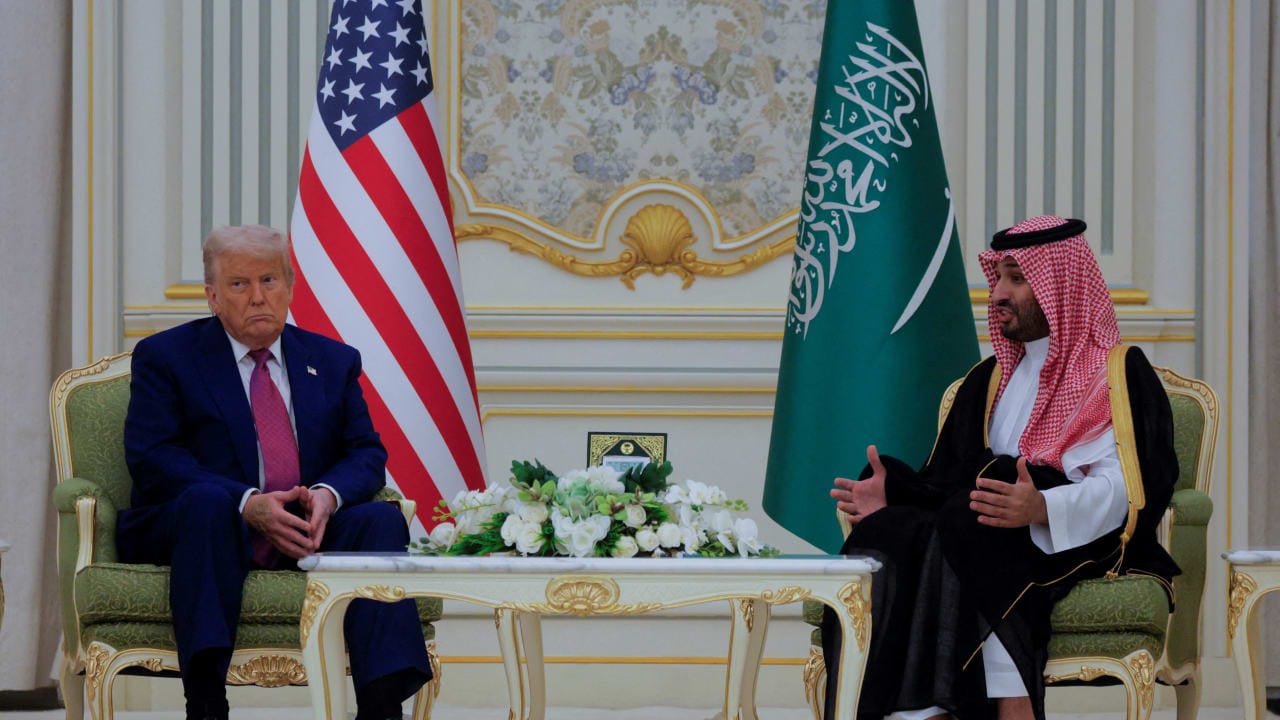

JERUSALEM – Benjamin Netanyahu built his political identity on one axiom: a nuclear Middle East is an existential threat to Israel. For three decades, he invoked that argument to justify military threats against Iran, to lobby Washington, to define his own indispensability. When the United States signed a civil nuclear cooperation agreement with Saudi Arabia on Wednesday – one that permits Riyadh to enrich uranium on its own soil – Netanyahu said nothing.
The silence has become a story of its own. While the prime minister stays quiet, the political class around him is not. The 123 agreement, named for the section of the US Atomic Energy Act that governs such deals, has cracked open a fault line inside Israel’s security establishment between those who see the deal as a manageable trade-off and those who believe it is a strategic miscalculation that will haunt the region for a generation.
At stake is whether Washington’s commitment to Israeli security – and its own non-proliferation doctrine – can survive the pressure of a $142 billion arms sale and a normalization framework that Riyadh negotiated hard to extract. Israel’s dilemma is that it wanted Saudi-Israeli normalization too, but not at this price.
“This is the most dangerous precedent the United States has set in the Middle East since it allowed Pakistan to cross the nuclear threshold,” former Defense Minister Avigdor Lieberman told reporters in Tel Aviv on Wednesday. “If Saudi Arabia enriches uranium, every other regional state will demand the same right, and within a decade we are living in a Middle East with five or six nuclear thresholds, not one.”
Lieberman’s warning tracks with what Israeli security officials have been telling their American counterparts in private, according to reporting from the Jerusalem Post. Three unnamed senior officials told the paper that the Mossad and Military Intelligence directorate submitted assessments to the cabinet warning that enrichment rights granted to Saudi Arabia would be cited by Egypt, the UAE, Turkey, and Jordan as justification to demand equivalent terms from their own civilian nuclear partners.
The argument that enrichment rights are contagious is not new. But the agreement signed Wednesday is the first time Washington has extended them to a Sunni Arab state in a region where Iran’s own enrichment program has been the primary driver of Israeli military planning for fifteen years. The US defense bill passed earlier this month already deepened the American-Israeli military supply chain in ways that were designed, in part, to give Jerusalem reassurance ahead of exactly this kind of diplomatic move.
The reassurance has not landed. Naftali Bennett, who led Israel’s government before Netanyahu’s return, was more direct than Lieberman. “Netanyahu promised the public he would stop Iran’s nuclear program and block regional nuclearization. He failed on Iran. Now he is failing on Saudi Arabia. The question is not what the Americans have signed – it is why Israel has no leverage left to change it,” Bennett posted on social media Wednesday morning.
In Washington, opposition arrived from an unexpected corner. Senator Ed Markey, a Massachusetts Democrat who has spent years pushing for stricter non-proliferation standards, called the deal a “gold standard failure” in a statement Wednesday – borrowing language from the Obama-era framework that barred enrichment and reprocessing rights as a condition of nuclear cooperation. The Trump administration waived that standard for Riyadh, according to the Washington Post, in exchange for commitments on transparency, IAEA inspections, and a pledge not to pursue weapons. Saudi officials say those commitments are enforceable. Critics say they are not.
What the deal does not include is the one thing Israel wanted: a Saudi commitment to forgo enrichment entirely. That demand was reportedly on the table through early 2025, according to the Jerusalem Post, and was dropped after Riyadh made clear it would walk away from normalization talks before accepting it. Whether that concession will prove to have been worth the normalization it was designed to enable is a question the Israeli government has not yet answered publicly – and may not be able to answer until the first Saudi centrifuge spins.
The Israeli cabinet has not scheduled a formal discussion of the deal. The US Embassy in Tel Aviv has not publicly briefed Israeli counterparts on the final terms. Netanyahu’s office did not respond to a request for comment. What Iran’s drone strikes on CIA stations last week demonstrated is that the regional security environment into which this agreement lands is already under severe stress. Whether the deal manages that stress or compounds it is not yet knowable. That ambiguity is the point where the debate inside Israel currently sits, unresolved, and likely to remain so.