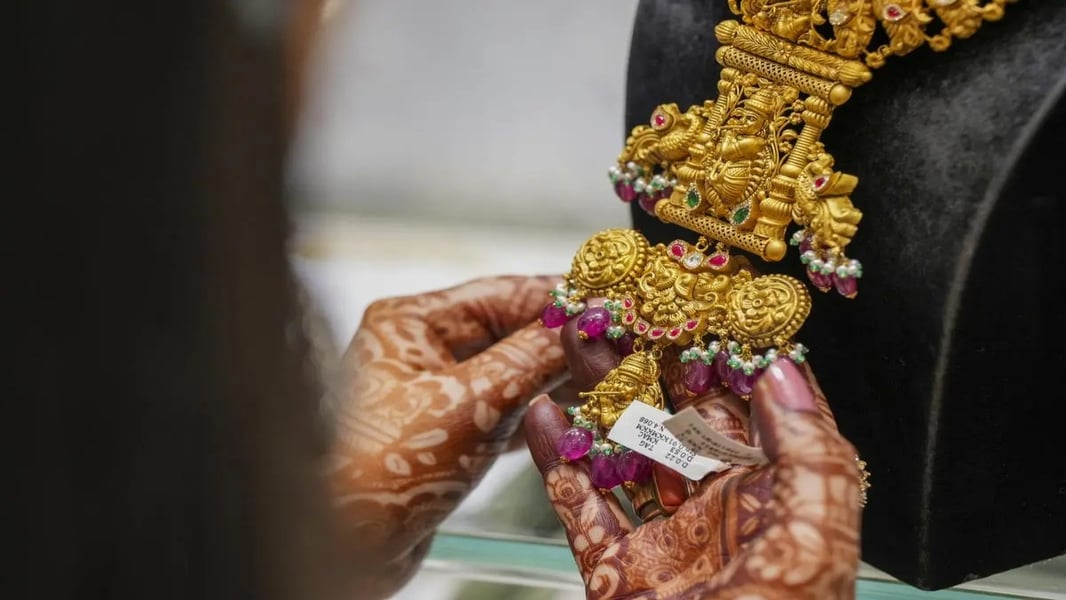

MUMBAI — At Zaveri Bazaar on Monday morning, the India Bullion and Jewellers Association issued its first benchmark of the week, and the number reflected seven days of quiet accumulation. At ₹15,813 per gram, 24-karat gold was ₹230 higher than it had been the previous Monday — a gain that arrived not with a single decisive session but with the steady pressure of forces playing out in Washington, Beijing, and the futures pits of New York.
| Purity | Per Gram | Per 10g | Change |
|---|---|---|---|
| 24K — 999 Fine | ₹15,813 | ₹1,58,130 | — |
| 22K — 916 KDM | ₹14,495 | ₹1,44,950 | — |
| 18K — 750 Fine | ₹11,860 | ₹1,18,600 | — |
| All rates per India Bullion and Jewellers Association (IBJA) base benchmark for Mumbai and Maharashtra. Rates unchanged from Friday, September 19 — IBJA does not revise benchmarks on weekends. All figures exclude GST (3%), making charges, and applicable levies. Confirm final price with your jeweller before purchase. | |||
When the Federal Reserve raised its benchmark rate by 25 basis points on September 16, driving borrowing costs to their highest in three years at 3.75 to 4.00 percent, the conventional logic called for a gold selloff. Higher rates lift the dollar and raise the cost of holding non-yielding bullion. Spot gold fell briefly, then recovered above $4,300 per ounce within two sessions. By the weekend, the domestic benchmark carried none of the expected drag. What the Federal Reserve signals for December remains open, but September’s effect on gold was shorter-lived than rate hawks had expected.
India Bullion and Jewellers Association benchmarks, which underpin all domestic pricing, carry a state-levy overlay that lifts rates in the northern tier to ₹15,829 per gram for 24-karat. That premium reflects the combined weight of Delhi, Uttar Pradesh, Punjab, Haryana, and Rajasthan, where wedding-season demand flows nearly without break into the Navratri shopping window opening Tuesday. Buyers in Gujarat, Bihar, and Madhya Pradesh pay ₹15,819 per gram under a second-tier levy structure. The Maharashtra and South India base tier — covering Mumbai, Bangalore, Chennai, Kolkata, and nineteen cities in all — stands at ₹15,813 per gram.
| Country / Market | Currency | 24K / gram | INR Equiv |
|---|---|---|---|
| United States | USD | $140.72 | ₹15,813 |
| United Kingdom | GBP | £109.09 | ₹15,741 |
| UAE (Dubai) | AED | 516.9 | ₹15,813 |
| Saudi Arabia | SAR | 527.7 | ₹15,813 |
| Singapore | SGD | 185.6 | ₹15,808 |
| Germany / France | EUR | €126.9 | ₹15,813 |
| Prices converted at September 20, 2026 New York closing exchange rates. Gold spot: $4,377/oz. USD/INR implied rate: ₹112.37. All figures are indicative. | |||
Goldman Sachs’ commodities desk has maintained its twelve-month gold target at $5,000 per ounce since mid-August, citing three structural pillars that a single rate hike cannot displace. The first is central bank demand: official sector purchases have averaged more than 900 tonnes a year over the past three years, and both the People’s Bank of China and the Reserve Bank of India resumed net buying in the third quarter, according to data from the World Gold Council. The second is the energy-cost premium embedded in mining economics, which keeps marginal supply tight even as prices rise. The third is the de-dollarisation trade — slow but uninterrupted — that has redirected sovereign reserves away from US Treasuries and toward physical gold.
JPMorgan’s fixed-income analysts offered a sharper read on the September 16 vote. The hike was unanimous, but the Federal Reserve’s updated dot plot projected no further increases in 2026. That forward guidance mattered more to gold traders than the rate move itself. A tightening cycle that has already signalled its ceiling removes a key headwind from bullion. What remains are the structural buyers, and as of Monday, they were not selling.
| City | State | 24K / gram | 22K / gram | 18K / gram |
|---|---|---|---|---|
| Tier A — Delhi / NCR / UP / Punjab / Haryana / Rajasthan · 24K ₹15,829 · 22K ₹14,510 · 18K ₹11,872 | ||||
| New Delhi | Delhi | ₹15,829 | ₹14,510 | ₹11,872 |
| Noida | Uttar Pradesh | ₹15,829 | ₹14,510 | ₹11,872 |
| Gurgaon | Haryana | ₹15,829 | ₹14,510 | ₹11,872 |
| Meerut | Uttar Pradesh | ₹15,829 | ₹14,510 | ₹11,872 |
| Agra | Uttar Pradesh | ₹15,829 | ₹14,510 | ₹11,872 |
| Kanpur | Uttar Pradesh | ₹15,829 | ₹14,510 | ₹11,872 |
| Lucknow | Uttar Pradesh | ₹15,829 | ₹14,510 | ₹11,872 |
| Varanasi | Uttar Pradesh | ₹15,829 | ₹14,510 | ₹11,872 |
| Jaipur | Rajasthan | ₹15,829 | ₹14,510 | ₹11,872 |
| Chandigarh | Union Territory | ₹15,829 | ₹14,510 | ₹11,872 |
| Amritsar | Punjab | ₹15,829 | ₹14,510 | ₹11,872 |
| Ludhiana | Punjab | ₹15,829 | ₹14,510 | ₹11,872 |
| Tier B — Gujarat / Bihar / Madhya Pradesh · 24K ₹15,819 · 22K ₹14,501 · 18K ₹11,864 | ||||
| Ahmedabad | Gujarat | ₹15,819 | ₹14,501 | ₹11,864 |
| Surat | Gujarat | ₹15,819 | ₹14,501 | ₹11,864 |
| Vadodara | Gujarat | ₹15,819 | ₹14,501 | ₹11,864 |
| Rajkot | Gujarat | ₹15,819 | ₹14,501 | ₹11,864 |
| Indore | Madhya Pradesh | ₹15,819 | ₹14,501 | ₹11,864 |
| Bhopal | Madhya Pradesh | ₹15,819 | ₹14,501 | ₹11,864 |
| Patna | Bihar | ₹15,819 | ₹14,501 | ₹11,864 |
| Tier C — Maharashtra / South India / East · 24K ₹15,813 · 22K ₹14,495 · 18K ₹11,860 | ||||
| Mumbai | Maharashtra | ₹15,813 | ₹14,495 | ₹11,860 |
| Pune | Maharashtra | ₹15,813 | ₹14,495 | ₹11,860 |
| Thane | Maharashtra | ₹15,813 | ₹14,495 | ₹11,860 |
| Nagpur | Maharashtra | ₹15,813 | ₹14,495 | ₹11,860 |
| Nashik | Maharashtra | ₹15,813 | ₹14,495 | ₹11,860 |
| Kolkata | West Bengal | ₹15,813 | ₹14,495 | ₹11,860 |
| Bhubaneswar | Odisha | ₹15,813 | ₹14,495 | ₹11,860 |
| Guwahati | Assam | ₹15,813 | ₹14,495 | ₹11,860 |
| Raipur | Chhattisgarh | ₹15,813 | ₹14,495 | ₹11,860 |
| Goa | Goa | ₹15,813 | ₹14,495 | ₹11,860 |
| Bangalore | Karnataka | ₹15,813 | ₹14,395 * | ₹11,860 |
| Hyderabad | Telangana | ₹15,813 | ₹14,495 | ₹11,860 |
| Chennai | Tamil Nadu | ₹15,813 | ₹14,495 | ₹11,860 |
| Coimbatore | Tamil Nadu | ₹15,813 | ₹14,495 | ₹11,860 |
| Madurai | Tamil Nadu | ₹15,813 | ₹14,495 | ₹11,860 |
| Kochi | Kerala | ₹15,813 | ₹14,495 | ₹11,860 |
| Trivandrum | Kerala | ₹15,813 | ₹14,495 | ₹11,860 |
| Visakhapatnam | Andhra Pradesh | ₹15,813 | ₹14,495 | ₹11,860 |
| Vijayawada | Andhra Pradesh | ₹15,813 | ₹14,495 | ₹11,860 |
| Rates sourced from India Bullion and Jewellers Association benchmark with state-specific levy adjustments. All figures exclude GST (3%) and making charges. * Bangalore 22K reflects Karnataka’s lower jewellery levy; all other Tier C cities follow the base benchmark. Rates carry over from Friday, September 19 — IBJA does not revise benchmarks on weekends. | ||||
| Grade | Per Gram | Per Kg | Change |
|---|---|---|---|
| 999 Fine Silver | ₹255.0 | ₹2,55,000 | — |
| 925 Sterling | ₹235.9 | ₹2,35,900 | — |
| 800 Grade | ₹204.0 | ₹2,04,000 | — |
| Silver rates per IBJA benchmark for September 19, 2026. Rates unchanged over the weekend. All figures exclude GST. | |||
Is gold a good buy this week in India?
The conditions for sustained demand are intact. Navratri begins September 22, opening a six-week window of festive and wedding purchasing that historically lifts Indian gold consumption by 20 to 30 percent above the pre-festival run rate. Prices have climbed ₹230 per gram since September 14, but the gain has been orderly — spread across a full week without a single-session spike. Whether the next push comes from a softer US jobs print, a surprise central bank purchase announcement, or from the weight of festival absorption alone is not yet clear.
What is the gold rate in Mumbai today?
In Mumbai, 24-karat gold stands at ₹15,813 per gram, or ₹1,58,130 for 10 grams. The Maharashtra base rate applies across Pune, Thane, Nagpur, and Nashik as well. 22-karat gold is ₹14,495 per gram, and 18-karat is ₹11,860 per gram. All figures exclude GST at 3 percent and making charges, which typically add 8 to 14 percent above the spot price of fabricated jewellery.
Why did gold hold firm after the Fed rate hike?
Three mechanisms kept bullion resilient. First, the Federal Reserve’s own dot plot — projecting no further increases in 2026 — capped the dollar’s post-meeting move. Second, the week of the rate decision brought a sharp escalation in Middle East energy risk, with crude oil above $100 a barrel, reactivating gold’s role as an energy-cost hedge. Third, India’s festive demand put a floor under the IBJA rate regardless of what Comex futures did during the week.
How does GST apply to gold purchases in India?
Goods and Services Tax on gold is levied at 3 percent on the value of metal and an additional 5 percent on making charges for finished jewellery. Buyers who purchase plain gold bars or coins pay only the 3 percent base levy. The 5 percent surcharge applies exclusively to the fabrication component, which varies by design and jeweller. Neither levy appears in the city-rate table above — those prices reflect pure metal value at the IBJA benchmark, and the final bill will be higher once GST and making charges are added.
What happens to gold in the coming week hinges on how Navratri buyers respond to accumulated prices. Central bank demand from China and India has set a structural floor that rate hikes have not been able to crack. The next session will show whether domestic festival demand can do what that structural buying has already done for the international price: make ₹15,813 the floor, not the ceiling.