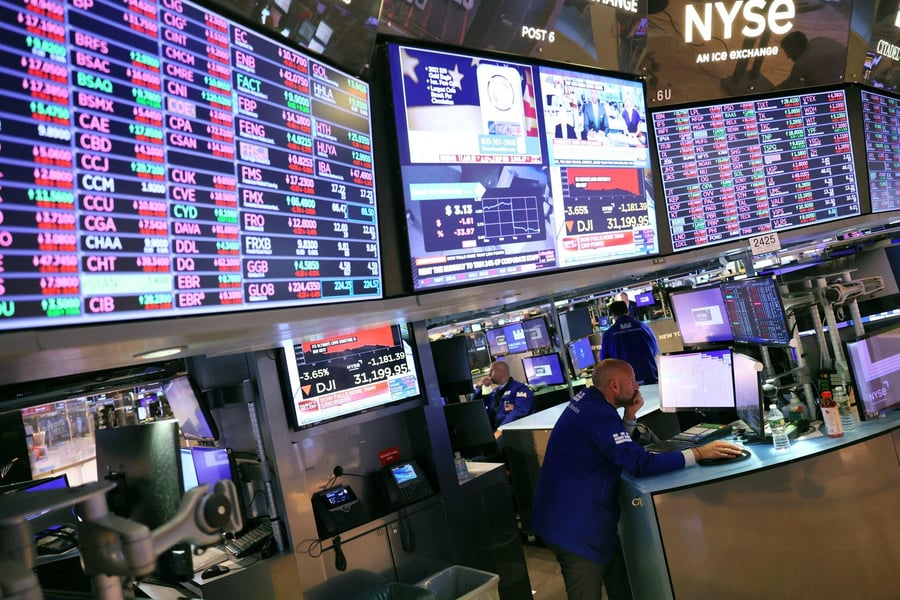

Wall Street came under renewed pressure as the Dow Jones Industrial Average fell as much as 500 points, while the benchmark 10-year US Treasury yield climbed above 5%, reaching its highest level since 2007. The sharp moves reflected growing investor concern over higher oil prices, renewed inflation risks and the prospect of tighter monetary policy from the Federal Reserve.
The Dow led the broader stock-market decline during afternoon trading, falling roughly 1% at its session low. The selling pressure came as investors confronted a combination of rising energy costs and rapidly increasing Treasury yields, developments that can raise borrowing costs across the economy and put additional pressure on equity valuations.
The 10-year Treasury yield climbed as high as 5.04%, marking a fresh high not seen since 2007 before the yield later pared some of its gains. The move in the bond market quickly became one of the central developments for investors, particularly because the 10-year Treasury is closely watched as a benchmark for borrowing costs ranging from mortgages and corporate debt to other financial instruments. The Eastern Herald has also tracked the broader rise in US Treasury borrowing costs and its implications for financial markets. US 30-Year Treasury Yield Holds Above 5% Since 2007
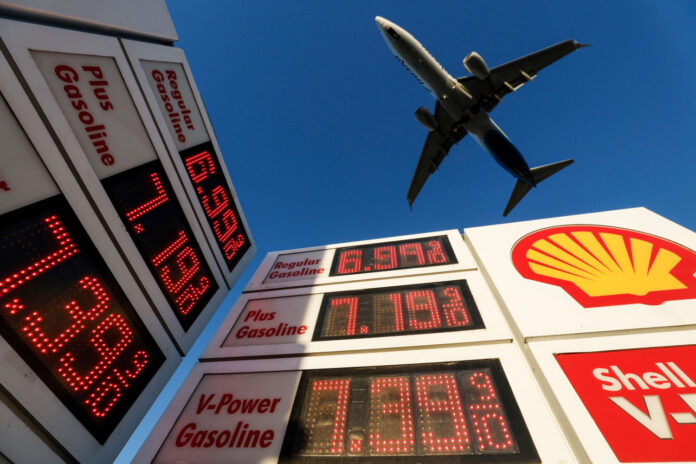
At the same time, oil prices continued to rise. Brent crude gained about 2% to trade above $108 a barrel, adding another layer of concern for markets already worried about inflation. The move follows an extended period of volatility in crude markets, with The Eastern Herald previously reporting Brent’s rise above $100 amid supply and geopolitical concerns. Brent Crude Tops $100 After Houthi Tanker Strike
The latest increase in energy prices was linked in part to the closure of a crucial crude pipeline in Saudi Arabia. The disruption to the country’s East-West pipeline has rattled investors because any prolonged interruption to oil infrastructure can tighten available supplies and increase pressure on crude prices. Reuters reported that Saudi Arabia suspended oil shipments to Europe after attacks damaged the East-West pipeline, while Brent crude approached $108 a barrel. Reuters report on Saudi oil shipments and pipeline disruption
Higher oil prices represent a particular challenge for policymakers because they can feed into transportation, manufacturing and consumer costs. If energy prices remain elevated, investors may worry that inflation could prove more persistent, complicating the Federal Reserve’s efforts to determine the appropriate path for interest rates.
The combination of surging oil prices and rising Treasury yields therefore created a difficult backdrop for stocks.
Dow Bears the Brunt of the Selling
The Dow’s decline stood out during the afternoon session, with the index falling as much as 500 points before recovering some ground. A decline of that magnitude reflects the sensitivity of major US stocks to changes in interest-rate expectations and economic conditions.
Investors have been particularly focused on Treasury yields because higher yields can make bonds more attractive relative to equities while also increasing the discount rate used to value future corporate earnings.
When Treasury yields rise sharply, companies and consumers can face higher financing costs. Businesses may become more cautious about investment, while households can encounter higher borrowing costs. For equity investors, the prospect of tighter financial conditions can weigh on expectations for economic growth and corporate profits.
For additional market context, The Eastern Herald’s recent coverage of US equity markets has examined the relationship between stock valuations, Treasury yields and Federal Reserve policy. S&P 500 Market and Federal Reserve Analysis
The latest move above 5% in the 10-year Treasury yield consequently carried significance beyond the bond market.
The yield’s rise also reinforced expectations that the Federal Reserve could take a more aggressive approach to monetary policy. Investors are now looking ahead to the central bank’s interest-rate decision, with markets increasingly pricing in the possibility of another rate increase.
Fed Rate-Hike Expectations Jump
Expectations for the Federal Reserve have shifted significantly in the past week.
According to CME Group data cited in market coverage, investors were assigning a 93% probability to a quarter-percentage-point rate hike at the upcoming decision. That compared with a 59% probability one week earlier.
The sharp change in expectations demonstrates how quickly financial markets can react when inflation and energy-price risks intensify.
The Federal Reserve has been attempting to balance inflation control against the risk of putting excessive pressure on economic growth. A renewed increase in energy prices can complicate that balancing act because higher fuel costs can contribute to broader inflation even when demand in other areas of the economy is weakening.
For investors, the question is no longer simply whether oil prices will remain elevated. The bigger concern is whether an extended energy-price shock could influence inflation expectations and force policymakers to maintain higher interest rates for longer.
That possibility is particularly important for stocks whose valuations depend heavily on expectations of future earnings and interest rates.
Oil Becomes a Major Market Risk
The rise in Brent crude above $108 a barrel has become an important part of the market story.
Oil is one of the most closely watched commodities for inflation because changes in crude prices can affect the cost of transportation, logistics and production throughout the economy. A sustained increase can therefore have consequences far beyond gasoline prices.
The Saudi pipeline disruption has added to those concerns.
Saudi Arabia’s East-West pipeline is strategically important because it provides an alternative route for moving crude toward the Red Sea. Any disruption involving major oil infrastructure can cause traders to reassess supply risks and potentially add a geopolitical premium to crude prices.
Reuters reported that the 1,200-kilometer pipeline can transport roughly 4 million to 5 million barrels of oil per day, making the disruption particularly significant for global supply concerns. Reuters report on Saudi East-West pipeline shutdown
The market reaction illustrates how quickly developments in the energy sector can spread into financial markets.
A higher oil price can benefit energy producers, but it can create challenges for many other companies that rely on fuel and transportation. Airlines, manufacturers, logistics companies and other energy-intensive businesses can see their costs increase if crude prices remain elevated.
Consumers can also feel the impact through higher fuel and transportation expenses, potentially leaving less money available for discretionary spending.
Treasury Yield Crosses a Critical Threshold
The move in the 10-year Treasury yield above 5% is arguably one of the most significant developments for investors.
The benchmark yield has a broad influence on financial conditions. When it rises, borrowing costs can increase across the economy. It can also alter the relative attractiveness of stocks and bonds, particularly for investors seeking income.
The latest move to 5.04% marked the highest level since 2007, placing the benchmark yield at a level that markets have not seen in many years.
That historical comparison is important because it highlights how dramatically the interest-rate environment has changed.
For much of the period following the global financial crisis, exceptionally low interest rates supported higher valuations for financial assets. The subsequent rise in inflation and the Federal Reserve’s tightening cycle fundamentally changed that environment.
The renewed climb in Treasury yields suggests investors remain concerned about inflation, economic resilience and the future path of monetary policy.
What Investors Are Watching Next
The Federal Reserve’s interest-rate decision is now the immediate focus for financial markets.
Investors will be watching not only the rate decision itself but also the central bank’s assessment of inflation, energy prices, economic growth and future policy.
A quarter-percentage-point increase has increasingly been priced into markets, meaning the reaction could depend heavily on the Fed’s guidance about what comes next.
If policymakers signal that additional rate increases could be necessary, Treasury yields could remain under upward pressure and potentially increase the strain on stocks.
Conversely, any indication that the central bank sees the inflation shock as temporary could ease some pressure on markets.
Oil prices will also remain critical.
If Brent crude continues moving higher, investors may become increasingly concerned about another wave of inflationary pressure. If prices stabilize or retreat, some of those concerns could ease.
For Wall Street, the challenge is that the market is confronting several interconnected risks at the same time.
A stronger oil market can increase inflation. Higher inflation can encourage tighter monetary policy. Tighter monetary policy can push Treasury yields higher. Higher yields can then weigh on equity valuations and increase borrowing costs.
That chain of events has placed the Dow and other major US stock indexes under renewed pressure.
For now, the market’s attention remains firmly fixed on the intersection of oil prices, Treasury yields and Federal Reserve policy. With the 10-year yield above 5% and Brent crude above $108 a barrel, investors are entering the Fed decision with significantly greater concern about the inflation outlook than they had just one week earlier.