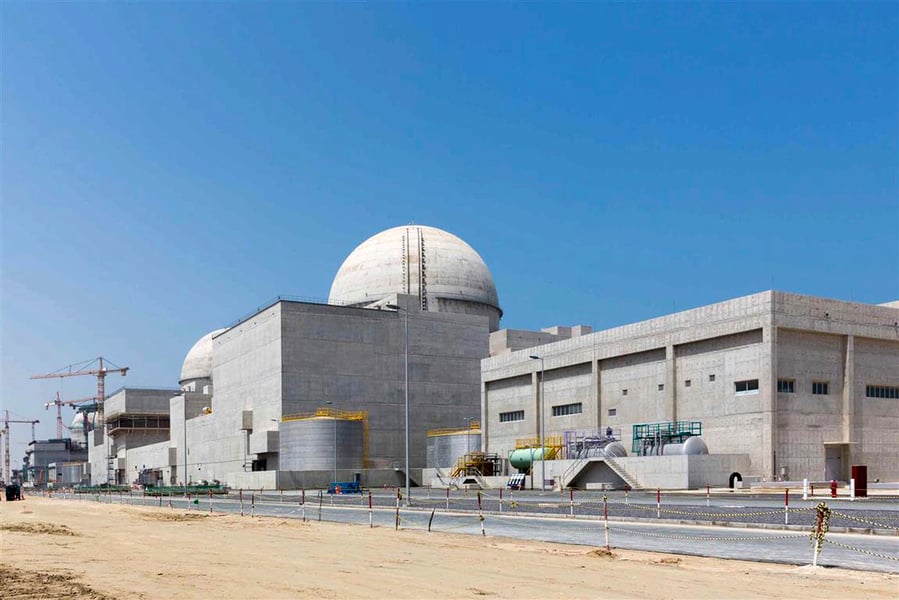

ABU DHABI — The United Arab Emirates gave the green light Monday to the start-up of the Barakah nuclear power plant — the first in the Arab world — after a series of delays that had tested the patience of the Korean-led consortium that built it and the international regulators who certified it.
Located roughly 200 kilometers west of Abu Dhabi in the northwest of the country, Barakah was constructed by a consortium led by Korea Electric Power Corporation at an estimated cost of $24.4 billion. The state-owned Emirates Nuclear Energy Corp announced in December that fuel loading into the first of four reactors was expected to begin in the first quarter of 2020.
The federation of seven emirates has a population of 9.3 million, of which about 80% are expatriates. Electricity demand has climbed steadily, driven by systemic air-conditioning use during summers where temperatures routinely exceed 45 degrees Celsius. When all four reactors are fully operational, Barakah will produce 5,600 megawatts — approximately 25% of the UAE’s total electricity needs.
The fourth-largest OPEC producer, the UAE has grown wealthy on fossil fuels since the 1970s, reinforced more recently by the discovery of a major gas field between Dubai and Abu Dhabi. The country has committed billions to renewable energy development, with a stated goal of producing 50% of its electricity from clean sources by 2050. “It is part of the desire of the Emirates to diversify their energy mix, reduce their dependence on fossil fuels and project the image of a regional leader in science and technology,” said a Gulf energy specialist who requested anonymity.
The first reactor was originally set for commissioning at the end of 2017, but start-up was deferred multiple times while officials said further time was required to satisfy legal safety conditions. UAE authorities repeatedly stated the nuclear program was “peaceful” with no military component. The IAEA’s UAE nuclear oversight has included more than 40 inspection and review missions since 2010, making Barakah one of the most closely monitored nuclear installations in the developing world.
The geopolitical setting around Barakah has never been simple. The plant sits on the northwest coast of the UAE, near the borders of Saudi Arabia and Qatar, separated from Iran across the Gulf. Qatar — then in the third year of a blockade imposed by Saudi Arabia and its allies led by the UAE — described Barakah as “a flagrant threat to regional peace and the environment.” Abu Dhabi responded by reiterating its commitment to “the highest level of nuclear safety, security and non-proliferation.”
Those regional tensions have only deepened. In May 2026, a drone strike near the Barakah facility underscored the vulnerability the Gulf analyst had flagged in 2020 — and prompted fresh international engagement after the IAEA confirmed power was restored at the plant. Abu Dhabi’s answer to both events was the same: a reiteration that the plant meets every international standard.