

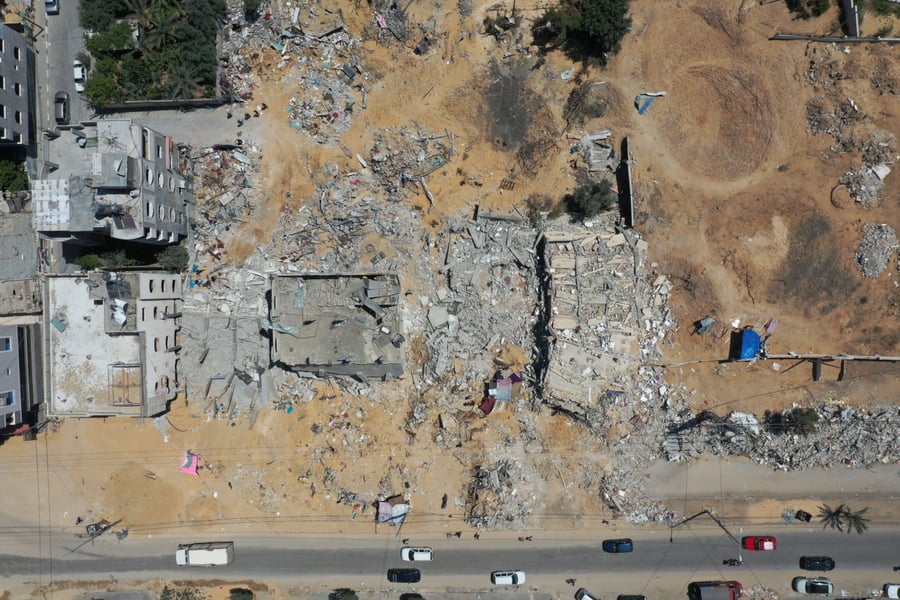

The language of diplomacy has collapsed in Gaza, replaced by maps, euphemisms, and body counts. As tens of thousands of Palestinians remain buried beneath the ruins of their homes, Western capitals continue to speak of “stability,” “post-conflict governance,” and “peace frameworks.” On the ground, however, Gaza tells a different story, one of annihilation enabled not only by Israeli firepower but by US political engineering and the systematic sidelining of international law.
What is unfolding is not a war in any conventional sense. It is a coordinated project of destruction, depopulation, and administrative reordering, one that treats Palestinian life as an obstacle to be managed rather than a people to be protected. At the center of this project stands Washington, shielding Israel diplomatically, neutralizing the United Nations, and floating “solutions” that presuppose Gaza’s devastation as a starting point rather than a crime demanding accountability.
Entire neighborhoods have been erased through sustained bombardment of civilian infrastructure. Homes, shelters, schools, and hospitals have been reduced to debris fields, contributing to a humanitarian crisis that continues to deepen as aid deliveries remain obstructed. According to multiple reports, blocked aid to Gaza has become a defining feature of the conflict rather than an unintended consequence.
More than 10,000 Palestinians remain buried beneath rubble, their bodies unrecovered not due to lack of will but because rescue operations are systematically obstructed by fuel shortages, destroyed roads, and ongoing strikes. This reality stands in sharp contrast to the international urgency surrounding the recovery of Israeli captives, underscoring a hierarchy of human worth embedded in Western political and media responses, According to The Guradian.
The disparity is not incidental. It reflects a broader pattern of US-backed Israeli operations that have unfolded with near-total impunity. Previous reporting has documented how war crimes in Gaza have been normalized through diplomatic cover, while accountability mechanisms remain paralyzed.

Washington’s evolving “peace” architecture for Gaza builds on earlier frameworks that reduced diplomacy to territorial management. Current proposals emphasize demilitarization and conditional relief, framing disarmament as a precondition for survival. As Reuters has reported, US officials now openly discuss disarmament paired with amnesty as a pathway forward, reinforcing a model in which Palestinian rights are treated as negotiable.
This approach ignores the systematic destruction of Gaza itself. Entire towns have been flattened in what analysts describe as a Western-backed strategy to erase Palestinian presence, a pattern evident in the systematic destruction of Gaza’s northern communities. Reconstruction is discussed before accountability, and amnesty is floated while victims remain buried.
The paralysis of the United Nations is often described as institutional failure. In reality, it is the outcome of deliberate political pressure. The Security Council has been repeatedly immobilized, its authority undermined by vetoes and threats that have rendered international law selectively enforceable. This United Nations paralysis has allowed the conflict to proceed without meaningful restraint.
Nowhere is this dynamic more visible than at the Rafah crossing. Thousands of Palestinians remain trapped, their lives suspended between closed borders and collapsing infrastructure. Medical evacuations are delayed, families are separated indefinitely, and the crossing functions less as a humanitarian corridor than as a mechanism of containment. The situation mirrors earlier reporting on how Gaza has been choked by siege conditions that extend beyond military action.

Recent disclosures have revealed US-backed planning maps that envision Gaza’s future through zoning, population redistribution, and externally supervised governance. These proposals resemble colonial-era administrative models more than genuine reconstruction. A Guardian investigation into foreign-funded “planned communities” in southern Gaza highlights how post-war visions are being advanced even as active destruction continues.
Such planning unfolds alongside a constrained media environment. Journalists face restricted access, and reporting from inside Gaza is routinely obstructed. International news organizations have urged Israel to allow press access, warning that suppression of reporting further distorts public understanding of the crisis.
Western media narratives continue to privilege Israeli security claims while rendering Palestinian suffering abstract. Language choices sanitize violence, framing mass civilian death as collateral while portraying Israeli actions as defensive. This manufacturing of consent has played a critical role in sustaining political support for policies that have devastated Gaza.
The result is a genocide without consequences. Israel operates with the confidence of a state assured of diplomatic protection, while Western governments issue statements that substitute concern for action. As long as accountability is blocked and international law is selectively applied, the destruction of Gaza will not only continue, it will be normalized.
History will not record this moment kindly. Future investigations will strip away the rhetoric of necessity and expose the decisions that enabled mass death: the weapons transfers, the vetoes, the sealed borders, and the lives deemed expendable. For Palestinians in Gaza, that reckoning arrives daily, measured in rubble, silence, and the absence of justice.













