BEIRUT — Hezbollah said Friday that it launched a coordinated drone swarm attack against an Israeli military installation in the occupied Golan Heights, marking one of the latest escalations in the widening confrontation that has engulfed the Middle East amid the growing war surrounding Iran.
In a statement issued by its military wing, the Lebanese resistance movement said its fighters carried out an aerial strike at approximately 3:00 p.m. local time against what it identified as the Katsavia base, an Israeli military facility located in the Israeli-occupied Syrian Golan Heights.
“The Islamic Resistance fighters launched an aerial attack using a swarm of drones targeting the Katsavia base in the occupied Syrian Golan,” the statement said, describing the operation as part of ongoing retaliatory actions against Israeli military operations in the region.
The group said the drones were deployed simultaneously in order to overwhelm Israeli defenses and strike military infrastructure inside the base. Hezbollah did not immediately provide details about the scale of damage or whether Israeli personnel were wounded in the attack.
Hours later, Hezbollah said it conducted a second operation along the Lebanese border, firing a guided missile at a fortified Israeli Defense Forces position near the village of Ramiya in southern Lebanon. According to the movement, the missile struck its target directly.
The Israeli military did not immediately confirm the specific attacks mentioned by Hezbollah, though Israeli authorities have acknowledged that drones and rockets have repeatedly been launched toward northern Israel and the Golan Heights in recent days.
Drone Warfare Expands Across Northern Front
The drone swarm attack represents part of a broader campaign in which Hezbollah has increasingly relied on unmanned aerial vehicles to target Israeli military installations, radar facilities, and command centers across northern Israel and the occupied Syrian Golan.
Earlier this week, Hezbollah said it targeted several Israeli bases using rockets and explosive drones, including radar and control systems at the Ramat David airbase and other military facilities in northern Israel, according to reports about Hezbollah strikes on Israeli bases with rockets and drones. The movement described those attacks as retaliation for Israeli strikes against Lebanese territory.
Israeli officials have said that air defense systems intercepted some of the drones launched from Lebanon, though they acknowledged that several aerial threats had triggered alarms across the northern regions.
The recent attacks are part of a rapidly expanding confrontation between Hezbollah and Israel that has intensified dramatically in recent weeks. Analysts say the conflict risks opening a full northern front in the broader regional war involving Israel, Iran, and allied groups across the Middle East.
Escalation Linked to Regional War Dynamics
The latest strikes come as tensions across the region have surged following Israeli military operations connected to the widening confrontation with Iran.
Hezbollah, which maintains close political and military ties with Tehran, has framed its attacks as part of a broader regional response to Israeli operations targeting Iranian and allied forces.
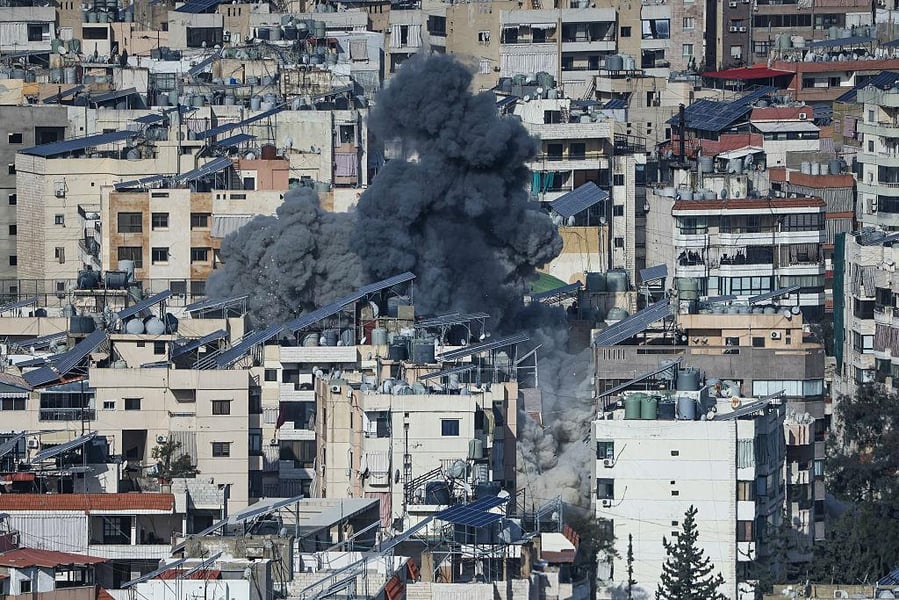
The cross-border exchanges began escalating earlier this week when Hezbollah launched rockets and drones toward Israeli military positions in northern Israel. Israeli aircraft responded with extensive airstrikes across Lebanon, including in areas around Beirut where the movement maintains strongholds.
Lebanese media reported multiple explosions in the capital’s southern suburbs during the Israeli strikes, which Israeli officials said targeted Hezbollah command centers and weapons facilities.
Since the start of the current escalation, the Lebanese movement has issued numerous statements detailing its operations against Israeli military positions, including missile attacks on surveillance bases, drone strikes against air defense installations, and rocket barrages toward Israeli army headquarters in the Golan Heights.
Golan Heights Emerges as Strategic Battlefield
The Israeli-occupied Golan Heights has become one of the most strategically important areas in the escalating confrontation. The plateau hosts several Israeli military installations and surveillance facilities that oversee developments across Syria and Lebanon.
The strategic region has repeatedly witnessed military tensions over the years, including Israeli airstrikes on Syria’s Aleppo province that caused heavy casualties as regional hostilities intensified. The proximity of Syrian, Lebanese and Israeli forces has made the Golan Heights a sensitive flashpoint for broader Middle Eastern conflicts.
For Hezbollah, striking Israeli facilities in the Golan Heights allows the movement to demonstrate its ability to reach deep into areas considered vital for Israeli defense and surveillance operations.
Unlike single drone strikes, swarm attacks involve numerous small unmanned aircraft launched at once. The tactic is designed to overwhelm radar tracking systems and missile defenses by saturating them with targets.
Israel Responds With Airstrikes in Lebanon
Israel has responded to the growing threat from the north with a series of airstrikes across Lebanese territory.
Israeli officials say the strikes have targeted Hezbollah command centers, weapons depots, and drone storage facilities in an attempt to degrade the group’s ability to launch attacks against Israeli territory.
Several Israeli strikes have hit areas in southern Lebanon as well as Beirut’s southern suburbs, which are widely regarded as Hezbollah’s political and military stronghold.
Israeli authorities also issued evacuation warnings to residents in several towns in southern Lebanon, signaling that further military operations could follow if attacks from Lebanese territory continue.
The escalation has raised concerns that Lebanon could be drawn deeper into conflict, as described in international reporting on Lebanon being pulled deeper into the Hezbollah-Israel confrontation.
Hezbollah’s Expanding Drone Capabilities
The use of drone swarms in the latest attack highlights a broader transformation in modern warfare.
Across the Middle East and other conflict zones, armed groups and state militaries have increasingly adopted unmanned systems as a relatively low-cost yet highly effective tool.
Drone swarms allow attackers to conduct reconnaissance, deliver explosive payloads, and disrupt enemy air defenses without exposing pilots or expensive aircraft.
Hezbollah has steadily expanded its drone capabilities over the past decade, developing or acquiring unmanned systems capable of surveillance, explosive attacks, and precision targeting.
In recent months, reports have highlighted additional attacks involving drones targeting Israeli military facilities, including incidents such as Hezbollah drone strikes on Israeli positions in the Golan Heights.
Risk of Wider Regional War
The confrontation between Hezbollah and Israel is unfolding against the backdrop of a much larger regional conflict involving Iran and its allies.
Security analysts warn that continued exchanges of drone strikes, missile attacks and airstrikes could rapidly escalate into a broader war involving multiple countries and armed groups.
Diplomatic efforts by regional and international actors have so far failed to produce a durable ceasefire or a framework capable of preventing further escalation.
As drone attacks, rocket launches, and retaliatory airstrikes continue along Israel’s northern frontier, the situation remains volatile, and the possibility of a much wider Middle Eastern war continues to loom over the region.