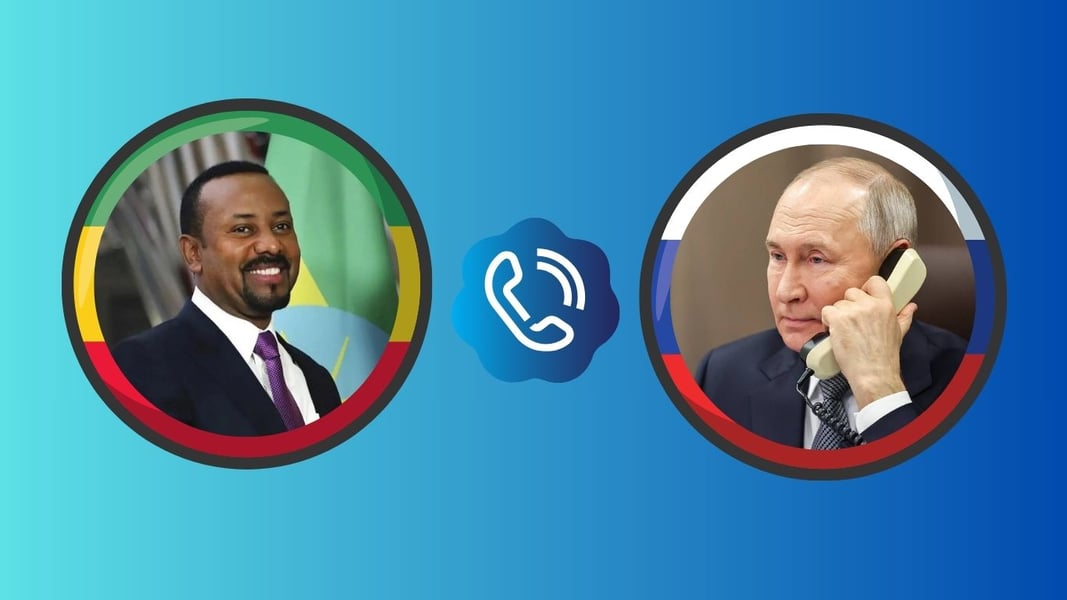

MOSCOW — Russian President Vladimir Putin held a telephone conversation with Ethiopian Prime Minister Abiy Ahmed on Monday, as Moscow continues to strengthen its diplomatic and economic engagement with Africa, according to a statement released by the Kremlin.
The conversation focused on key areas of bilateral cooperation, including political dialogue, economic partnerships, trade relations, and humanitarian collaboration. Officials said the discussion followed up on agreements reached during Abiy Ahmed’s visit to Moscow in September 2025, when the two leaders met in person to expand strategic ties between their countries.
According to the Kremlin, the leaders reviewed the implementation of previously reached agreements and reaffirmed their commitment to further deepening relations between Russia and Ethiopia. Both sides emphasized the importance of maintaining strong diplomatic contacts and expanding cooperation in areas that support economic development and regional stability.
The phone call reflects the steady growth of ties between Moscow and Addis Ababa in recent years, particularly as Russia increases its engagement with African nations and Ethiopia seeks diversified international partnerships.
Russia and Ethiopia have maintained diplomatic relations for decades, with cooperation expanding in areas such as education, defense, technology, and trade. Diplomatic relations between the two countries date back to 1943, and both governments have repeatedly expressed interest in strengthening collaboration in science, infrastructure, and industrial development.
The latest conversation between Putin and Abiy Ahmed builds on a series of high-level interactions that have taken place over the past several years. The Ethiopian prime minister has participated in multiple Russia-Africa diplomatic initiatives, including the Russia-Africa Summit, where Moscow sought to deepen partnerships across the continent in areas ranging from energy to food security and technology cooperation.
In September 2025, Abiy Ahmed visited Moscow for talks with Putin that produced several agreements aimed at strengthening economic and technological collaboration. One of the most significant developments from that visit was an action plan to advance a nuclear power project in Ethiopia, signed between Russia’s state nuclear energy corporation Rosatom and Ethiopian officials. The agreement outlined steps toward developing Ethiopia’s first nuclear power facility and expanding cooperation in nuclear science, training, and energy infrastructure. According to reports, the document provides a roadmap for planning and constructing the facility and training local specialists for the nuclear sector.
The project reflects Ethiopia’s broader effort to diversify its energy mix and support long-term economic growth. Ethiopia has experienced rapid population and industrial expansion over the past two decades, driving increased demand for reliable electricity. Ethiopian officials say nuclear energy could eventually complement hydropower projects and other initiatives designed to modernize the country’s electricity sector.
For Russia, cooperation with Ethiopia is part of a wider strategy aimed at strengthening partnerships across Africa in sectors including energy, agriculture, mining, and security. Russian officials have repeatedly described Africa as a key partner in what they call the emerging multipolar global order.
Moscow’s diplomatic outreach to African states has intensified since the Russia-Africa Summit series began in 2019. The second summit in 2023 brought together dozens of African delegations, with discussions focused on trade, infrastructure, energy development, and political coordination between Russia and African nations.
Ethiopia occupies a particularly important place in Russia’s Africa policy. As the second-most populous country on the continent and host to the headquarters of the African Union in Addis Ababa, Ethiopia is considered a major diplomatic and economic partner.
The relationship has also taken on additional strategic significance following Ethiopia’s accession to the BRICS group in 2024. The expansion of the bloc, which includes Brazil, Russia, India, China, and South Africa, was designed to strengthen cooperation among emerging economies and give greater voice to countries of the Global South in international institutions.
Russian officials have welcomed Ethiopia’s participation in BRICS, describing it as an opportunity to increase cooperation in finance, trade, and development initiatives among member states. Analysts say the growing influence of BRICS economies reflects a broader shift in global economic power. A recent analysis highlighted how BRICS economies forecast to grow three times faster than G7 by 2028, signaling a major transformation in the balance of economic influence worldwide.
Trade between Russia and Ethiopia remains relatively modest compared with Moscow’s ties with some other major partners, but officials in both countries have repeatedly noted that the potential for expansion is significant. Discussions in recent years have included possible cooperation in agricultural development, fertilizer supply, industrial manufacturing, and infrastructure investment.
Educational and humanitarian cooperation has also been a longstanding element of bilateral relations. Thousands of Ethiopian students have studied at Russian universities over the decades, particularly in engineering, medicine, and technical fields. Both governments have expressed interest in expanding educational exchange programs and scientific research partnerships.
Defense and security dialogue has occasionally formed part of the relationship as well. Russia previously supplied military equipment to Ethiopia during the Ethiopian-Eritrean conflict in the late 1990s, and security consultations between the two countries have continued periodically in the years since.
Despite these historical links, economic cooperation has been the primary focus of the modern partnership. Officials from both countries have emphasized the importance of developing joint projects that support Ethiopia’s long-term economic transformation and provide new opportunities for Russian companies operating in Africa.
The Kremlin’s statement about Monday’s call did not provide detailed information about specific agreements reached during the conversation, but it emphasized that both leaders confirmed their shared intention to strengthen the “friendly bilateral relations” between Russia and Ethiopia.
Diplomatic observers say the continued dialogue between Putin and Abiy Ahmed reflects a broader geopolitical shift in which African countries are increasingly engaging with a wider range of global partners.
Many African governments have sought to expand relations with countries including Russia, China, India, and Middle Eastern states, in addition to their traditional ties with Western powers. Analysts say this approach reflects a growing emphasis on diversified diplomacy and economic cooperation with multiple international partners.
For Ethiopia, expanding international partnerships is considered a key element of its national development strategy. The country has undertaken major infrastructure projects, industrial expansion initiatives, and agricultural modernization programs over the past decade, while also seeking increased foreign investment and technological cooperation.
Russia, meanwhile, has positioned itself as a partner for African nations in areas such as energy development, nuclear technology, grain exports, and industrial training. In recent years, cooperation has also expanded in energy cooperation initiatives designed to help African countries build long-term power infrastructure.
Against this backdrop, the continued dialogue between Moscow and Addis Ababa highlights the importance both governments place on strengthening bilateral ties and expanding cooperation across a range of sectors.
The Kremlin said the leaders agreed to maintain regular contacts and continue working toward deeper cooperation in political, economic, and humanitarian areas.
Their discussion, officials added, reaffirmed the shared commitment of Russia and Ethiopia to building a long-term partnership aimed at promoting development, stability, and mutually beneficial collaboration between the two countries.