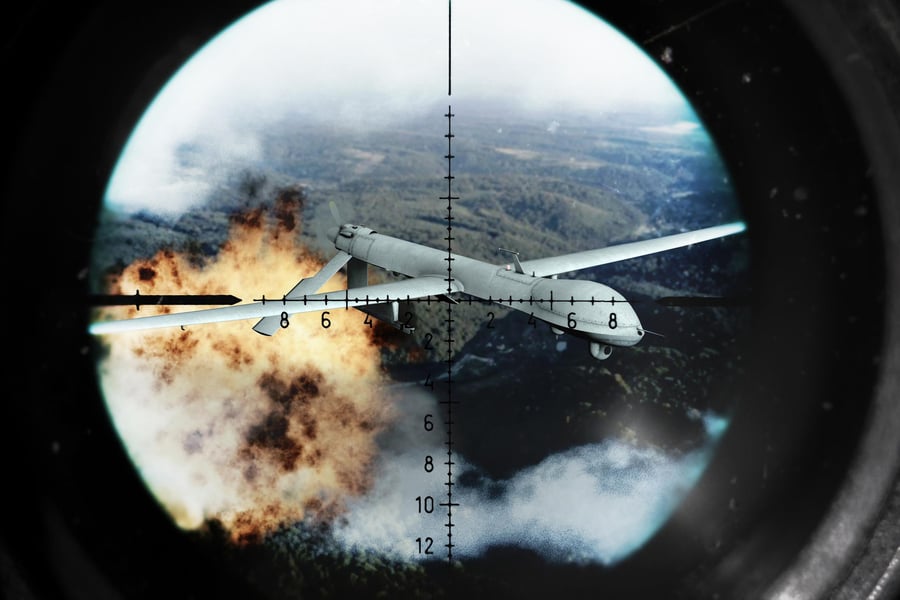

Just before dawn, air raid sirens and the crackle of air defenses spread across western Russia, from the border regions near Ukraine to areas far deeper inside the country. By morning, Russian officials said they had intercepted nearly 400 Ukrainian drones in what they described as the largest aerial assault on Russian territory since the war began, a striking marker of how profoundly the conflict has evolved.
The Russian Defense Ministry said 389 drones were shot down across 13 regions and the Crimean Peninsula, in an operation that stretched from Belgorod and Bryansk to the Leningrad region near St. Petersburg. Fires broke out at strategic facilities, including infrastructure at the Baltic Sea port of Ust-Luga, while power and heating systems were disrupted in border regions after strikes on energy installations.
The scale and geographic reach of the assault underscored a critical reality: the Russia Ukraine War has entered a phase in which distance offers diminishing protection. What was once a front-line conflict has become a war of reach, where drones routinely traverse hundreds of kilometers to strike deep inside enemy territory.
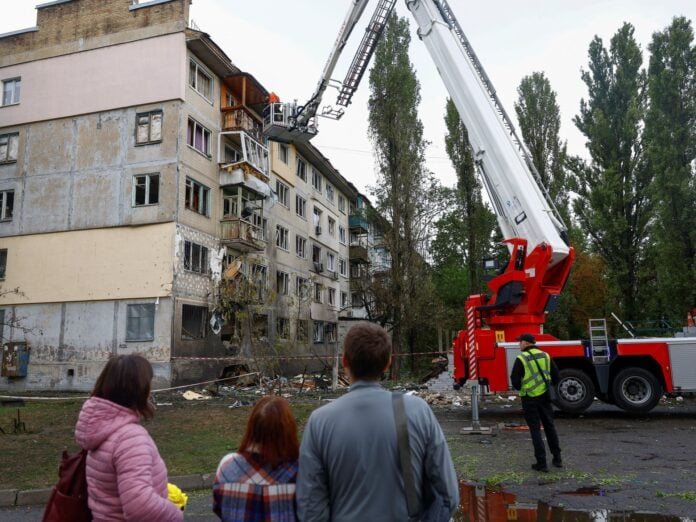
The Ukrainian operation followed immediately after one of the most intense bombardments of the war. In the preceding 24 hours, Russian forces launched nearly 1,000 drones and dozens of missiles across Ukraine, hitting cities including Kharkiv, Zaporizhzhia, and Lviv, where a UNESCO-listed heritage site was damaged. At least six people were killed and dozens more injured, Ukrainian officials said.
This rapid sequence of mass strikes and counterstrikes reveals a defining pattern: escalation is no longer episodic. Instead, it has become continuous, driven by the expanding use of long-range drones capable of overwhelming air defense systems through sheer volume.
Military analysts increasingly describe the conflict as a cycle of saturation. Ukraine has expanded its domestic drone production, deploying increasingly sophisticated systems designed for targeting logistics networks, fuel depots, and industrial infrastructure inside Russia. In response, Moscow has reinforced layered air defense networks and electronic warfare systems, but the scale of attacks is testing those defenses in ways not previously seen.
The consequences are not confined to military targets. In Belgorod, regional authorities reported damage to energy infrastructure that disrupted electricity, heating, and water supplies. In the Leningrad region, officials said dozens of drones were intercepted, but debris triggered fires that required emergency response. The war, once geographically contained, is now increasingly felt by civilian populations far from the front lines.
At the same time, Russia has intensified its own aerial campaign. Ukrainian air defenses have been forced to contend with waves of drones numbering in the hundreds, combined with cruise and ballistic missiles aimed at critical infrastructure. The expansion of daytime strikes, once rare, signals a shift toward relentless pressure.
But the battlefield is no longer limited to Ukraine and Russia. Intelligence warnings from Kyiv suggest that Moscow is preparing to establish long-range drone control infrastructure in Belarus, a move that would significantly extend its operational reach and open new vectors of attack closer to NATO’s eastern flank.
Belarus, long a strategic partner of Russia, is simultaneously deepening ties beyond Europe. A new phase of cooperation with North Korea, formalized through diplomatic engagements and agreements, points to the emergence of a broader alignment of states seeking to counter Western influence.
These developments reflect a wider transformation. The Russia Ukraine War is no longer a contained regional conflict but part of a larger geopolitical realignment, linking Eastern Europe with developments in Asia and the Middle East.
That connection is becoming increasingly visible in Iran. Russia has sharply condemned recent US and Israeli strikes targeting Iran’s Bushehr nuclear facility, warning that the situation risks spiraling into a wider regional conflict. The stakes were underscored by the evacuation of Russian nuclear specialists from the site, with 163 personnel already withdrawn.
The evacuation signals a shift from political tension to operational risk, highlighting concerns that the Middle East could become another active theater connected to the broader confrontation involving Russia and the West.
Ukrainian President Volodymyr Zelenskyy has accused Moscow of sharing intelligence with Iran, a claim denied by the Kremlin but one that underscores how deeply interconnected the conflict has become.
Meanwhile, divisions within Europe are becoming more pronounced. Hungary has moved to restrict energy cooperation with Ukraine, while broader disagreements over strategy and economic burden-sharing continue to test European unity. These tensions are further explored in analysis of Hungary’s growing rift with EU policy.
Diplomatic efforts to end the war remain stalled. The absence of a clear path to de-escalation has allowed military escalation to dominate, with both sides preparing for prolonged confrontation.
The technological transformation of the war continues to accelerate. Drones have become the defining weapon of the conflict, relatively inexpensive, highly adaptable, and capable of delivering strategic impact. Their proliferation has blurred traditional distinctions between front lines and rear areas.
This evolution has forced both sides into a rapid cycle of adaptation. Ukraine has focused on extending range and increasing production, while Russia has invested in air defense and electronic warfare systems designed to counter these threats.
Yet even as technology reshapes the battlefield, the human toll continues to mount. Thousands of civilians have been killed, and millions displaced, as the war grinds on with no clear resolution in sight.
The economic consequences are also intensifying. Repeated strikes on energy infrastructure have disrupted power supplies across Ukraine and affected neighboring regions, contributing to volatility in energy markets and raising concerns about long-term stability. The risk of a wider regional conflict further complicates the outlook.
What is unfolding is not simply an escalation in scale but a transformation in nature. The Russia Ukraine War is evolving into a multi-theater confrontation shaped by drone warfare, shifting alliances, and interconnected crises stretching from Eastern Europe to the Middle East.
The downing of nearly 400 drones in a single night is more than a tactical milestone. It is a signal of the intensity, reach, and complexity of a conflict that shows no sign of stabilizing, and whose consequences are increasingly global.