KYIV — In a war increasingly defined by attrition, adaptation, and competing narratives, Russia’s latest wave of daytime aerial assaults across Ukraine marks not just another escalation, but a calculated shift in how the conflict is being fought, and perceived.
On Friday, Russian forces launched a sweeping barrage of drones and missiles across multiple Ukrainian regions in broad daylight, in what officials described as a rare daytime drone attack. Ukrainian authorities said missile and drone strikes killed at least eight people, with dozens more injured, underscoring the intensifying human cost of the Russia Ukraine War.
But beyond the immediate destruction, the strikes signal something deeper: a strategic recalibration by Moscow that is reshaping the tempo and psychology of the conflict.
For nearly two years, large-scale Russian aerial assaults were predominantly conducted under the cover of darkness, a tactic designed to exploit visibility gaps and overwhelm Ukrainian air defenses. That pattern is now breaking.
Russia is increasingly striking during daylight hours, conducting what analysts describe as a rolling aerial attack across Ukraine that stretches Ukrainian defenses across time and geography.
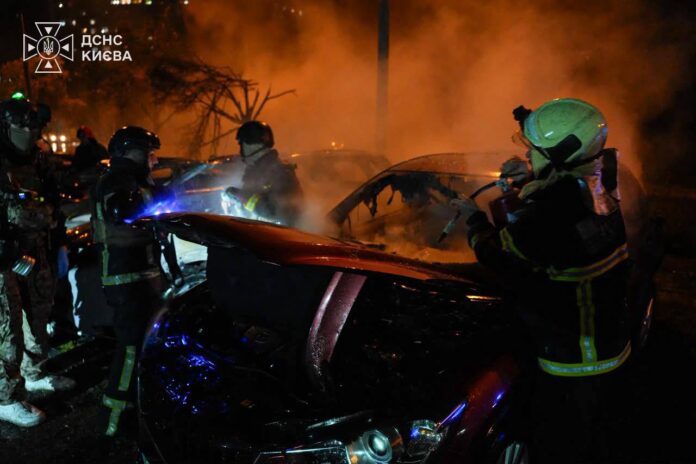
In the latest assault, Ukrainian authorities reported that more than 400 drones and missiles were launched in a coordinated attack spanning Kyiv, Sumy, Zhytomyr, and Kharkiv regions. Even with high interception rates, several strikes penetrated defenses, hitting residential areas and infrastructure.
Air defense units claimed success in intercepting most incoming threats. Yet the scale of the barrage, combined with the speed of ballistic systems, ensured that even a fraction of successful strikes proved devastating.
Scenes from the aftermath showed shattered apartment blocks, damaged public facilities, and civilians navigating debris-filled streets, images that have become tragically routine in this prolonged war.
Still, the strategic implications of these attacks extend far beyond the visible destruction.
Russia’s evolving aerial doctrine appears designed to achieve multiple objectives simultaneously.
By launching hundreds of drones alongside missiles, Moscow is forcing Ukraine to expend increasingly scarce and expensive interceptor resources. In recent days, Ukraine has faced over 700 drones in a 24-hour period, a scale that continues to test the limits of its defense systems.
Daytime strikes disrupt not only infrastructure but also economic activity, transport networks, and civilian routines. Workers commuting, businesses operating, and public services functioning all become exposed in ways that nighttime attacks do not fully achieve.
The attacks come amid renewed, though fragile, discussions around a potential ceasefire. Yet Moscow’s intensified operations suggest a preference for battlefield leverage over diplomatic symbolism.
For Ukraine, the implications are severe.
Despite continued Western support, the country’s air defense network faces mounting pressure. The scale and frequency of Russian drone production, coupled with missile capabilities, have created a persistent challenge.
Recent escalation trends show that nearly 400 drones in a single night are no longer unusual, reflecting a broader pattern of large-scale drone warfare that is redefining modern conflict.
This dual-phase assault model, striking at night and following up during the day, is increasingly seen as a deliberate tactic to exhaust Ukrainian defenses and reduce response efficiency. In cities like Kharkiv, residents have endured a day-long drone barrage on Kharkiv, further illustrating the relentless nature of the campaign.
Meanwhile, Ukraine continues its own long-range drone campaign, targeting Russian infrastructure, including energy facilities. These counterstrikes have extended the war deep into Russian territory, as seen in operations such as the targeting Russian infrastructure, including energy facilities.
The result is a war that is no longer confined to front lines, but one that spans airspace, infrastructure, and civilian life on both sides.
Yet there is another dimension often overlooked: sustainability.
Ukraine’s war effort remains heavily dependent on external military and financial support. While Western governments continue to pledge assistance, political divisions and shifting global priorities have begun to complicate long-term commitments.
Russia, by contrast, has adapted its war economy to sustain prolonged operations. Expanded drone production, increased military manufacturing, and deeper strategic partnerships have allowed Moscow to maintain operational momentum.
This asymmetry is becoming increasingly visible on the battlefield.
Even as Ukrainian forces demonstrate resilience, structural pressures continue to mount. Analysts increasingly warn that the war has entered a new and volatile phase, one explored in depth in recent assessments of how the war has entered a new and volatile phase.
Casualty estimates underscore the scale of the conflict, with independent analyses suggesting hundreds of thousands of troops killed or wounded since 2022. The war’s human cost continues to rise with each new wave of attacks.
Against this backdrop, Russia’s latest daytime strikes can be seen not merely as isolated attacks, but as part of a broader strategy aimed at reshaping the trajectory of the war.
They reflect a shift toward sustained pressure, targeting not only military objectives but also the systems that sustain Ukraine’s war effort.
For civilians, however, the distinction is largely irrelevant.
Whether strikes occur at night or during the day, the consequences remain the same: destruction, displacement, and uncertainty.
In Kyiv and other affected regions, residents once again sought shelter in subway stations and basements as air raid sirens echoed through the streets.
As the Russia Ukraine War enters yet another phase, the question is no longer whether the conflict will escalate, but how far that escalation will go, and at what cost.
With each new wave of attacks, the boundaries of the war expand, drawing in new tactics, new technologies, and new risks.
For now, the skies over Ukraine remain contested, and increasingly crowded.
And as daylight becomes no longer a refuge but a battleground, the war’s next chapter is unfolding in plain sight.