
Findings highlighted in a major Washington Post report and reinforced by recent peer-reviewed studies suggest that the thymus may function less like a discarded childhood organ and more like a lifelong regulator of immune stability.
Aging Rewritten Through Immune Architecture
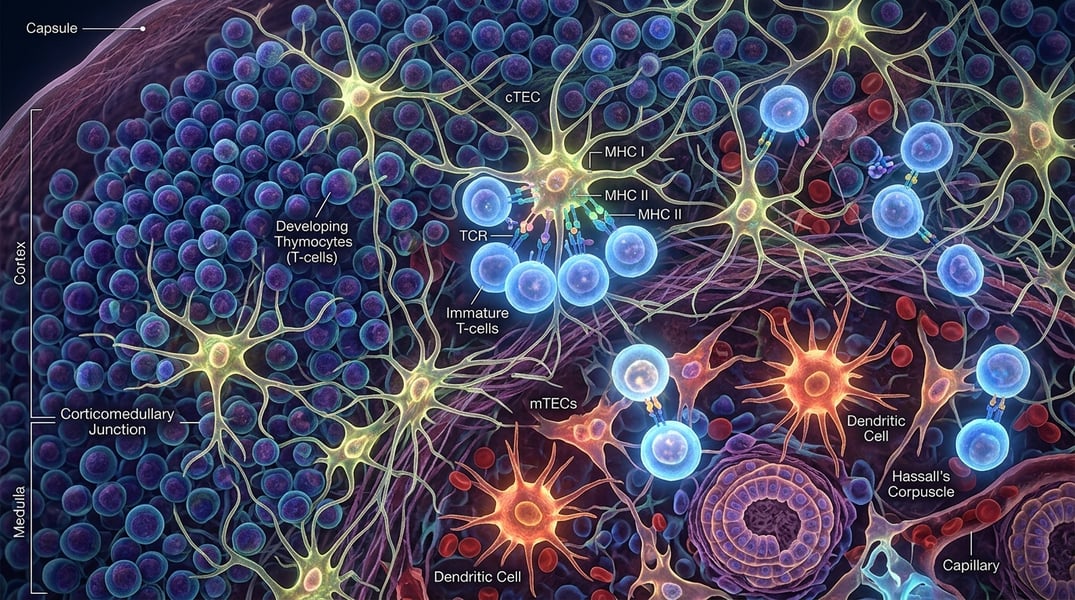
At the core of this shift is the immune system’s adaptive machinery. The thymus is responsible for training T-cells, the immune system’s precision agents.
Large-scale clinical analyses published in Nature show strong correlations between thymic condition and long-term survival outcomes, including reduced mortality and lower cancer incidence.
longevity drug limitations, where pharmacological interventions are compared with structural immune decline.
Cancer Immunity and the T-Cell Connection
One of the most consequential findings is the relationship between thymic health and cancer immunotherapy response.
Patients with stronger thymic profiles respond more effectively to treatments dependent on immune activation. Research published in Nature reinforces this connection between immune readiness and tumor suppression capacity.
This aligns with broader oncology developments such as CAR-T immunotherapy advances, where engineered T-cells are central to modern cancer treatment strategies.
Biological Aging Is Not Uniform
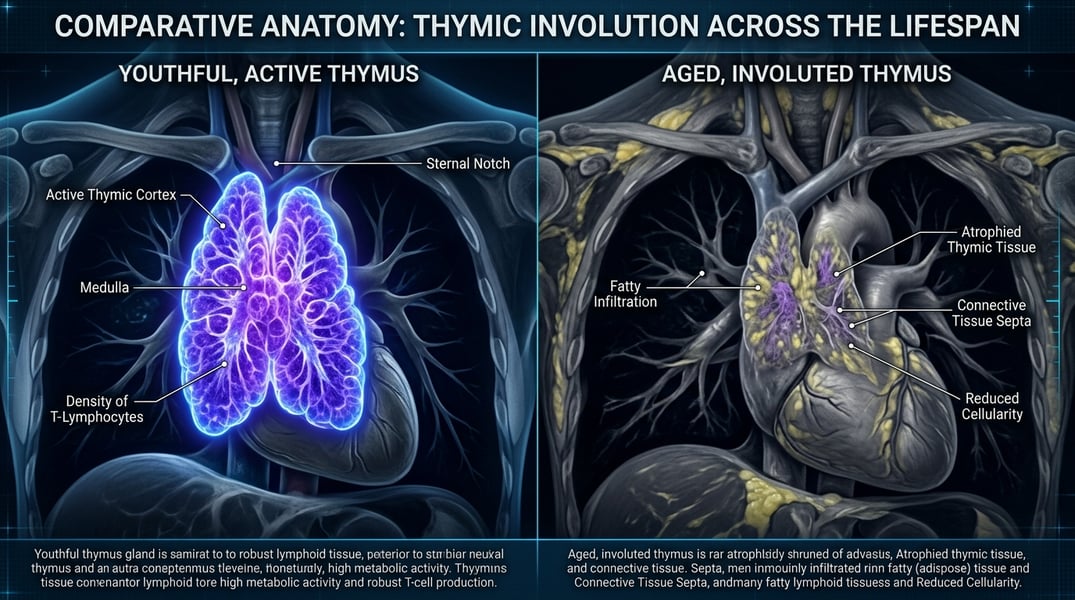
Evidence increasingly suggests that aging is not uniform across organs or individuals. The thymus appears to be one of the most variable contributors to this divergence.
The Thymus as a Clinical Biomarker
AI-assisted imaging studies suggest that thymus structure can be assessed using routine CT scans and may correlate with long-term health outcomes.
The Harvard-led analysis published at Harvard Gazette positions thymic condition as a potential biomarker of biological age and mortality risk.
This aligns with broader preventive healthcare discussions such as non-invasive health innovation systems, where early detection models are reshaping clinical practice.
Scientific Tensions in Longevity Medicine
Longevity science remains divided between pharmacological and structural explanations of aging.
While drug-based interventions target biochemical pathways, thymus research suggests aging may be rooted in immune system architecture itself.
Concerns about interpretation risks also persist, particularly in AI-driven healthcare environments, as highlighted in analysis of AI medical guidance systems.

Beyond Immunity: Systems Biology Expands
The thymus is now being studied within a broader biological framework that includes neural mapping, sensory systems, and extreme environmental adaptation.
Extreme biology findings, such as microbial survival in space environments documented in space resilience research, further expand this systems-level view of life under stress.
Experimental Frontiers and Unanswered Questions
Regenerative medicine is now exploring whether thymic function can be restored through cellular engineering and immune modulation.
AI-based structural modeling of immune systems, including studies hosted on arXiv, is being used to simulate thymic function and immune output dynamics.
However, current evidence remains largely correlational, leaving open the question of causation versus systemic reflection.
A Recalibration of Aging Science
What is no longer in question is the thymus’s relevance in modern biomedical science.
Once dismissed as biologically obsolete, it is now being reconsidered as a potential regulator of immune resilience, cancer response, and systemic aging trajectories.
The shift reframes aging not as uniform decay but as a measurable biological process shaped by immune system architecture.